
Toyota Tundra 2003
The 2003 Toyota Tundra came with 2 engines: 3.4 L 6-cylinder, 4.7 L 8-cylinder. It gets 14 to 16 MPG combined depending on the engine, per the EPA. 10 recall campaigns and 40 owner complaints are on record.
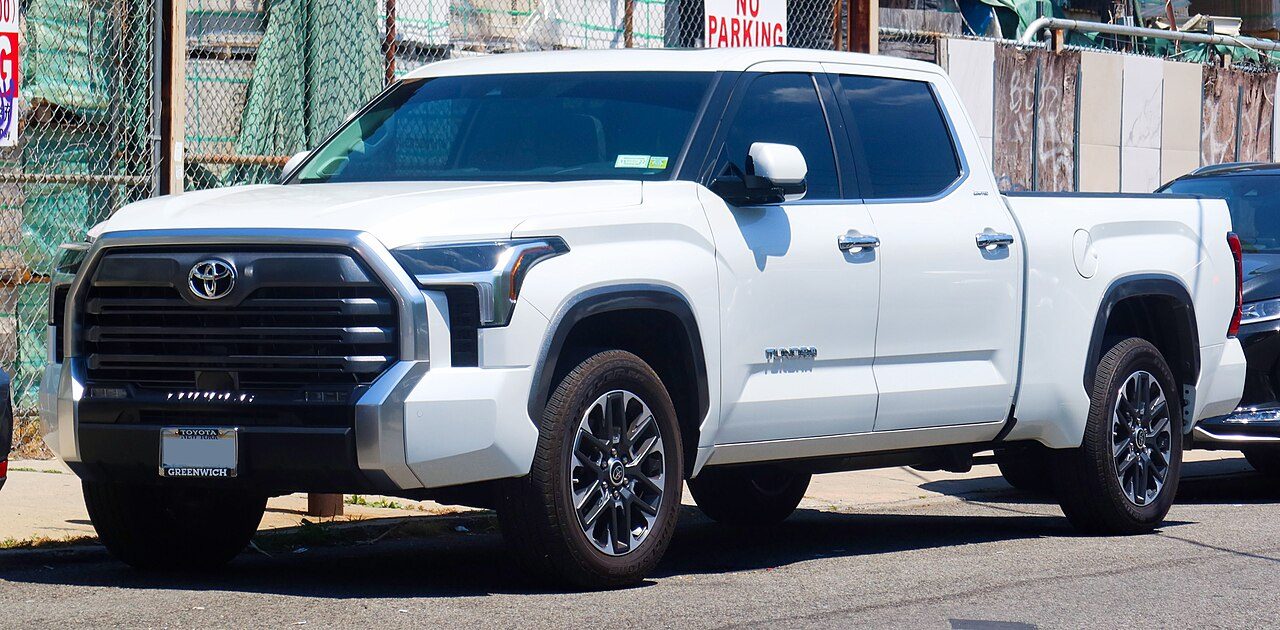
Specs
| Cylinders | 6 |
|---|---|
| Transmission | Automatic · 4 speeds |
| Drivetrain | AWD |
| Dimensions (L × W × H) | 5,410 × 1,910 × 1,820 mm (213.0 × 75.2 × 71.7 in) |
| Wheelbase | 3,260 mm (128.3 in) |
| Curb weight | 1,950 kg (4,299 lb) |
| Body style | Standard Pickup Trucks 2WD |
Dimensions and weight: median of the 5 versions in Canada's official specifications (NHTSA vPIC). Each version differs slightly.
For sale in United States
Safety
Crash-test results across markets. They can vary by version and equipment.
Fuel economy (MPG)
🇺🇸 Local dataBy version
| Engine | Transmission | Drivetrain | City | Highway | Combined |
|---|---|---|---|---|---|
| 3.4 L 6-cylinder | Automatic · 4 speeds | AWD | 14 MPG | 17 MPG | 15 MPG |
| 3.4 L 6-cylinder | Automatic · 4 speeds | Rear-wheel (RWD) | 15 MPG | 18 MPG | 16 MPG |
| 3.4 L 6-cylinder | Manual · 5 speeds | AWD | 15 MPG | 18 MPG | 16 MPG |
| 3.4 L 6-cylinder | Manual · 5 speeds | Rear-wheel (RWD) | 15 MPG | 18 MPG | 16 MPG |
| 4.7 L 8-cylinder | Automatic · 4 speeds | AWD | 13 MPG | 16 MPG | 14 MPG |
| 4.7 L 8-cylinder | Automatic · 4 speeds | Rear-wheel (RWD) | 13 MPG | 17 MPG | 15 MPG |
EPA figures for each version sold in the U.S.
Recalls
Consequence · Remedy
An inflator explosion may result in sharp metal fragments striking the driver or other occupants resulting in serious injury or death.
Toyota will notify owners. Depending on the vehicle model, dealers will replace the front driver inflator, front passenger airbag inflator, the airbag assembly, or the front passenger airbag sub-assembly and inflator. The recall began November 20, 2019. Owners may contact Toyota customer service at 1-888-270-9371 or Lexus customer service at 1-800-255-3987. Toyota's numbers for this recall are J0A, J0B, and J0C. Lexus' numbers for this recall are JLI, JLJ, and JLK.
Consequence · Remedy
An inflator explosion may result in sharp metal fragments striking the driver or other occupants resulting in serious injury or death.
Toyota will notify the Toyota and Lexus owners. General Motors will notify the Pontiac Vibe owners. Depending on the vehicle model, dealers will replace the front passenger air bag inflator with an alternate inflator, or replace the air bag assembly that includes an alternate inflator, free of charge. The recall began January 23, 2019. Owners may contact Toyota customer service at 1-888-270-9371, Lexus customer service at 1-800-255-3987 or Pontiac customer service at 1-800-762-2737. Toyota's numbers for these recalls are J0A (Zone A Toyota), J0B (Zone B Toyota), J0C (Zone C Toyota), JLI (Zone A Lexus), JLJ (Zone B Lexus), and JLK (Zone C Lexus). Note: This recall includes vehicles that have had their air bag previously replaced under an earlier air bag campaign.
Consequence · Remedy
In the event of a crash necessitating deployment of the passenger's frontal air bag, the inflator could rupture with metal fragments striking the vehicle occupants potentially resulting in serious injury or death.
2003-2004 Corolla and Corolla Matrix vehicles that are recalled under both 15V-043 and 15V-285 are under a Do Not Drive advisory. Owners of these vehicles are advised not to drive their vehicles until the recall remedy has been completed. Toyota will notify their owners. Pontiac Vibe owners will be notified by GM. Dealers will replace the front passenger air bag. The recall began on July 13, 2015. Toyota owners may contact Toyota customer service at 1-800-331-4331. Pontiac owners may call 1-800-762-2737. NOTE: This recall supersedes recall 14V-312 in its entirety.
Consequence · Remedy
In the event of a crash necessitating deployment of the passenger's frontal air bag, the inflator could rupture with metal fragments striking the vehicle occupants potentially resulting in serious injury or death.
2003-2004 Corolla and Corolla Matrix vehicles that are recalled under both 15V-043 and 15V-286 are under a Do Not Drive advisory. Owners of these vehicles are advised not to drive their vehicles until the recall remedy has been completed. Toyota will notify their owners. Pontiac Vibe owners will be notified by GM. Dealers will replace the passenger side front air bag, free of charge. Owners may contact Toyota customer service at 1-800-331-4331. Toyota began the recall on July 13, 2015. Pontiac Vibe owners may contact GM at 1-800-762-2737. GM began the recall on June 29, 2015. NOTE: This recacll supersedes recall 14V-655 in its entirety. For vehicles located in the U.S. states not listed above, please see Toyota recall 15V-285 which covers all other U.S. states.
Consequence · Remedy
SEPARATION OF THE SPARE TIRE AND DIMINISHED BRAKE CAPACITY COULD INCREASE THE RISK OF A CRASH.
TOYOTA IS ASKING OWNERS OF THE AFFECTED VEHICLES TO REMOVE THE SPARE TIRE FROM UNDER THE VEHICLE UNTIL A REMEDY CAN BE OBTAINED. DEALERS WILL INSPECT THE REAR CROSS MEMBER AND RELATED COMPONENTS, INCLUDING THE BRAKE LINES, AND REPLACE THEM IF NECESSARY. IF THE CROSS MEMBER DOES NOT NEED TO BE REPLACED, IT WILL BE SPRAYED WITH A CORROSION PROTECTION COMPOUND. THESE SERVICES WILL BE PERFORMED FREE OF CHARGE, HOWEVER MULTIPLE VISITS TO THE DEALER MAY BE REQUIRED. THE SAFETY RECALL IS EXPECTED TO BEGIN ON OR ABOUT APRIL 30, 2010. OWNER MAY CONTACT TOYOTA AT 1-800-331-4331.
Consequence · Remedy
DECREASED LIGHTING VISIBILITY MAY RESULT IN A VEHICLE CRASH.
DOPE, INC. WILL NOTIFY OWNERS AND OFFER A FULL REFUND FOR THE NONCOMPLIANT COMBINATION LAMPS. THE SAFETY RECALL BEGAN ON JULY 28, 2009. OWNERS MAY CONTACT DOPE, INC. AT 1-626-272-1798.
Consequence · Remedy
LACK OF AMBER SIDE REFLECTORS IN THE LAMPS WILL DECREASE LIGHTING VISIBILITY TO OTHER DRIVERS AND MAY POSSIBLY RESULT IN A VEHICLE CRASH.
AJ MOTORSPORT WILL NOTIFY OWNERS AND OFFER REIMBURSEMENT FOR THE LAMPS. THE RECALL BEGAN ON JULY 31, 2006. OWNERS MAY CONTACT AJ MOTORSPORT AT 626-618-2026.
Consequence · Remedy
WITHOUT THE AMBER REFLECTORS, THE VEHICLE WILL BE POORLY ILLUMINATED, POSSIBLY RESULTING IN A VEHICLE CRASH WITHOUT WARNING.
PRO-A MOTORS WILL NOTIFY OWNERS AND OFFER TO REPURCHASE THE LAMPS. THE RECALL BEGAN ON APRIL 3, 2006. OWNERS MAY CONTACT PRO-A MOTORS AT 323-838-2988.
Consequence · Remedy
THIS STANDARD ESTABLISHES REQUIREMENTS FOR CHILD RESTRAINT ANCHORAGE SYSTEMS TO ENSURE THEIR PROPER LOCATION AND STRENGTH FOR THE EFFECTIVE SECURING OF CHILD RESTRAINTS, TO REDUCE THE LIKELIHOOD OF THE ANCHORAGE SYSTEMS' FAILURE, AND TO INCREASE THE LIKELIHOOD THAT CHILD RESTRAINTS ARE PROPERLY SECURED AND THUS MORE FULLY ACHIEVE THEIR POTENTIAL EFFECTIVENESS IN MOTOR VEHICLES.
DEALERS WILL REMOVE THE MANUAL AIR BAG ON-OFF SWITCH, REPLACE THE OWNER'S MANUAL, AND AFFIX A NEW SUN VISOR AIR BAG WARNING LABEL. THE RECALL BEGAN IN EARLY JANUARY 2007. OWNERS MAY CONTACT TOYOTA AT 1-800-331-4331.
Consequence · Remedy
THE LOWER BALL JOINT MAY SEPARATE FROM THE KNUCKLE CAUSING LOSS OF STEERING CONTROL AND A CRASH COULD OCCUR.
DEALERS WILL REPLACE THE FRONT SUSPENSION LOWER BALL JOINTS FREE OF CHARGE. THE RECALL BEGAN ON JULY 5, 2005. OWNERS MAY CONTACT TOYOTA AT 1-800-331-4331.
It may not apply to vehicles sold in your country. Check with your VIN at the source.
Details
Issue: On certain vehicles, long-term exposure to high absolute humidity and temperature, combined with high temperature cycling, may eventually degrade the propellant contained in the passenger-front airbag. This could cause the airbag to deploy with more force than normal. If the airbag inflator ruptures, fragments could be propelled toward vehicle occupants or cause damage to the airbag assembly, preventing its proper function. Safety Risk: If the vehicle is involved in a crash requiring an airbag deployment, the airbag inflator could rupture and create a risk of injury. Corrective Action: Owners will be notified by mail and instructed to take their vehicle to a dealer to have the passenger-front airbag inflator or airbag module replaced. Note: The Canadian climate results in the propellant degrading slowly. This recall is being conducted as a precaution to address future risk. It is expected that all airbag inflators will be replaced before their function would be affected. Additional Note: Vehicles may have had the original front passenger airbag inflator replaced as a "like-for-like" replacement under recall 2016-103 (Toyota Recall #'s SRC 241 & SRC 242) as a temporary remedy while evaluating a permanent remedy. These vehicles will receive the permanent remedy passenger airbag assembly under this recall.
Details
On certain vehicles, long-term exposure to high absolute humidity and temperature, combined with high temperature cycling, could eventually degrade the propellant contained in the passenger frontal airbag. This could cause the airbag to deploy with more force than normal. As a result, if the vehicle were involved in a collision that warrants airbag deployment, fragments could be propelled toward vehicle occupants, and the airbag assembly could be damaged, preventing proper function. These issues could increase the risk of injury. Correction: Dealers will replace the passenger frontal airbag inflator or airbag assembly. <br><br> Note: Canadian climate results in the propellant degrading slowly. The recall is being conducted as a precaution to address future risk, and is expected to replace airbag inflators before their function would be affected. Vehicles may have had the original front passenger airbag inflator replaced as a “like-for-like” replacement under recall 2013-133 (Toyota Recall #'s SSC 193/241 & SSC 194/242) as a temporary remedy while evaluating a permanent remedy. These vehicles will receive the permanent remedy passenger airbag assembly under this recall.
Details
On certain vehicles, the passenger (frontal) airbag inflator could produce excessive internal pressure during airbag deployment. Increased pressure may cause the inflator to rupture, which could allow fragments to be propelled toward vehicle occupants, increasing the risk of injury. This could also damage the airbag module, which could prevent proper deployment. Failure of the passenger airbag to fully deploy during a crash (where deployment is warranted) could increase the risk of personal injury to the seat occupant. Note: This recall supersedes recalls 2013113, 2014224, 2015197 and 2015269. Correction: All vehicles having not received a replacement inflator as part of the previous recall will now have a replacement inflator installed by dealers. For Matrix model vehicles, dealers may replace the front passenger airbag assembly with one equipped with a newly specified inflator.
Details
On certain vehicles, the passenger (frontal) airbag inflator could produce excessive internal pressure during airbag deployment. Increased pressure may cause the inflator to rupture, which could allow fragments to be propelled toward vehicle occupants, increasing the risk of injury. This could also damage the airbag module, which could prevent proper deployment. Failure of the passenger airbag to fully deploy during a crash (where deployment is warranted) could increase the risk of personal injury to the seat occupant. Note: This recall is superseded by recall 2016103. Please see recall 2016103 for more information. <a href="http://wwwapps.tc.gc.ca/Saf-Sec-Sur/7/VRDB-BDRV/search-recherche/detail.aspx?lang=eng&&rn=2016103">Click here for more information</a>
Details
On certain vehicles operated in areas of heavy road salt usage, excessive corrosion of the rear cross member may cause separation of the spare tire stowed under the truck bed. Corrosion of the rear cross member may also affect the functionality of the rear brake line at the proportioning valve. A spare tire that separates during vehicle usage could impact nearby persons or objects resulting in personal injury and/or vehicle and property damage. Correction: Dealers will inspect the rear cross member and surrounding components and, depending on the amount of corrosion detected, either apply a corrosion-resistant compound or replace the cross member assembly.
Details
On certain vehicles, a manufacturing issue with the front lower ball joint could result in premature wear. If the vehicle is operated for an extended period of time in this condition, the ball joint may eventually experience excessive wear and looseness, resulting in increased steering effort, reduced vehicle self-centering and noise in the front suspension. In extreme cases, when the driver continues to operate the vehicle in this condition, the lower ball joint may separate from the knuckle causing a loss of vehicle steering control. Correction: Dealers will inspect and, if necessary, replace the front lower ball joints.
Common problems
40 reports🇺🇸 Local dataReported by owners to the source below. It is not a verdict on this car: it is what people wrote.
NHTSA Campaign 09V444000 for 2000-2003 Toyota Tundra to address severe corrosion on the rear frame cross-member section or rear brake lining proportion valve. Vehicle was apparently treated with CRC in 2010, but vehicle continued to rust severely in the specified recall zone, even after Toyota Safety Recall 90M had be…
Getting Airbag light on . Went to Modesto Toyota and they installed new clock spring strap in steering wheel. After installing the airbag light came back on . I again went back to dealer with same issue. They installed another clock spring in steering wheel. Drove about 1 mile , again airbag came on. Took it back to d…
NHTSA Campaign 09V444000 for 2000-2003 Toyota Tundra to address severe corrosion on the rear frame cross-member section or rear brake lining proportion valve. Vehicle was apparently treated with CRC in 2010, but vehicle continued to rust severely in the specified recall zone, even after Toyota Safety Recall 90M had …
I own a 2003 Toyota Tundra (VIN: [XXX] ) that was subject to Toyota’s frame corrosion recall (Limited Service Campaign A0F). The vehicle was inspected by Toyota in January 2011 and confirmed to have no perforation. In March 2012, Toyota applied a corrosion-resistant compound as part of the recall remedy. Despite thi…
The frame was undercoated incorrectly and is actively falling apart. Super unsafe to drive. Very clearly was not undercoated correctly as there is areas in the frame that have no signs of undercoating. This is putting the driver of the vehicle at risk as well as the other drivers on the road. This is a huge recall t…
The frame was not professionally undercoated and is actively falling apart. Super unsafe to drive.
The frame is bad on driver and passenger side between the cab and bed. Auto body tech states there is no good metal to make the necessary repairs (welding new metal) to at this time. Inspection garage states it is a solid truck but will not pass inspection due to the frame’s condition. The vehicle has 106k miles on…
There was a recall for the frame rusting out prematurely. Toyota had the recall until 2012. I did not own the truck then and it did not get fixed. Now I have a rusted out frame. Toyota is claiming they are not able to fix the frame due to it being 14 years later. They would however be able to keep the recall open…
Many things are happening to my truck that’s why I am contacting you people to see if I got any callback thank you so much
I have a 2003 Toyota Tundra with a Rusted out frame, I have called Toyota with no help from them as it was Sorry its your problem.. I need Help Toyota, this is my only transportation. I BOUGHT YOUR PRODUCT IN GOOD FAITH, Please stand behind your product.
Frame Corrosion: There was originally a customer service campaign for 2000-2003 Toyota Tundra’s for frame corrosion that was extended under administration tracking code “BXD.” My vehicle was manufactured in Indiana and has major frame rust on the rear cross member portion of the frame. This extension has no expiration…
I need to have rear shock replaced. They found that the bracket holder rusted thru . Shock was fine . The Rear frame corrosion and separation, spare tire frame corrosion is really bad. I have had this truck since 2004 . I absolutely love my truck. I am deeply saddened that all the care I took still didn’t prevent all …
Questions
- What engine does the 2003 Toyota Tundra have?
- The 2003 Toyota Tundra came with 2 engines: 3.4 L 6-cylinder, 4.7 L 8-cylinder.
- What is the fuel economy of the 2003 Toyota Tundra?
- It gets 14 to 16 MPG combined depending on the engine, per the EPA.
- Does the 2003 Toyota Tundra have recalls?
- 10 recall campaigns are on record. The latest concerns Air Bags (2019-10-17).
- What are the common problems of the 2003 Toyota Tundra?
- 40 owners have filed complaints, most often about Structure.
Other years
Other models by Toyota
Do you own one?
Post it for free and reach buyers who are already looking at this exact car.