
Toyota Tundra 2003
El 2003 Toyota Tundra vino con 2 motores: 3.4 L 6-cilindro, 4.7 L 8-cilindro. Obtiene 6.0 a 6.8 km/l combinado dependiendo del motor, según la EPA. 10 campañas de retiro y 40 quejas de propietarios están registradas.
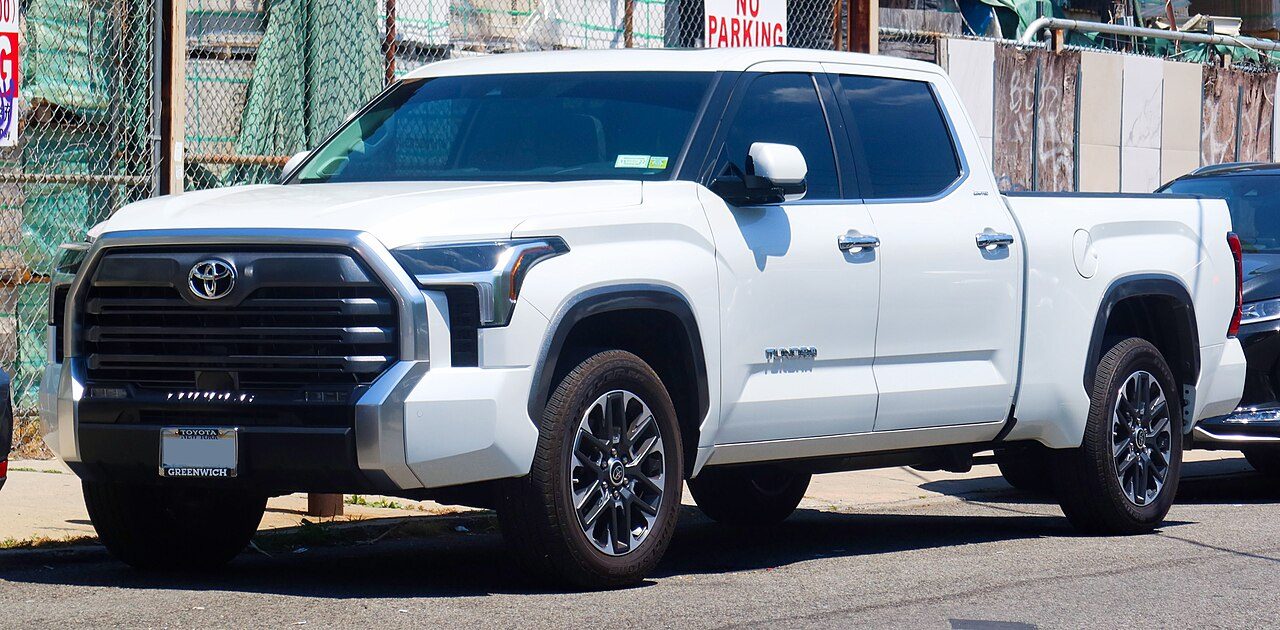
Especificaciones
| Cilindros | 6 |
|---|---|
| Transmisión | Automática · 4 velocidades |
| Tracción | AWD |
| Dimensiones (L × A × H) | 5,410 × 1,910 × 1,820 mm (213.0 × 75.2 × 71.7 in) |
| Distancia entre ejes | 3,260 mm (128.3 in) |
| Peso en vacío | 1,950 kg (4,299 lb) |
| Estilo de carrocería | Camionetas estándar 2WD |
Dimensiones y peso: mediana de las 5 versiones en las especificaciones oficiales de Canadá (NHTSA vPIC). Cada versión difiere ligeramente.
A la venta en Estados Unidos
Seguridad
Resultados de pruebas de choque por mercado. Pueden variar según versión y equipamiento.
Economía de combustible (MPG)
🇺🇸 Dato localPor versión
| Motor | Transmisión | Tracción | Ciudad | Autopista | Mixto |
|---|---|---|---|---|---|
| 3.4 L 6-cilindro | Automática · 4 velocidades | AWD | 6.0 km/l (14 MPG) | 7.2 km/l (17 MPG) | 6.4 km/l (15 MPG) |
| 3.4 L 6-cilindro | Automática · 4 velocidades | Tracción trasera (RWD) | 6.4 km/l (15 MPG) | 7.6 km/l (18 MPG) | 6.8 km/l (16 MPG) |
| 3.4 L 6-cilindro | Manual · 5 velocidades | AWD | 6.4 km/l (15 MPG) | 7.6 km/l (18 MPG) | 6.8 km/l (16 MPG) |
| 3.4 L 6-cilindro | Manual · 5 velocidades | Tracción trasera (RWD) | 6.4 km/l (15 MPG) | 7.6 km/l (18 MPG) | 6.8 km/l (16 MPG) |
| 4.7 L 8-cilindro | Automática · 4 velocidades | AWD | 5.5 km/l (13 MPG) | 6.8 km/l (16 MPG) | 6.0 km/l (14 MPG) |
| 4.7 L 8-cilindro | Automática · 4 velocidades | Tracción trasera (RWD) | 5.5 km/l (13 MPG) | 7.2 km/l (17 MPG) | 6.4 km/l (15 MPG) |
Cifras de la EPA para cada versión vendida en EE. UU.
Llamados a revisión
Traducción automática del texto oficial. El original está en la fuente.
Consecuencia · Remedio
Una explosión del inflador puede resultar en fragmentos de metal afilados golpeando al conductor u otros ocupantes, resultando en lesiones graves o muerte.
Toyota notificará a los propietarios. Dependiendo del modelo del vehículo, los distribuidores reemplazarán el inflador del airbag del conductor delantero, el inflador del airbag del pasajero delantero, el ensamblaje del airbag, o el sub-ensamblaje del airbag del pasajero delantero y el inflador. El recall comenzó el 20 de noviembre de 2019. Los propietarios pueden contactar el servicio al cliente de Toyota al 1-888-270-9371 o el servicio al cliente de Lexus al 1-800-255-3987. Los números de Toyota para este recall son J0A, J0B y J0C. Los números de Lexus para este recall son JLI, JLJ y JLK.
Consecuencia · Remedio
Una explosión del inflador puede resultar en fragmentos de metal afilados golpeando al conductor u otros ocupantes, resultando en lesiones graves o muerte.
Toyota notificará a los propietarios de Toyota y Lexus. General Motors notificará a los propietarios de Pontiac Vibe. Dependiendo del modelo del vehículo, los distribuidores reemplazarán el inflador del airbag del pasajero delantero con un inflador alternativo, o reemplazarán el ensamblaje del airbag que incluye un inflador alternativo, sin costo. El recall comenzó el 23 de enero de 2019. Los propietarios pueden contactar el servicio al cliente de Toyota al 1-888-270-9371, el servicio al cliente de Lexus al 1-800-255-3987 o el servicio al cliente de Pontiac al 1-800-762-2737. Los números de Toyota para estos recalls son J0A (Zona A Toyota), J0B (Zona B Toyota), J0C (Zona C Toyota), JLI (Zona A Lexus), JLJ (Zona B Lexus), y JLK (Zona C Lexus). Nota: Este recall incluye vehículos que ya han tenido su airbag reemplazado anteriormente bajo una campaña de airbag anterior.
Consecuencia · Remedio
En caso de un accidente que requiera el despliegue del airbag frontal del pasajero, el inflador podría romperse con fragmentos metálicos que impacten a los ocupantes del vehículo, lo que podría resultar en lesiones graves o la muerte.
Los vehículos Corolla y Corolla Matrix 2003-2004 que son objeto de un retiro bajo los códigos 15V-043 y 15V-285 tienen un aviso de No Conducir. Se aconseja a los propietarios de estos vehículos que no conduzcan sus vehículos hasta que se complete el remedio del retiro. Toyota notificará a sus propietarios. Los propietarios de Pontiac Vibe serán notificados por GM. Los concesionarios reemplazarán el airbag del pasajero delantero. El retiro comenzó el 13 de julio de 2015. Los propietarios de Toyota pueden contactar al servicio al cliente de Toyota al 1-800-331-4331. Los propietarios de Pontiac pueden llamar al 1-800-762-2737. NOTA: Este retiro sustituye al retiro 14V-312 en su totalidad.
Consecuencia · Remedio
En caso de un accidente que requiera el despliegue del airbag frontal del pasajero, el inflador podría romperse con fragmentos metálicos que impacten a los ocupantes del vehículo, lo que podría resultar en lesiones graves o la muerte.
Los vehículos Corolla y Corolla Matrix 2003-2004 que son objeto de un retiro bajo los códigos 15V-043 y 15V-286 tienen un aviso de No Conducir. Se aconseja a los propietarios de estos vehículos que no conduzcan sus vehículos hasta que se complete el remedio del retiro. Toyota notificará a sus propietarios. Los propietarios de Pontiac Vibe serán notificados por GM. Los concesionarios reemplazarán el airbag del lado del pasajero delantero, sin costo alguno. Los propietarios pueden contactar al servicio al cliente de Toyota al 1-800-331-4331. Toyota comenzó el retiro el 13 de julio de 2015. Los propietarios de Pontiac Vibe pueden contactar a GM al 1-800-762-2737. GM comenzó el retiro el 29 de junio de 2015. NOTA: Este retiro sustituye al retiro 14V-655 en su totalidad. Para vehículos ubicados en los estados de EE. UU. no listados arriba, por favor consulte el retiro de Toyota 15V-285 que cubre todos los demás estados de EE. UU.
Consecuencia · Remedio
LA SEPARACIÓN DE LA LLANTA DE REPUESTO Y LA DISMINUCIÓN DE LA CAPACIDAD DE FRENADO PODRÍAN AUMENTAR EL RIESGO DE UN ACCIDENTE.
TOYOTA ESTÁ SOLICITANDO A LOS PROPIETARIOS DE LOS VEHÍCULOS AFECTADOS QUE RETIREN LA LLANTA DE REPUESTO DEBAJO DEL VEHÍCULO HASTA QUE SE OBTENGA UNA SOLUCIÓN. LOS CONCESIONARIOS INSPECCIONARÁN EL MIEMBRO TRANSVERSAL TRASERO Y LOS COMPONENTES RELACIONADOS, INCLUYENDO LAS LÍNEAS DE FRENOS, Y LOS REEMPLAZARÁN SI ES NECESARIO. SI EL MIEMBRO TRANSVERSAL NO NECESITA SER REEMPLAZADO, SE ROCIARÁ CON UN COMPUESTO PROTECTOR CONTRA LA CORROSIÓN. ESTOS SERVICIOS SE REALIZARÁN SIN CARGO, SIN EMBARGO SE PUEDEN REQUERIR MÚLTIPLES VISITAS AL CONCESIONARIO. SE ESPERA QUE EL RECALL DE SEGURIDAD COMIENCE ALREDEDOR DEL 30 DE ABRIL DE 2010. LOS PROPIETARIOS PUEDEN CONTACTAR A TOYOTA AL 1-800-331-4331.
Consecuencia · Remedio
UNA VISIBILIDAD DE LUZ DISMINUIDA PUEDE RESULTAR EN UN ACCIDENTE VEHICULAR.
DOPE, INC. NOTIFICARÁ A LOS DUEÑOS Y OFRECERÁ UN REEMBOLSO COMPLETO POR LAS LÁMPARAS DE COMBINACIÓN NO CONFORMES. EL RETROCESO DE SEGURIDAD COMENZÓ EL 28 DE JULIO DE 2009. LOS DUEÑOS PUEDEN CONTACTAR A DOPE, INC. AL 1-626-272-1798.
Consecuencia · Remedio
FALTA DE REFLECTORES ANARANJADOS EN LOS FAROS REDUCIRÁ LA VISIBILIDAD LUMINOSA PARA OTROS CONDUCTORES Y PODRÍA RESULTAR EN UN ACCIDENTE DE VEHÍCULO.
AJ MOTORSPORT NOTIFICARÁ A LOS PROPIETARIOS Y OFRECERÁ REEMBOLSO POR LAS LÁMPARAS. EL RETIRO COMENZÓ EL 31 DE JULIO DE 2006. LOS PROPIETARIOS PUEDEN CONTACTAR A AJ MOTORSPORT AL 626-618-2026.
Consecuencia · Remedio
SIN LOS REFLECTORES AMBAR, EL VEHÍCULO ESTARÁ MAL ILUMINADO, LO QUE PODRÍA RESULTAR EN UN CHOQUE DEL VEHÍCULO SIN ADVERTENCIA.
PRO-A MOTORS NOTIFICARÁ A LOS PROPIETARIOS Y OFRECERÁ COMPRAR DE NUEVO LAS LAMPARAS. LA CAMPAÑA DE RETROCESO COMENZÓ EL 3 DE ABRIL DE 2006. LOS PROPIETARIOS PUEDEN CONTACTAR A PRO-A MOTORS AL 323-838-2988.
Consecuencia · Remedio
ESTE ESTÁNDAR ESTABLECE REQUISITOS PARA LOS SISTEMAS DE ANCLAJE DE SUJECIÓN DE NIÑOS PARA GARANTIZAR SU UBICACIÓN Y FUERZA ADECUADAS PARA SECURAR EFECTIVAMENTE LOS SUJETOS DE NIÑOS, PARA REDUCIR LA PROBABILIDAD DE FALLA DE LOS SISTEMAS DE ANCLAJE Y AUMENTAR LA PROBABILIDAD DE QUE LOS SUJETOS DE NIÑOS ESTÉN CORRECTAMENTE ASEGURADOS Y, POR LO TANTO, LOGREN PLENAMENTE SU EFECTIVIDAD POTENCIAL EN VEHÍCULOS DE MOTOR.
LOS CONCESIONARIOS RETIRARÁN EL INTERRUPTOR MANUAL DE AIRBAG Y REEMPLAZARÁN EL MANUAL DEL PROPIETARIO, Y COLOCARÁN UNA NUEVA ETIQUETA DE ADVERTENCIA DE AIRBAG EN EL VISOR DEL SOL. EL RECLAMO COMENZÓ A PRINCIPIOS DE ENERO DE 2007. LOS PROPIETARIOS PUEDEN CONTACTAR A TOYOTA AL 1-800-331-4331.
Consecuencia · Remedio
EL JUEGO DE BOLA INFERIOR PUEDE SEPARARSE DEL NUDO CAUSANDO PÉRDIDA DEL CONTROL DE DIRECCIÓN Y PODRÍA OCURRIR UN ACCIDENTE.
LOS CONCESIONARIOS REEMPLAZARÁN LOS JOINTS DE BOLA INFERIORES DE LA SUSPENSIÓN DELANTERA SIN CARGO. EL RECALL COMENZÓ EL 5 DE JULIO DE 2005. LOS DUEÑOS PUEDEN CONTACTAR A TOYOTA AL 1-800-331-4331.
Traducción automática del texto oficial. El original está en la fuente.
Puede no aplicar a los vehículos vendidos en tu país. Verifica con tu VIN en la fuente.
Detalles
Issue: On certain vehicles, long-term exposure to high absolute humidity and temperature, combined with high temperature cycling, may eventually degrade the propellant contained in the passenger-front airbag. This could cause the airbag to deploy with more force than normal. If the airbag inflator ruptures, fragments could be propelled toward vehicle occupants or cause damage to the airbag assembly, preventing its proper function. Safety Risk: If the vehicle is involved in a crash requiring an airbag deployment, the airbag inflator could rupture and create a risk of injury. Corrective Action: Owners will be notified by mail and instructed to take their vehicle to a dealer to have the passenger-front airbag inflator or airbag module replaced. Note: The Canadian climate results in the propellant degrading slowly. This recall is being conducted as a precaution to address future risk. It is expected that all airbag inflators will be replaced before their function would be affected. Additional Note: Vehicles may have had the original front passenger airbag inflator replaced as a "like-for-like" replacement under recall 2016-103 (Toyota Recall #'s SRC 241 & SRC 242) as a temporary remedy while evaluating a permanent remedy. These vehicles will receive the permanent remedy passenger airbag assembly under this recall.
Detalles
On certain vehicles, long-term exposure to high absolute humidity and temperature, combined with high temperature cycling, could eventually degrade the propellant contained in the passenger frontal airbag. This could cause the airbag to deploy with more force than normal. As a result, if the vehicle were involved in a collision that warrants airbag deployment, fragments could be propelled toward vehicle occupants, and the airbag assembly could be damaged, preventing proper function. These issues could increase the risk of injury. Correction: Dealers will replace the passenger frontal airbag inflator or airbag assembly. <br><br> Note: Canadian climate results in the propellant degrading slowly. The recall is being conducted as a precaution to address future risk, and is expected to replace airbag inflators before their function would be affected. Vehicles may have had the original front passenger airbag inflator replaced as a “like-for-like” replacement under recall 2013-133 (Toyota Recall #'s SSC 193/241 & SSC 194/242) as a temporary remedy while evaluating a permanent remedy. These vehicles will receive the permanent remedy passenger airbag assembly under this recall.
Detalles
On certain vehicles, the passenger (frontal) airbag inflator could produce excessive internal pressure during airbag deployment. Increased pressure may cause the inflator to rupture, which could allow fragments to be propelled toward vehicle occupants, increasing the risk of injury. This could also damage the airbag module, which could prevent proper deployment. Failure of the passenger airbag to fully deploy during a crash (where deployment is warranted) could increase the risk of personal injury to the seat occupant. Note: This recall supersedes recalls 2013113, 2014224, 2015197 and 2015269. Correction: All vehicles having not received a replacement inflator as part of the previous recall will now have a replacement inflator installed by dealers. For Matrix model vehicles, dealers may replace the front passenger airbag assembly with one equipped with a newly specified inflator.
Detalles
On certain vehicles, the passenger (frontal) airbag inflator could produce excessive internal pressure during airbag deployment. Increased pressure may cause the inflator to rupture, which could allow fragments to be propelled toward vehicle occupants, increasing the risk of injury. This could also damage the airbag module, which could prevent proper deployment. Failure of the passenger airbag to fully deploy during a crash (where deployment is warranted) could increase the risk of personal injury to the seat occupant. Note: This recall is superseded by recall 2016103. Please see recall 2016103 for more information. <a href="http://wwwapps.tc.gc.ca/Saf-Sec-Sur/7/VRDB-BDRV/search-recherche/detail.aspx?lang=eng&&rn=2016103">Click here for more information</a>
Detalles
On certain vehicles operated in areas of heavy road salt usage, excessive corrosion of the rear cross member may cause separation of the spare tire stowed under the truck bed. Corrosion of the rear cross member may also affect the functionality of the rear brake line at the proportioning valve. A spare tire that separates during vehicle usage could impact nearby persons or objects resulting in personal injury and/or vehicle and property damage. Correction: Dealers will inspect the rear cross member and surrounding components and, depending on the amount of corrosion detected, either apply a corrosion-resistant compound or replace the cross member assembly.
Detalles
On certain vehicles, a manufacturing issue with the front lower ball joint could result in premature wear. If the vehicle is operated for an extended period of time in this condition, the ball joint may eventually experience excessive wear and looseness, resulting in increased steering effort, reduced vehicle self-centering and noise in the front suspension. In extreme cases, when the driver continues to operate the vehicle in this condition, the lower ball joint may separate from the knuckle causing a loss of vehicle steering control. Correction: Dealers will inspect and, if necessary, replace the front lower ball joints.
Problemas comunes
40 reportes🇺🇸 Dato localReportado por dueños a la fuente de abajo. No es un veredicto sobre este auto: es lo que la gente escribió.
NHTSA Campaign 09V444000 for 2000-2003 Toyota Tundra to address severe corrosion on the rear frame cross-member section or rear brake lining proportion valve. Vehicle was apparently treated with CRC in 2010, but vehicle continued to rust severely in the specified recall zone, even after Toyota Safety Recall 90M had be…
Getting Airbag light on . Went to Modesto Toyota and they installed new clock spring strap in steering wheel. After installing the airbag light came back on . I again went back to dealer with same issue. They installed another clock spring in steering wheel. Drove about 1 mile , again airbag came on. Took it back to d…
NHTSA Campaign 09V444000 for 2000-2003 Toyota Tundra to address severe corrosion on the rear frame cross-member section or rear brake lining proportion valve. Vehicle was apparently treated with CRC in 2010, but vehicle continued to rust severely in the specified recall zone, even after Toyota Safety Recall 90M had …
I own a 2003 Toyota Tundra (VIN: [XXX] ) that was subject to Toyota’s frame corrosion recall (Limited Service Campaign A0F). The vehicle was inspected by Toyota in January 2011 and confirmed to have no perforation. In March 2012, Toyota applied a corrosion-resistant compound as part of the recall remedy. Despite thi…
The frame was undercoated incorrectly and is actively falling apart. Super unsafe to drive. Very clearly was not undercoated correctly as there is areas in the frame that have no signs of undercoating. This is putting the driver of the vehicle at risk as well as the other drivers on the road. This is a huge recall t…
The frame was not professionally undercoated and is actively falling apart. Super unsafe to drive.
The frame is bad on driver and passenger side between the cab and bed. Auto body tech states there is no good metal to make the necessary repairs (welding new metal) to at this time. Inspection garage states it is a solid truck but will not pass inspection due to the frame’s condition. The vehicle has 106k miles on…
There was a recall for the frame rusting out prematurely. Toyota had the recall until 2012. I did not own the truck then and it did not get fixed. Now I have a rusted out frame. Toyota is claiming they are not able to fix the frame due to it being 14 years later. They would however be able to keep the recall open…
Many things are happening to my truck that’s why I am contacting you people to see if I got any callback thank you so much
I have a 2003 Toyota Tundra with a Rusted out frame, I have called Toyota with no help from them as it was Sorry its your problem.. I need Help Toyota, this is my only transportation. I BOUGHT YOUR PRODUCT IN GOOD FAITH, Please stand behind your product.
Frame Corrosion: There was originally a customer service campaign for 2000-2003 Toyota Tundra’s for frame corrosion that was extended under administration tracking code “BXD.” My vehicle was manufactured in Indiana and has major frame rust on the rear cross member portion of the frame. This extension has no expiration…
I need to have rear shock replaced. They found that the bracket holder rusted thru . Shock was fine . The Rear frame corrosion and separation, spare tire frame corrosion is really bad. I have had this truck since 2004 . I absolutely love my truck. I am deeply saddened that all the care I took still didn’t prevent all …
Preguntas
- ¿Qué motor tiene el 2003 Toyota Tundra?
- El 2003 Toyota Tundra vino con 2 motores: 3.4 L 6-cilindro, 4.7 L 8-cilindro.
- ¿Cuál es la economía de combustible del 2003 Toyota Tundra?
- Obtiene 6.0 a 6.8 km/l combinado dependiendo del motor, según la EPA.
- ¿Tiene el 2003 Toyota Tundra campañas de retiro?
- 10 campañas de retiro están registradas. La más reciente concierne a Air Bags (2019-10-17).
- ¿Cuáles son los problemas comunes del 2003 Toyota Tundra?
- 40 propietarios han presentado quejas, la mayoría sobre Structure.
Otros años
Otros modelos de Toyota
¿Tienes uno?
Publícalo gratis y llega a compradores que ya están buscando este auto en particular.