
Toyota Tundra 2004
The 2004 Toyota Tundra came with 2 engines: 3.4 L 6-cylinder, 4.7 L 8-cylinder. It gets 14 to 16 MPG combined depending on the engine, per the EPA. 13 recall campaigns and 40 owner complaints are on record.
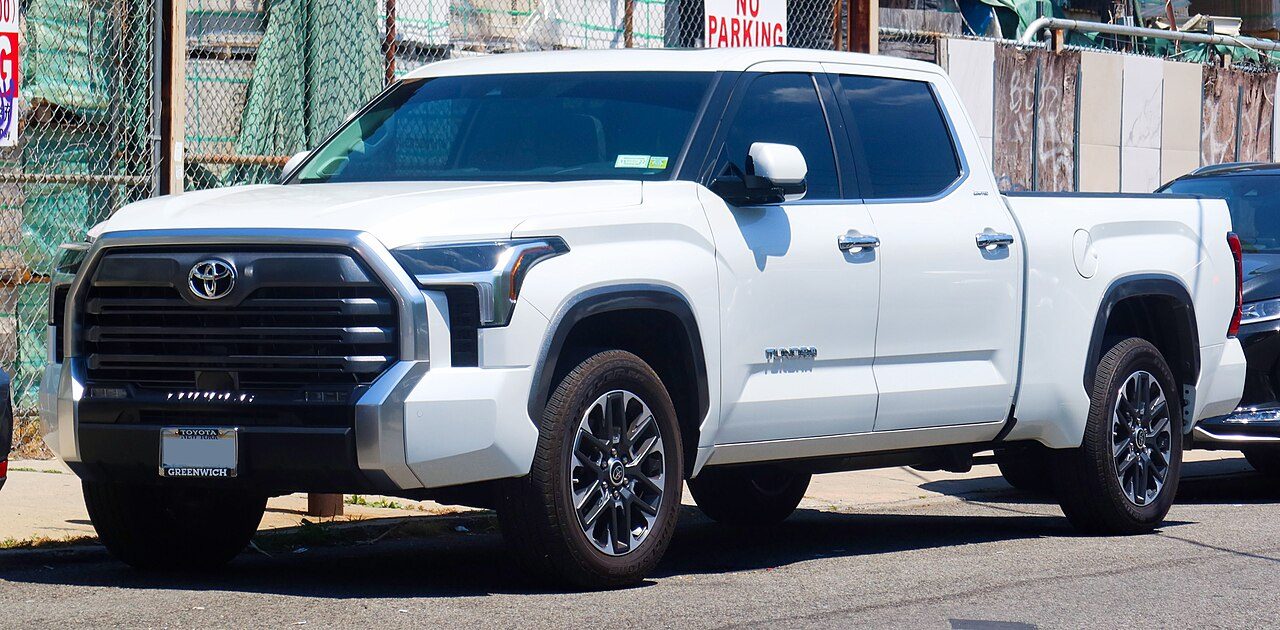
Specs
| Cylinders | 6 |
|---|---|
| Transmission | Automatic · 4 speeds |
| Drivetrain | AWD |
| Dimensions (L × W × H) | 5,410 × 1,910 × 1,830 mm (213.0 × 75.2 × 72.0 in) |
| Wheelbase | 3,260 mm (128.3 in) |
| Curb weight | 2,028 kg (4,471 lb) |
| Body style | Standard Pickup Trucks 2WD |
Dimensions and weight: median of the 8 versions in Canada's official specifications (NHTSA vPIC). Each version differs slightly.
For sale in United States
Safety
Crash-test results across markets. They can vary by version and equipment.
Fuel economy (MPG)
🇺🇸 Local dataBy version
| Engine | Transmission | Drivetrain | City | Highway | Combined |
|---|---|---|---|---|---|
| 3.4 L 6-cylinder | Automatic · 4 speeds | AWD | 14 MPG | 17 MPG | 15 MPG |
| 3.4 L 6-cylinder | Automatic · 4 speeds | Rear-wheel (RWD) | 15 MPG | 18 MPG | 16 MPG |
| 3.4 L 6-cylinder | Manual · 5 speeds | AWD | 15 MPG | 18 MPG | 16 MPG |
| 3.4 L 6-cylinder | Manual · 5 speeds | Rear-wheel (RWD) | 15 MPG | 18 MPG | 16 MPG |
| 4.7 L 8-cylinder | Automatic · 4 speeds | AWD | 13 MPG | 16 MPG | 14 MPG |
| 4.7 L 8-cylinder | Automatic · 4 speeds | Rear-wheel (RWD) | 13 MPG | 16 MPG | 14 MPG |
EPA figures for each version sold in the U.S.
Recalls
Consequence · Remedy
A ball joint failure may cause a loss of control, increasing the risk of a crash.
DRiV will work with distributors to return unsold parts. Dealers will inspect and replace the ball joint as necessary, free of charge. Owner notification letters were mailed on March 17, 2022. Owners may contact DRiV customer service at 1-877-489-6659 or at RECALL.SUPPORT@DRIV.COM.
Consequence · Remedy
An inflator explosion may result in sharp metal fragments striking the driver or other occupants resulting in serious injury or death.
Toyota will notify owners. Depending on the vehicle model, dealers will replace the front driver inflator, front passenger airbag inflator, the airbag assembly, or the front passenger airbag sub-assembly and inflator. The recall began November 20, 2019. Owners may contact Toyota customer service at 1-888-270-9371 or Lexus customer service at 1-800-255-3987. Toyota's numbers for this recall are J0A, J0B, and J0C. Lexus' numbers for this recall are JLI, JLJ, and JLK.
Consequence · Remedy
An inflator explosion may result in sharp metal fragments striking the driver or other occupants resulting in serious injury or death.
Toyota will notify the Toyota and Lexus owners. General Motors will notify the Pontiac Vibe owners. Depending on the vehicle model, dealers will replace the front passenger air bag inflator with an alternate inflator, or replace the air bag assembly that includes an alternate inflator, free of charge. The recall began January 23, 2019. Owners may contact Toyota customer service at 1-888-270-9371, Lexus customer service at 1-800-255-3987 or Pontiac customer service at 1-800-762-2737. Toyota's numbers for these recalls are J0A (Zone A Toyota), J0B (Zone B Toyota), J0C (Zone C Toyota), JLI (Zone A Lexus), JLJ (Zone B Lexus), and JLK (Zone C Lexus). Note: This recall includes vehicles that have had their air bag previously replaced under an earlier air bag campaign.
Consequence · Remedy
In the event of a crash necessitating deployment of the passenger's frontal air bag, the inflator could rupture with metal fragments striking the vehicle occupants potentially resulting in serious injury or death.
2003-2004 Corolla and Corolla Matrix vehicles that are recalled under both 15V-043 and 15V-285 are under a Do Not Drive advisory. Owners of these vehicles are advised not to drive their vehicles until the recall remedy has been completed. Toyota will notify their owners. Pontiac Vibe owners will be notified by GM. Dealers will replace the front passenger air bag. The recall began on July 13, 2015. Toyota owners may contact Toyota customer service at 1-800-331-4331. Pontiac owners may call 1-800-762-2737. NOTE: This recall supersedes recall 14V-312 in its entirety.
Consequence · Remedy
In the event of a crash necessitating deployment of the passenger's frontal air bag, the inflator could rupture with metal fragments striking the vehicle occupants potentially resulting in serious injury or death.
2003-2004 Corolla and Corolla Matrix vehicles that are recalled under both 15V-043 and 15V-286 are under a Do Not Drive advisory. Owners of these vehicles are advised not to drive their vehicles until the recall remedy has been completed. Toyota will notify their owners. Pontiac Vibe owners will be notified by GM. Dealers will replace the passenger side front air bag, free of charge. Owners may contact Toyota customer service at 1-800-331-4331. Toyota began the recall on July 13, 2015. Pontiac Vibe owners may contact GM at 1-800-762-2737. GM began the recall on June 29, 2015. NOTE: This recacll supersedes recall 14V-655 in its entirety. For vehicles located in the U.S. states not listed above, please see Toyota recall 15V-285 which covers all other U.S. states.
Consequence · Remedy
DECREASED LIGHTING VISIBILITY MAY RESULT IN A VEHICLE CRASH.
DOPE, INC. WILL NOTIFY OWNERS AND OFFER A FULL REFUND FOR THE NONCOMPLIANT COMBINATION LAMPS. THE SAFETY RECALL BEGAN ON JULY 28, 2009. OWNERS MAY CONTACT DOPE, INC. AT 1-626-272-1798.
Consequence · Remedy
IN EXTREME CASES, IF THE VEHICLE IS CONTINUOUSLY OPERATED IN THIS CONDITION, THE LOWER BALL JOINT MAY SEPARATE FROM THE KNUCKLE AND COULD CAUSE A LOSS OF VEHICLE CONTROL.
DEALERS WILL REPLACE THE FRONT SUSPENSION LOWER BALL JOINTS. THE RECALL BEGAN ON FEBRUARY 28, 2007. OWNERS MAY CONTACT TOYOTA AT 1-800-331-4331.
Consequence · Remedy
LACK OF AMBER SIDE REFLECTORS IN THE LAMPS WILL DECREASE LIGHTING VISIBILITY TO OTHER DRIVERS AND MAY POSSIBLY RESULT IN A VEHICLE CRASH.
AJ MOTORSPORT WILL NOTIFY OWNERS AND OFFER REIMBURSEMENT FOR THE LAMPS. THE RECALL BEGAN ON JULY 31, 2006. OWNERS MAY CONTACT AJ MOTORSPORT AT 626-618-2026.
Consequence · Remedy
WITHOUT THE AMBER REFLECTORS, THE VEHICLE WILL BE POORLY ILLUMINATED, POSSIBLY RESULTING IN A VEHICLE CRASH WITHOUT WARNING.
CK MOTORSPORT WILL NOTIFY OWNERS AND REPLACE THE NONCOMPLIANT LAMPS FREE OF CHARGE. THE RECALL BEGAN ON JULY 1, 2006. OWNERS MAY CONTACT CK MOTORSPORT AT 1-909-610-7211.
Consequence · Remedy
WITHOUT THE AMBER REFLECTORS, THE VEHICLE WILL BE POORLY ILLUMINATED, POSSIBLY RESULTING IN A VEHICLE CRASH WITHOUT WARNING.
PRO-A MOTORS WILL NOTIFY OWNERS AND OFFER TO REPURCHASE THE LAMPS. THE RECALL BEGAN ON APRIL 3, 2006. OWNERS MAY CONTACT PRO-A MOTORS AT 323-838-2988.
Consequence · Remedy
THIS STANDARD ESTABLISHES REQUIREMENTS FOR CHILD RESTRAINT ANCHORAGE SYSTEMS TO ENSURE THEIR PROPER LOCATION AND STRENGTH FOR THE EFFECTIVE SECURING OF CHILD RESTRAINTS, TO REDUCE THE LIKELIHOOD OF THE ANCHORAGE SYSTEMS' FAILURE, AND TO INCREASE THE LIKELIHOOD THAT CHILD RESTRAINTS ARE PROPERLY SECURED AND THUS MORE FULLY ACHIEVE THEIR POTENTIAL EFFECTIVENESS IN MOTOR VEHICLES.
DEALERS WILL REMOVE THE MANUAL AIR BAG ON-OFF SWITCH, REPLACE THE OWNER'S MANUAL, AND AFFIX A NEW SUN VISOR AIR BAG WARNING LABEL. THE RECALL BEGAN IN EARLY JANUARY 2007. OWNERS MAY CONTACT TOYOTA AT 1-800-331-4331.
Consequence · Remedy
THE LOWER BALL JOINT MAY SEPARATE FROM THE KNUCKLE CAUSING LOSS OF STEERING CONTROL AND A CRASH COULD OCCUR.
DEALERS WILL REPLACE THE FRONT SUSPENSION LOWER BALL JOINTS FREE OF CHARGE. THE RECALL BEGAN ON JULY 5, 2005. OWNERS MAY CONTACT TOYOTA AT 1-800-331-4331.
Consequence · Remedy
IN THIS CONDITION, THE EXHAUST PIPE FLANGE MAY RUB AGAINST THE RIGHT REAR BRAKE LINE, WHICH COULD CAUSE BRAKE FLUID LEAKAGE. THIS COULD LEAD TO AN INCREASE OF VEHICLE STOPPING DISTANCE, WHICH COULD RESULT IN A CRASH.
DEALERS WILL INSPECT AND, IF SO EQUIPPED, WILL REPLACE THE TRD DUAL EXHAUST SYSTEM FREE OF CHARGE. DURING THIS REPLACEMENT, THE DEALER WILL ALSO INSPECT THE SPECIFIC BRAKE LINE TO ASSURE IT HAS NOT BEEN DAMAGED AND REPLACE IT IF NECESSARY. THE RECALL BEGAN ON MAY 31, 2005. OWNERS SHOULD CONTACT TOYOTA AT 1-800-331-4331.
It may not apply to vehicles sold in your country. Check with your VIN at the source.
Details
Issue: On certain vehicles, long-term exposure to high absolute humidity and temperature, combined with high temperature cycling, may eventually degrade the propellant contained in the passenger-front airbag. This could cause the airbag to deploy with more force than normal. If the airbag inflator ruptures, fragments could be propelled toward vehicle occupants or cause damage to the airbag assembly, preventing its proper function. Safety Risk: If the vehicle is involved in a crash requiring an airbag deployment, the airbag inflator could rupture and create a risk of injury. Corrective Action: Owners will be notified by mail and instructed to take their vehicle to a dealer to have the passenger-front airbag inflator or airbag module replaced. Note: The Canadian climate results in the propellant degrading slowly. This recall is being conducted as a precaution to address future risk. It is expected that all airbag inflators will be replaced before their function would be affected. Additional Note: Vehicles may have had the original front passenger airbag inflator replaced as a "like-for-like" replacement under recall 2016-103 (Toyota Recall #'s SRC 241 & SRC 242) as a temporary remedy while evaluating a permanent remedy. These vehicles will receive the permanent remedy passenger airbag assembly under this recall.
Details
On certain vehicles, the passenger (frontal) airbag inflator could produce excessive internal pressure during airbag deployment. Increased pressure may cause the inflator to rupture, which could allow fragments to be propelled toward vehicle occupants, increasing the risk of injury. This could also damage the airbag module, which could prevent proper deployment. Failure of the passenger airbag to fully deploy during a crash (where deployment is warranted) could increase the risk of personal injury to the seat occupant. Note: This recall supersedes recalls 2013113, 2014224, 2015197 and 2015269. Correction: All vehicles having not received a replacement inflator as part of the previous recall will now have a replacement inflator installed by dealers. For Matrix model vehicles, dealers may replace the front passenger airbag assembly with one equipped with a newly specified inflator.
Details
On certain vehicles, the passenger (frontal) airbag inflator could produce excessive internal pressure during airbag deployment. Increased pressure may cause the inflator to rupture, which could allow fragments to be propelled toward vehicle occupants, increasing the risk of injury. This could also damage the airbag module, which could prevent proper deployment. Failure of the passenger airbag to fully deploy during a crash (where deployment is warranted) could increase the risk of personal injury to the seat occupant. Note: This recall is superseded by recall 2016103. Please see recall 2016103 for more information. <a href="http://wwwapps.tc.gc.ca/Saf-Sec-Sur/7/VRDB-BDRV/search-recherche/detail.aspx?lang=eng&&rn=2016103">Click here for more information</a>
Details
On certain vehicles, a manufacturing issue with the front lower ball joint could result in premature wear. If the vehicle is operated for an extended period of time in this condition, the ball joint may eventually experience excessive wear and looseness, resulting in increased steering effort, reduced vehicle self-centering and noise in the front suspension. In extreme cases, when the driver continues to operate the vehicle in this condition, the lower ball joint may separate from the knuckle causing a loss of vehicle steering control. Correction: Dealers will inspect and, if necessary, replace the front lower ball joints.
Common problems
40 reports🇺🇸 Local dataReported by owners to the source below. It is not a verdict on this car: it is what people wrote.
The contact owns a 2004 Toyota Tundra. The contact stated that while driving approximately 60 MPH during heavy rains, the vehicle hydroplaned and spun several times before the front end crashed into a guardrail. The driver's side air bag failed to deploy, causing the driver's chest to strike the steering wheel. A byst…
1) The newly installed rack & pinion rack locks up and tried to turn right when on a continuous or left turn followed closely by another left turn. 2) My safety and the other drivers near me were all in danger when the loss of steering control occurs. The problem makes the vehicle want to turn hard to the right and t…
The contact owns a 2004 Toyota Tundra. The contact stated that the vehicle was Emissions tested, and rust was discovered on the driver’s and passenger’s side subframes. The dealer was notified of the issue, but the vehicle was not repaired. The manufacturer was notified of the failure. The contact related the failure …
The contact owns a 2004 Toyota Tundra. The contact stated that while driving approximately 40 MPH, there was an abnormal screeching sound coming from the vehicle. The contact then saw sparks coming from the rear driver’s side of the vehicle, and the driver’s side rear wheel was turned sideways. The vehicle was pulled …
The contact owns a 2004 Toyota Tundra. The contact stated that after purchasing tires for replacement, the tire technician stated that the subframe was damaged from corrosion to the front frame, the side members, and the rear subframe. The contact was informed that the most severe corrosion was located on the driver's…
Frame rot on the original frame with a recall
The contact owns a 2004 Toyota Tundra. The contact stated that on several occasions, while driving at undisclosed speeds and then parking the vehicle, the contact observed oil leaking from the vehicle. The contact stated that on another occasion, while driving at an undisclosed speed, the check engine warning light il…
2004 Toyota Tundra. Left rear upper shock mount rotted away and the shock absorber is no longer connected. (rust) Auto Service report 12/30/2024. October 21, 2021 Toyota Dealership report: Recommends replace spare tire cross member. (rust perforation damage) Recall issued for rust and dealership performed a very l…
The contact owns a 2004 Toyota Tundra. The contact stated that while the vehicle was parked, the contact became aware that the sub frame underneath the vehicle was rusted. The contact was concerned that the sub frame could collapse. The vehicle was taking to the dealer to be inspected. The contact was informed that th…
I purchased 4 Cooper Adventurer 265/70R16 tires in 3-2022 from Pep Boys in Mobile, AL. I had a ASE Certified mechanic checked these tires and found there was a bulge on the tread of the passenger front & tread separation on the driver's rear tire. The tires have approx. 17K miles since purchase. Pep Boys refused to r…
Frame is rusting out, only one bolt is holding left frame per tire dealership & Toyota dealer knows of rusting frame. Spare tire underneath fell out while turning on road, thankfully no cars following.
The warranty work done on the frame of my Tundra that has since failed. The Bracket holding my SwayBar has broken off the frame and, more importantly, the frame has rusted to the point where there is now a hole in it. These are areas where the warranty work occurred.
Questions
- What engine does the 2004 Toyota Tundra have?
- The 2004 Toyota Tundra came with 2 engines: 3.4 L 6-cylinder, 4.7 L 8-cylinder.
- What is the fuel economy of the 2004 Toyota Tundra?
- It gets 14 to 16 MPG combined depending on the engine, per the EPA.
- Does the 2004 Toyota Tundra have recalls?
- 13 recall campaigns are on record. The latest concerns Suspension (2022-01-14).
- What are the common problems of the 2004 Toyota Tundra?
- 40 owners have filed complaints, most often about Structure.
Other years
Other models by Toyota
Do you own one?
Post it for free and reach buyers who are already looking at this exact car.