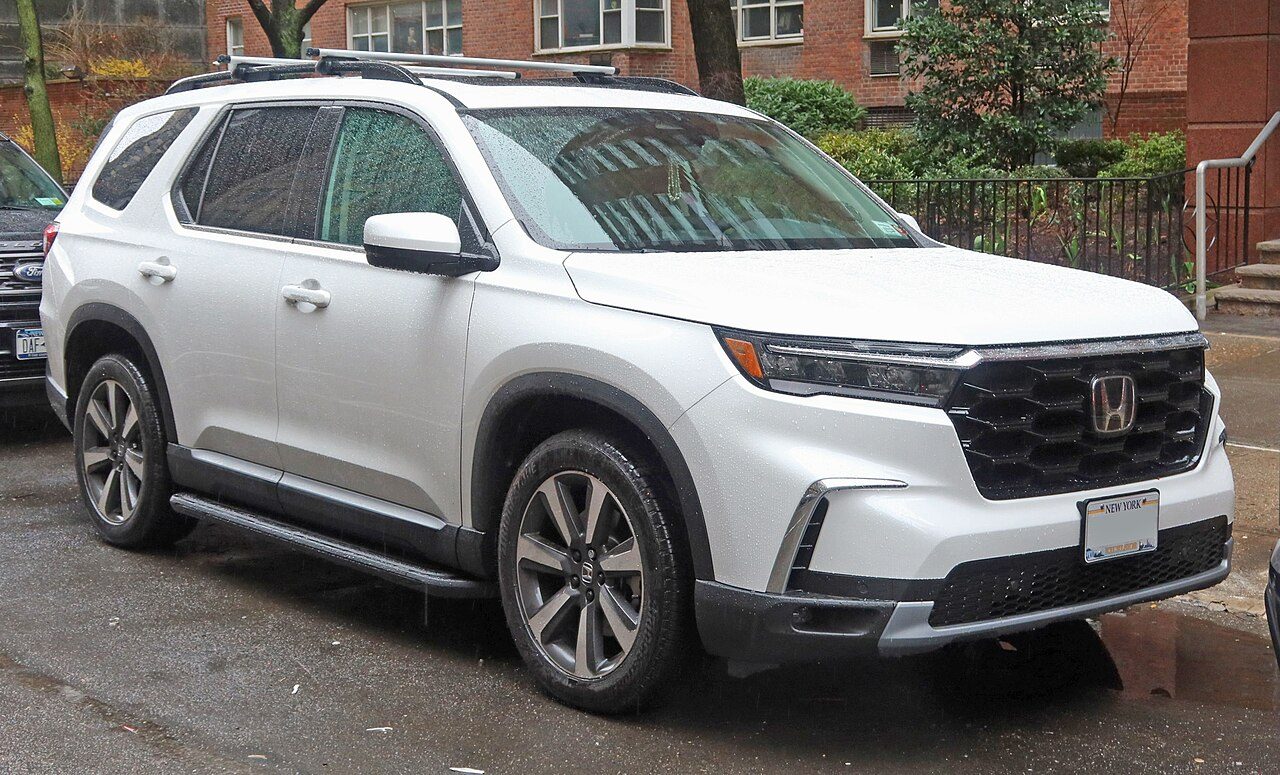
2016 Honda Pilot
The 2016 Honda Pilot has a 3.5 L engine. It gets 22 MPG combined (19 city, 26 highway), per the EPA. NHTSA NCAP rates it 5 out of 5 stars. 8 recall campaigns and 1,729 owner complaints are on record.
Specs
| Cylinders | 6 |
|---|---|
| Transmission | Automatic · 9 speeds |
| Drivetrain | AWD |
| Dimensions (L × W × H) | 4,950 × 2,030 × 1,770 mm (194.9 × 79.9 × 69.7 in) |
| Wheelbase | 2,820 mm (111.0 in) |
| Curb weight | 1,896 kg (4,180 lb) |
| Body style | Small Sport Utility Vehicle 2WD |
Dimensions and weight: median of the 2 versions in Canada's official specifications (NHTSA vPIC). Each version differs slightly.
For sale in United States
Safety
Crash-test results across markets. They can vary by version and equipment.
Fuel economy (MPG)
🇺🇸 Local dataBy version
| Engine | Transmission | Drivetrain | City | Highway | Combined |
|---|---|---|---|---|---|
| 3.5 L 6-cylinder | Automatic · 9 speeds | AWD | 19 MPG | 26 MPG | 22 MPG |
| 3.5 L 6-cylinder | Automatic · 6 speeds | AWD | 18 MPG | 25 MPG | 21 MPG |
| 3.5 L 6-cylinder | Automatic · 9 speeds | Front-wheel (FWD) | 20 MPG | 27 MPG | 23 MPG |
| 3.5 L 6-cylinder | Automatic · 6 speeds | Front-wheel (FWD) | 19 MPG | 27 MPG | 22 MPG |
EPA figures for each version sold in the U.S.
Recalls
Consequence · Remedy
Failure of rear suspension components, such as the rear control arm, can cause a loss of vehicle handling and control, increasing the risk of a crash or injury.
Dealers will inspect the rear subframe and install a rear subframe reinforcement kit and, as necessary, repair or replace the rear subframe components, free of charge. Interim letters notifying owners of the safety risk were mailed July 27, 2026. Additional letters will be sent once the final remedy is available, anticipated in the fall of 2026. Owners may contact Honda's customer service at 1-888-234-2138. Honda's numbers for this recall are AOU and AOT. Vehicle Identification Numbers (VINs) involved in this recall will become searchable on NHTSA.gov beginning June 10, 2026.
Consequence · Remedy
Fuel pump failure can cause an engine stall while driving, increasing the risk of a crash.
Dealers will replace the fuel pump module, free of charge. Owner letters were mailed September 6, 2024. Owners may contact Honda customer service at 1-888-234-2138. Honda's numbers for this recall are KGC and KGD. This recall is an expansion of NHTSA recall numbers 21V-215 and 20V-314.
Consequence · Remedy
A damaged engine may run improperly or stall while driving, increasing the risk of a fire, crash, or injury.
Dealers will inspect and repair, or replace the engine as necessary, free of charge. Owner letters were mailed March 28, 2024. 2016-2017 Acura MDX owner letters were mailed November 1, 2024. 2016-2020 Acura MDX owner letters are expected to be mailed in mid-December 2024. Honda began mailing owner notification letters as of March 18, 2024. 2015-2016 Acura owner letters are expected to be mailed mid-December 2024, 2018 Acura TLX owner letters are expected to be mailed the end of March/early April 2024, 2019 Acura TLX owner letters are expected to be mailed mid-May 2024, 2020 Acura TLX owner letters are expected to be mailed mid-June 2024, and 2016-2020 Acura MDX owner letters are expected to be mailed January 27, 2025. Owners may contact Honda customer service at 1-888-234-2138. Honda's numbers for these recalls are XG1 and GG0.
Consequence · Remedy
A hood that opens while driving can obstruct the driver's view and increase the risk of a crash.
Dealers will either repair the hood latch striker, or replace the hood if necessary, free of charge. Owner notification letters were mailed January 18, 2022. Owners may contact Honda customer service at 1-888-234-2138. Honda's number for this recall is PBV.
Consequence · Remedy
A fuel leak in the presence of an ignition source can increase the risk of a fire.
Honda will notify owners, and dealers will replace the fuel tank, free of charge. Owners may contact Honda customer service at 1-888-234-2138. Honda's number for this recall is KE8.
Consequence · Remedy
A fuel leak in the presence of an ignition source may result in a fire.
Honda will notify owners, and dealers will replace the fuel tanks, free of charge. Owners may contact Honda/Acura customer service at 1-888-234-2138. The recall began on July 29, 2016. Honda's numbers for this recall are KA9 (Honda vehicles) and KB0 (Acura vehicles).
Consequence · Remedy
If a safety system cannot immediately warn the driver when needed, the driver may be at increased risk of a crash.
Honda will notify owners, and dealers will update the instrument cluster software, free of charge. The recall began on December 11, 2015. Owners may contact Honda customer service at 1-888-234-2138. Honda's number for this recall is JV7.
Consequence · Remedy
If the third row seatbelt is trapped, the occupants may not be restrained properly, increasing the risk of injury.
Honda will notify owners, and dealers will inspect and repair the rear third row seat belt, free of charge. The recall began on August 6, 2015. Owners may contact Honda customer service at 1-310-783-2000. Honda's number for this recall is JS7.
It may not apply to vehicles sold in your country. Check with your VIN at the source.
Details
Issue: On certain vehicles, the suspension mounting points on the rear subframe could rust. As a result, rear suspension components could fail. This could lead to poor handling and a loss of vehicle control. Safety Risk: A loss of control could create the risk of a crash. Corrective Actions: Honda will notify owners by mail and advise you to take your vehicle to a dealership to inspect and install a rear subframe reinforcement kit or replace the subframe, as necessary.
Details
Issue: On certain vehicles equipped with a V6 engine, the connecting rod bearings could wear prematurely and become damaged. If this happens, the engine could make abnormal noises and a warning light may turn on. If you continue to drive the vehicle with these symptoms, the engine could fail. Safety Risk: An engine failure could cause a sudden loss of power and/or increase the risk of a vehicle fire. Both issues could increase the risk of a crash or injury. Corrective actions: Honda will notify owners by mail and advise you to take your vehicle to a dealership to inspect the engine. If damage is found, the dealer will replace the necessary parts.
Details
Issue: On certain vehicles, the hood latch striker could separate from the hood. If this happens, the hood could open while driving. Note: A loose or vibrating hood may be a warning that the hood latch is failing. Safety Risk: A hood that opens suddenly while driving could block the driver's view and increase the risk of a crash. Corrective Actions: Honda will notify owners by mail and instruct you to take your vehicle to a dealer to inspect the hood latch striker. Depending on its condition, a striker support plate will be installed, or if necessary, the hood will be replaced.
Details
On certain vehicles, the fuel tank may have received insufficient welds during manufacturing. Over time, the insufficient welds may separate and allow for fuel leakage. A fuel leak in the presence of an ignition source could result in a fire causing injury and/or property damage. Correction: Dealers will replace the fuel tank.
Details
Certain vehicles fail to comply with the requirements of Canada Motor Vehicle Safety Standard 135 - Brake Systems and Canada Motor Vehicle Safety Standard 126 - Electronic Stability Control Systems. Due to a software error in the instrument cluster, Vehicle Stability Assist (VSA), ABS and BRAKE warning lamps may not illuminate under certain conditions, which fails to meet the requirements of the standard. Failure of these lights to illuminate could increase the risk of a crash causing injury and/or damage to property. Note: The warning light will illuminate with next key cycle. Correction: Dealers will update the instrument cluster software.
Common problems
1729 reports🇺🇸 Local dataReported by owners to the source below. It is not a verdict on this car: it is what people wrote.
My 2016 Honda Pilot has suffered catastrophic engine failure due to an apparent connecting rod bearing failure, identical to the defect described in NHTSA Recall 23V-751. During driving on the interstate the engine began knocking, made a loud banging sound, abruptly seized while driving which caused a sudden loss of m…
The manufacturer’s defective fuel delivery system (faulty fuel injectors covered under Honda TSB #19-056) causes severe engine cylinder misfires, dropping the vehicle into an immediate, unpredictable, and sluggish 'limp mode' while driving at highway speeds. This sudden loss of power and acceleration creates a severe …
Vehicle experiences a severe 3-to-4 second extended engine crank before starting due to fuel pressure loss. Priming the low-pressure fuel pump manually bypasses the issue, indicating a check-valve bleed-down failure. It is continuously worsening over time. This is identical to the failure mode of the active low-pressu…
I was stopped at a traffic light just off a highway exit ramp, with my vehicle in drive. When the light changed and I attempted to accelerate, the vehicle would not move forward. I immediately shut off the engine. Because I was stopped in an active traffic lane near a highway ramp, I became concerned for my safety …
The auto idle malfunctioned; the vehicle did not restart when the break was released and/or moving steering wheel. It was in the middle of a busy intersection so that is definitely putting my safety as well as my daughter's and others safety at risk. It took at least a minute to restart the vehicle, by putting the gea…
I have a series of dashboard warning lights that have went off due to failure of this camera-based (LKAS) unit. They are labeled as: 1) Lane Keeping Assist Problem 2) Auto Matic Cruise Control Problem 3) Traction Control Problem 4) ABS - braking system failure. These issues, IMO, are enough to suggest a recall is…
I have been having issues with my 2016 Honda Pilot and I looked on Experian and it stated that there is a recall. There are two different recalls, the first one says Fuel Injector/W Software Update the date is 11/24/2020 and recall # W8V. Also recall for Start/Stop Switch that the recall date was 12/9/2020 and recall …
Hello, While driving, the engine developed a distinct, heavy metallic knocking sound coming from the bottom end. I took the vehicle to an independent repair shop for inspection, where the mechanic drained the oil and cut open the oil filter. The filter pleats contained significant metallic debris and bearing shavings…
Connecting rod spun a bearing/ rod knock Verified le customer's concern regarding an abnormal engine knockır oise. Conducted a diagnostic inspection and confirmed pronounced metallic knocking noise originating from the ower engine assembly. Used a mechanic's stethoscope tr isolate the noise to the crankshaft/connectin…
While driving our 2016 Honda Pilot on the highway approximately three weeks ago, we experienced a sudden, loud clunk from the engine, followed by catastrophic engine failure. The failure occurred unexpectedly while the vehicle was traveling at highway speed, creating a serious safety concern. Following the incident,…
The engine has developed a severe internal engine knocking/rattling noise while running. This symptom matches the defective crankshaft and connecting rod bearing failures detailed under NHTSA Campaign 23V751000, presenting a severe risk of sudden stalling and complete engine failure under load.
I am writing to report a severe internal engine defect on my 2016 Honda Pilot that poses a sudden stalling and safety hazard, identical to the failures covered under NHTSA Recall Campaign Number 23V-751. My vehicle is currently experiencing a distinct metallic rattling/knocking noise coming from the lower engine block…
2016 vs. other Pilot years
🇺🇸 Local dataOwner complaints and recall campaigns on record at NHTSA for each model year. Fewer complaints can also mean fewer cars sold or a newer car.
Questions
- What engine does the 2016 Honda Pilot have?
- The 2016 Honda Pilot has a 3.5 L engine.
- What is the fuel economy of the 2016 Honda Pilot?
- It gets 22 MPG combined (19 city, 26 highway), per the EPA.
- Is the 2016 Honda Pilot safe?
- NHTSA NCAP rates it 5 out of 5 stars.
- Does the 2016 Honda Pilot have recalls?
- 8 recall campaigns are on record. The latest concerns Structure (2026-06-04).
- What are the common problems of the 2016 Honda Pilot?
- 1,729 owners have filed complaints, most often about engine.
Other years
Other models by Honda
Do you own a 2016 Pilot?
Post it for free and reach buyers who are already looking at this exact car.
- Free, with no commission
- About three minutes
- Your listing shows up on this page