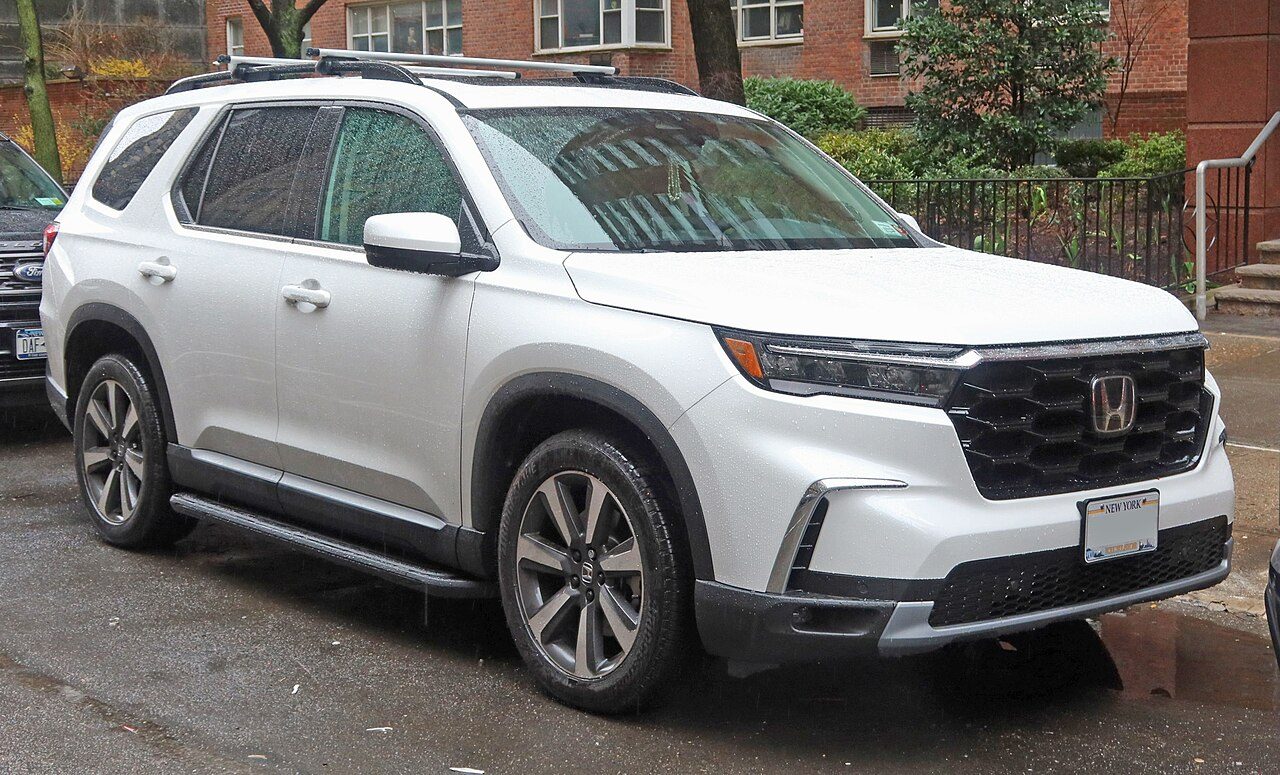
Honda Pilot 2016
O 2016 Honda Pilot tem um motor de 3.5 L. Ele usa 10.7 L/100 km combinados (12.4 cidade, 9.0 rodovia), segundo a EPA. NHTSA NCAP classifica em 5 de 5 estrelas. 8 campanhas de recall e 1,729 reclamações de proprietários estão registradas.
Especificações
| Cilindros | 6 |
|---|---|
| Câmbio | Automático · 9 marchas |
| Tração | AWD |
| Dimensões (C × L × A) | 4,950 × 2,030 × 1,770 mm |
| Distância entre eixos | 2,820 mm |
| Peso bruto | 1,896 kg |
| Carroceria | Veículo utilitário esportivo pequeno 2WD |
Dimensões e peso: mediana das 2 versões nas especificações oficiais do Canadá (NHTSA vPIC). Cada versão difere ligeiramente.
À venda em Uganda
Segurança
Resultados de testes de colisão por mercado. Podem variar conforme versão e equipamento.
Consumo de combustível
🇺🇸 Dado dos EUAMedido no ciclo dos EUA; o consumo real no seu país depende do combustível, do trânsito e da altitude.
Por versão
| Motor | Câmbio | Tração | Cidade | Estrada | Misto |
|---|---|---|---|---|---|
| 3.5 L 6-cilindro | Automático · 9 marchas | AWD | 12.4 L/100 km | 9.0 L/100 km | 10.7 L/100 km |
| 3.5 L 6-cilindro | Automático · 6 marchas | AWD | 13.1 L/100 km | 9.4 L/100 km | 11.2 L/100 km |
| 3.5 L 6-cilindro | Automático · 9 marchas | Dianteira (FWD) | 11.8 L/100 km | 8.7 L/100 km | 10.2 L/100 km |
| 3.5 L 6-cilindro | Automático · 6 marchas | Dianteira (FWD) | 12.4 L/100 km | 8.7 L/100 km | 10.7 L/100 km |
Dados da EPA para cada versão vendida nos EUA.
Chamadas de retorno
Em Uganda
As campanhas abaixo foram emitidas nos Estados Unidos ou no Canadá. A versão vendida em Uganda pode diferir: verifique o VIN do seu carro com o revendedor da marca.
Pode não se aplicar aos veículos vendidos no seu país. Verifique com seu VIN na fonte.
Consequência · Solução
Failure of rear suspension components, such as the rear control arm, can cause a loss of vehicle handling and control, increasing the risk of a crash or injury.
Dealers will inspect the rear subframe and install a rear subframe reinforcement kit and, as necessary, repair or replace the rear subframe components, free of charge. Interim letters notifying owners of the safety risk were mailed July 27, 2026. Additional letters will be sent once the final remedy is available, anticipated in the fall of 2026. Owners may contact Honda's customer service at 1-888-234-2138. Honda's numbers for this recall are AOU and AOT. Vehicle Identification Numbers (VINs) involved in this recall will become searchable on NHTSA.gov beginning June 10, 2026.
Consequência · Solução
Fuel pump failure can cause an engine stall while driving, increasing the risk of a crash.
Dealers will replace the fuel pump module, free of charge. Owner letters were mailed September 6, 2024. Owners may contact Honda customer service at 1-888-234-2138. Honda's numbers for this recall are KGC and KGD. This recall is an expansion of NHTSA recall numbers 21V-215 and 20V-314.
Consequência · Solução
A damaged engine may run improperly or stall while driving, increasing the risk of a fire, crash, or injury.
Dealers will inspect and repair, or replace the engine as necessary, free of charge. Owner letters were mailed March 28, 2024. 2016-2017 Acura MDX owner letters were mailed November 1, 2024. 2016-2020 Acura MDX owner letters are expected to be mailed in mid-December 2024. Honda began mailing owner notification letters as of March 18, 2024. 2015-2016 Acura owner letters are expected to be mailed mid-December 2024, 2018 Acura TLX owner letters are expected to be mailed the end of March/early April 2024, 2019 Acura TLX owner letters are expected to be mailed mid-May 2024, 2020 Acura TLX owner letters are expected to be mailed mid-June 2024, and 2016-2020 Acura MDX owner letters are expected to be mailed January 27, 2025. Owners may contact Honda customer service at 1-888-234-2138. Honda's numbers for these recalls are XG1 and GG0.
Consequência · Solução
A hood that opens while driving can obstruct the driver's view and increase the risk of a crash.
Dealers will either repair the hood latch striker, or replace the hood if necessary, free of charge. Owner notification letters were mailed January 18, 2022. Owners may contact Honda customer service at 1-888-234-2138. Honda's number for this recall is PBV.
Consequência · Solução
A fuel leak in the presence of an ignition source can increase the risk of a fire.
Honda will notify owners, and dealers will replace the fuel tank, free of charge. Owners may contact Honda customer service at 1-888-234-2138. Honda's number for this recall is KE8.
Consequência · Solução
A fuel leak in the presence of an ignition source may result in a fire.
Honda will notify owners, and dealers will replace the fuel tanks, free of charge. Owners may contact Honda/Acura customer service at 1-888-234-2138. The recall began on July 29, 2016. Honda's numbers for this recall are KA9 (Honda vehicles) and KB0 (Acura vehicles).
Consequência · Solução
If a safety system cannot immediately warn the driver when needed, the driver may be at increased risk of a crash.
Honda will notify owners, and dealers will update the instrument cluster software, free of charge. The recall began on December 11, 2015. Owners may contact Honda customer service at 1-888-234-2138. Honda's number for this recall is JV7.
Consequência · Solução
If the third row seatbelt is trapped, the occupants may not be restrained properly, increasing the risk of injury.
Honda will notify owners, and dealers will inspect and repair the rear third row seat belt, free of charge. The recall began on August 6, 2015. Owners may contact Honda customer service at 1-310-783-2000. Honda's number for this recall is JS7.
Pode não se aplicar aos veículos vendidos no seu país. Verifique com seu VIN na fonte.
Detalhes
Issue: On certain vehicles, the suspension mounting points on the rear subframe could rust. As a result, rear suspension components could fail. This could lead to poor handling and a loss of vehicle control. Safety Risk: A loss of control could create the risk of a crash. Corrective Actions: Honda will notify owners by mail and advise you to take your vehicle to a dealership to inspect and install a rear subframe reinforcement kit or replace the subframe, as necessary.
Detalhes
Issue: On certain vehicles equipped with a V6 engine, the connecting rod bearings could wear prematurely and become damaged. If this happens, the engine could make abnormal noises and a warning light may turn on. If you continue to drive the vehicle with these symptoms, the engine could fail. Safety Risk: An engine failure could cause a sudden loss of power and/or increase the risk of a vehicle fire. Both issues could increase the risk of a crash or injury. Corrective actions: Honda will notify owners by mail and advise you to take your vehicle to a dealership to inspect the engine. If damage is found, the dealer will replace the necessary parts.
Detalhes
Issue: On certain vehicles, the hood latch striker could separate from the hood. If this happens, the hood could open while driving. Note: A loose or vibrating hood may be a warning that the hood latch is failing. Safety Risk: A hood that opens suddenly while driving could block the driver's view and increase the risk of a crash. Corrective Actions: Honda will notify owners by mail and instruct you to take your vehicle to a dealer to inspect the hood latch striker. Depending on its condition, a striker support plate will be installed, or if necessary, the hood will be replaced.
Detalhes
On certain vehicles, the fuel tank may have received insufficient welds during manufacturing. Over time, the insufficient welds may separate and allow for fuel leakage. A fuel leak in the presence of an ignition source could result in a fire causing injury and/or property damage. Correction: Dealers will replace the fuel tank.
Detalhes
Certain vehicles fail to comply with the requirements of Canada Motor Vehicle Safety Standard 135 - Brake Systems and Canada Motor Vehicle Safety Standard 126 - Electronic Stability Control Systems. Due to a software error in the instrument cluster, Vehicle Stability Assist (VSA), ABS and BRAKE warning lamps may not illuminate under certain conditions, which fails to meet the requirements of the standard. Failure of these lights to illuminate could increase the risk of a crash causing injury and/or damage to property. Note: The warning light will illuminate with next key cycle. Correction: Dealers will update the instrument cluster software.
Problemas comuns
1729 relatos🇺🇸 Dado dos EUARelatado por donos à fonte abaixo. Não é um veredito sobre este carro: é o que as pessoas escreveram.
My 2016 Honda Pilot has suffered catastrophic engine failure due to an apparent connecting rod bearing failure, identical to the defect described in NHTSA Recall 23V-751. During driving on the interstate the engine began knocking, made a loud banging sound, abruptly seized while driving which caused a sudden loss of m…
The manufacturer’s defective fuel delivery system (faulty fuel injectors covered under Honda TSB #19-056) causes severe engine cylinder misfires, dropping the vehicle into an immediate, unpredictable, and sluggish 'limp mode' while driving at highway speeds. This sudden loss of power and acceleration creates a severe …
Vehicle experiences a severe 3-to-4 second extended engine crank before starting due to fuel pressure loss. Priming the low-pressure fuel pump manually bypasses the issue, indicating a check-valve bleed-down failure. It is continuously worsening over time. This is identical to the failure mode of the active low-pressu…
I was stopped at a traffic light just off a highway exit ramp, with my vehicle in drive. When the light changed and I attempted to accelerate, the vehicle would not move forward. I immediately shut off the engine. Because I was stopped in an active traffic lane near a highway ramp, I became concerned for my safety …
The auto idle malfunctioned; the vehicle did not restart when the break was released and/or moving steering wheel. It was in the middle of a busy intersection so that is definitely putting my safety as well as my daughter's and others safety at risk. It took at least a minute to restart the vehicle, by putting the gea…
I have a series of dashboard warning lights that have went off due to failure of this camera-based (LKAS) unit. They are labeled as: 1) Lane Keeping Assist Problem 2) Auto Matic Cruise Control Problem 3) Traction Control Problem 4) ABS - braking system failure. These issues, IMO, are enough to suggest a recall is…
I have been having issues with my 2016 Honda Pilot and I looked on Experian and it stated that there is a recall. There are two different recalls, the first one says Fuel Injector/W Software Update the date is 11/24/2020 and recall # W8V. Also recall for Start/Stop Switch that the recall date was 12/9/2020 and recall …
Hello, While driving, the engine developed a distinct, heavy metallic knocking sound coming from the bottom end. I took the vehicle to an independent repair shop for inspection, where the mechanic drained the oil and cut open the oil filter. The filter pleats contained significant metallic debris and bearing shavings…
Connecting rod spun a bearing/ rod knock Verified le customer's concern regarding an abnormal engine knockır oise. Conducted a diagnostic inspection and confirmed pronounced metallic knocking noise originating from the ower engine assembly. Used a mechanic's stethoscope tr isolate the noise to the crankshaft/connectin…
While driving our 2016 Honda Pilot on the highway approximately three weeks ago, we experienced a sudden, loud clunk from the engine, followed by catastrophic engine failure. The failure occurred unexpectedly while the vehicle was traveling at highway speed, creating a serious safety concern. Following the incident,…
The engine has developed a severe internal engine knocking/rattling noise while running. This symptom matches the defective crankshaft and connecting rod bearing failures detailed under NHTSA Campaign 23V751000, presenting a severe risk of sudden stalling and complete engine failure under load.
I am writing to report a severe internal engine defect on my 2016 Honda Pilot that poses a sudden stalling and safety hazard, identical to the failures covered under NHTSA Recall Campaign Number 23V-751. My vehicle is currently experiencing a distinct metallic rattling/knocking noise coming from the lower engine block…
2016 vs. outros anos Pilot
🇺🇸 Dado dos EUAReclamações de proprietários e campanhas de recall registradas na NHTSA para cada ano do modelo. Menos reclamações também podem significar menos carros vendidos ou um carro mais novo.
Perguntas
- Qual motor tem o 2016 Honda Pilot?
- O 2016 Honda Pilot tem um motor de 3.5 L.
- Qual é a economia de combustível do 2016 Honda Pilot?
- Ele usa 10.7 L/100 km combinados (12.4 cidade, 9.0 rodovia), segundo a EPA.
- O 2016 Honda Pilot é seguro?
- NHTSA NCAP classifica em 5 de 5 estrelas.
- O 2016 Honda Pilot tem campanhas de recall?
- 8 campanhas de recall estão registradas. A mais recente envolve Structure (2026-06-04).
- Quais são os problemas comuns do 2016 Honda Pilot?
- 1,729 proprietários apresentaram reclamações, com mais frequência sobre motor.
Outros anos
Outros modelos da Honda
Você possui um 2016 Pilot?
Publique-o gratuitamente e alcance compradores que já estão interessados neste carro exato.
- Gratuito, sem comissão
- Cerca de três minutos
- Seu anúncio aparece nesta página