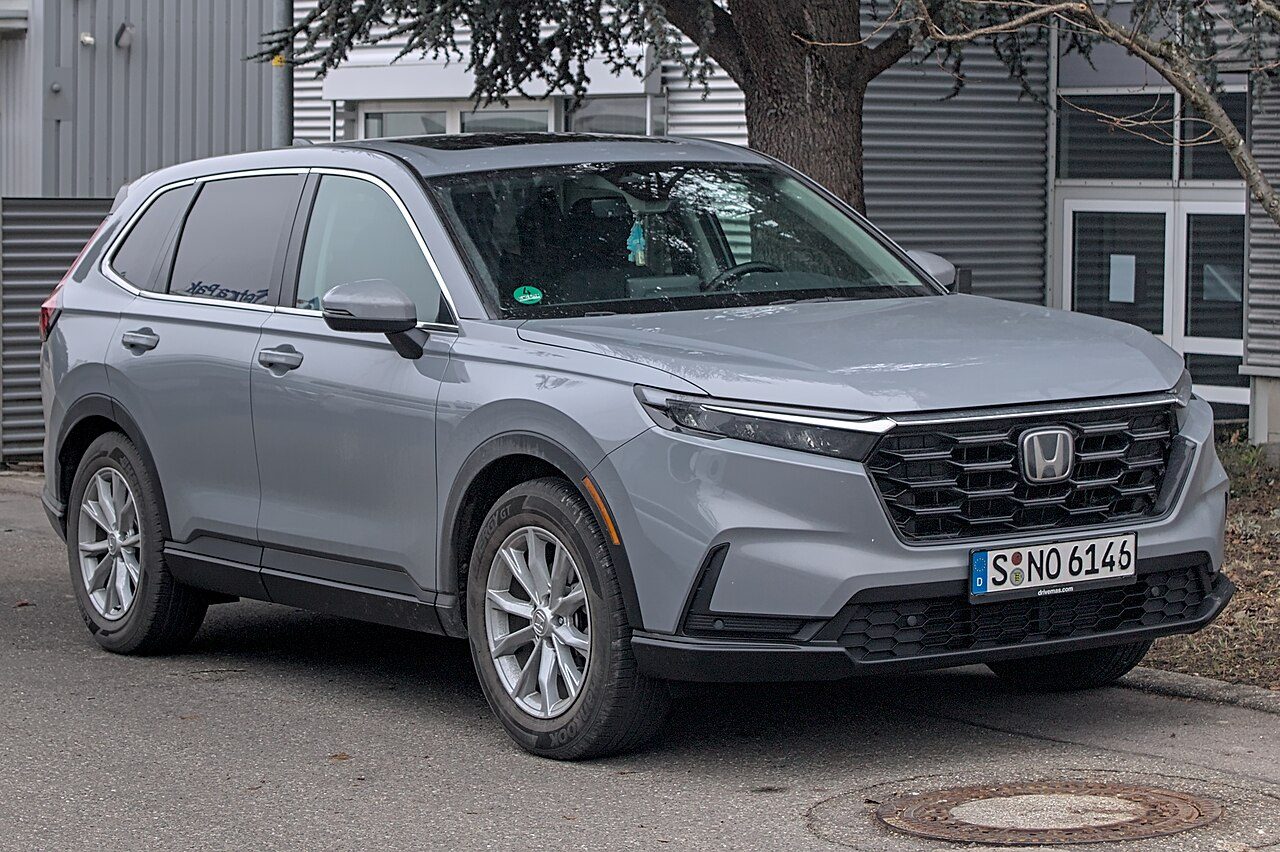
2010 Honda CR-V
The 2010 Honda CR-V has a 2.4 L engine. It gets 23 MPG combined (21 city, 27 highway), per the EPA. 15 recall campaigns and 483 owner complaints are on record.
Specs
| Cylinders | 4 |
|---|---|
| Transmission | Automatic · 5 speeds |
| Drivetrain | AWD |
| Dimensions (L × W × H) | 4,520 × 1,820 × 1,680 mm (178.0 × 71.7 × 66.1 in) |
| Wheelbase | 2,620 mm (103.1 in) |
| Curb weight | 1,600 kg (3,527 lb) |
| Body style | Sport Utility Vehicle - 2WD |
Dimensions and weight: median of the 2 versions in Canada's official specifications (NHTSA vPIC). Each version differs slightly.
For sale in United States
Safety
Crash-test results across markets. They can vary by version and equipment.
Fuel economy (MPG)
🇺🇸 Local dataBy version
| Engine | Transmission | Drivetrain | City | Highway | Combined |
|---|---|---|---|---|---|
| 2.4 L 4-cylinder | Automatic · 5 speeds | AWD | 21 MPG | 27 MPG | 23 MPG |
| 2.4 L 4-cylinder | Automatic · 5 speeds | Front-wheel (FWD) | 21 MPG | 28 MPG | 24 MPG |
EPA figures for each version sold in the U.S.
Recalls
Consequence · Remedy
A detached rear trailing arm can cause a loss of vehicle control, increasing the risk of a crash.
Dealers will inspect and install a support brace or repair the rear frame, as necessary, free of charge. Depending on the extent of any corrosion damage, Honda may offer to repurchase the vehicle. Owner notification letters were mailed May 22, 2023. Owners may contact Honda customer service at 1-888-234-2138. Honda's number for this recall is UE3.
Consequence · Remedy
An inflator explosion may result in sharp metal fragments striking the driver or other occupants resulting in serious injury or death.
Honda will notify owners, and dealers will replace the driver frontal air bag inflator, free of charge. The recall began August 12, 2019. Owners may contact Honda customer service at 1-888-234-2138. Honda's numbers for this recall are S5B and W59.
Consequence · Remedy
An inflator explosion may result in sharp metal fragments striking the driver or other occupants resulting in serious injury or death.
Honda will notify owners, and dealers will replace the passenger frontal air bag inflator, free of charge. The recall began August 12, 2019. Owners may contact Honda customer service at 1-888-234-2138. Honda's numbers for this recall are F5F and Q5E.
Consequence · Remedy
An incorrectly installed air bag inflator may not properly deploy the passenger frontal air bag in the event of a crash, increasing the risk of injury.
Honda will notify owners, and dealers will inspect the inflator installation and, if necessary, replace the passenger frontal air bag module assembly, free of charge. The recall began July 5, 2019. Owners may contact Honda customer service at 1-888-234-2138. Honda's numbers for this recall are M4O, P4R, T4Q, and W4P.
Consequence · Remedy
An explosion of an inflator within the driver frontal air bag module may result in sharp metal fragments striking the driver, front seat passenger or other occupants resulting in serious injury or death.
Honda will notify owners, and dealers will replace the driver's air bag inflator with an alternate inflator, free of charge. The recall began April 10, 2019. Honda owners may contact customer service at 1-888-234-2138. Honda's number for this recall is O41. Acura owners may contact customer service at 1-888-234-2138. Acura's number for this recall is U40.
Consequence · Remedy
An inflator explosion may result in sharp metal fragments striking the driver or other occupants resulting in serious injury or death.
Honda will notify owners, and dealers will replace the passenger frontal air bag inflator, free of charge. The recall began November 6, 2018. Owners may contact Honda customer service at 1-888-234-2138. Honda's numbers for this recall are M2J and S2K.
Consequence · Remedy
An incorrectly installed air bag may deploy improperly in the event of a crash, increasing the risk of injury.
Honda will notify owners, and dealers will inspect and, if necessary, replace the passenger frontal air bag module assembly, free of charge. The recall began June 22, 2018. Owners may contact Honda customer service at 1-888-234-2138. Honda's numbers for this recall are K1P, and M1O.
Consequence · Remedy
An inflator explosion may result in sharp metal fragments striking the driver or other occupants resulting in serious injury or death.
Honda will notify owners, and dealers will replace the passenger frontal air bag inflator, free of charge. The recall began February 16, 2018. Owners may contact Honda customer service at 1-888-234-2138. Honda's numbers for this recall are B0K and L0J.
Consequence · Remedy
In the event of a crash, an incorrectly installed passenger frontal air bag inflator may deploy the air bag improperly, increasing the risk of injury.
Honda will notify owners, and dealers will replace the passenger frontal air bag module assembly, free of charge. The recall began October 30, 2017. Owners may contact Honda customer service at 1-888-234-2138. Honda's numbers for this recall are O07, Y0A, N06, G05, M04, Y01, and O09.
Consequence · Remedy
If an inflator with an incorrect wire harness is installed, the air bag may not deploy as intended, increasing the risk of injury in the event of a crash.
Honda will notify owners, and dealers will inspect and, if necessary, replace the passenger frontal air bag inflator, free of charge. The recall began on August 3, 2017. Owners may contact Honda customer service at 1-888-234-2138. Honda's number for this recall is KF9.
Consequence · Remedy
An inflator rupture may result in metal fragments striking the vehicle occupants resulting in serious injury or death.
Honda will notify owners, and dealers will replace the front passenger side air bag inflator, free of charge. The manufacturer has mailed an interim notification, and will send a second notification when parts are available. Owners may contact Honda customer service at 1-888-234-2138. Honda's numbers for this recall are KE1 and KE2.
Consequence · Remedy
An inflator rupture may result in metal fragments striking the vehicle occupants resulting in serious injury or death.
Honda will notify owners, and dealers will replace the inflator, free of charge. The recall began March 2017. Owners may contact Honda customer service at 1-888-234-2138. Honda's numbers for this recall is KA4, KA5, KA6, and KA7.
Consequence · Remedy
In the event of a crash necessitating deployment of the driver's frontal air bag, the inflator could rupture with metal fragments striking the driver or other occupants resulting in serious injury or death.
Honda will notify owners, and dealers will replace the inflator, free of charge. The recall began March 2017. Owners may contact Honda customer service at 1-888-234-2138. Honda's numbers for this recall are JY0, JY1, and JY2.
Consequence · Remedy
THIS COULD RESULT IN A SHORT CIRCUIT CAUSING THE ENGINE TO STALL. ADDITIONALLY, BROKEN PIECES OF THE OUTER RACE OR BALL BEARING FROM THE SECONDARY SHAFT MAY BECOME LODGED IN THE PARKING PAWL RESULTING IN THE VEHICLE ROLLING AFTER THE DRIVER HAS PLACED THE GEAR SELECTOR IN THE PARK POSITION. ENGINE STALL AND UNEXPECTED VEHICLE MOVEMENT INCREASES THE RISK OF A CRASH OR PERSONAL INJURY TO PERSONS WITHIN THE PATH OF A ROLLING VEHICLE.
HONDA WILL NOTIFY OWNERS AND DEALERS WILL UPDATE THE AUTOMATIC TRANSMISSION CONTROL MODULE SOFTWARE FREE OF CHARGE. THE SAFETY RECALL BEGAN ON AUGUST 27, 2011. OWNERS MAY CONTACT HONDA AUTOMOBILE CUSTOMER SERVICE AT 1-800-999-1009.
Consequence · Remedy
AN ENGINE STALL WILL INCREASE THE RISK OF A CRASH.
DEALER WILL INSPECT AND REPLACE THE IGNITION WIRING HARNESS CONNECTOR FREE OF CHARGE. THE SAFETY RECALL IS EXPECTED TO BEGIN ON OR BEFORE JANUARY 24, 2011. OWNERS MAY CONTACT HONDA AT 1-800-999-1009.
It may not apply to vehicles sold in your country. Check with your VIN at the source.
Details
Issue: On certain vehicles, the rear frame could rust. In extreme cases, this could result in a rear trailing arm separating from the vehicle. Note: This recall replaces recall HN70 (Transport Canada Recall No. 2019-025). Vehicles that were inspected or repaired under that recall also require this second inspection and repair. Safety Risk: A rear trailing arm that separates could cause a loss of control and increase the risk of a crash. Corrective Actions: Honda will notify owners by mail and instruct you to take your vehicle to a dealership for an inspection of the rear frame stiffeners. If the vehicle passes the inspection, the dealer will install a brace. For a vehicle that does not pass the inspection, Honda will repurchase the vehicle. In the event the repurchase is declined by an owner, a secondary inspection and body shop repair method may be possible.
Details
Issue: This recall is for aftermarket replacement rear window glass produced by Vitro Automotriz. Certain rear window glass may not have been properly tempered. If the window breaks, the glass may separate into large pieces instead of very small ones. Note: This is a voluntary recall that is not being conducted under the requirements of the Motor Vehicle Safety Act. Safety Risk: Glass that breaks in to large pieces could create a risk of injury. Corrective Actions: The company will notify consumers by mail and instruct them to inspect the designation code marked on the rear window glass. Products affected by this recall have the designation “DOT 287” along with the lettering “VMR” (Replacement Market) and a date code that is before July 2019. This information is printed on the bottom corner of the glass. Consumers should contact Vitro's customer service at 1-412-995-6457 or argbacklites@vitro.com to arrange for replacement of the glass.
Details
This recall was replaced by Transport Canada Recall No. 2023-187. Issue: On certain vehicles, the rear frame could rust. In extreme cases, this could result in a rear trailing arm separating from the vehicle. This recall applies to vehicles originally sold or currently registered in areas of heavy road salt usage (Ontario, Quebec, New Brunswick, Nova Scotia, Prince Edward Island, and Newfoundland & Labrador). Safety Risk: A rear trailing arm that separates could cause a loss of control and increase the risk of a crash. Corrective Actions: The company will notify owners by mail. Owners will be instructed to take their vehicle to a dealer for an inspection of the rear frame stiffeners. If the vehicle passes the inspection, dealers will apply corrosion protection. For a vehicle that does not pass the inspection, Honda will repurchase the vehicle. In the event the repurchase is declined by an owner, a secondary inspection and body shop repair method may be possible.
Details
On certain vehicles, long-term exposure to high absolute humidity and temperature, combined with high temperature cycling, could eventually degrade the propellant contained in the passenger frontal airbag. This could cause the airbag to deploy with more force than normal. As a result, if the vehicle were involved in a collision that warrants airbag deployment, fragments could be propelled toward vehicle occupants, and the airbag assembly could be damaged, preventing proper function. These issues could increase the risk of injury. Correction: Dealers will replace the passenger frontal airbag inflator.
Details
On certain vehicles, the driver frontal airbag inflator could produce excessive internal pressure during airbag deployment. Increased pressure may cause the inflator to rupture, which could allow fragments to be propelled toward vehicle occupants, increasing the risk of injury. This could also damage the airbag module, which could prevent proper deployment. Failure of the airbag to fully deploy during a crash (where deployment is warranted) could increase the risk of personal injury to the seat occupant. Correction: Dealers will inspect/replace the driver's frontal airbag inflator. Note: Honda Canada has created a special Airbag Inflator Hotline for immediate assistance. For more information, please contact: For Honda Owners: 1-877-445-7754 For Acura Owners: 1-877-445-9844
Details
On certain vehicles, the secondary shaft bearing in the automatic transmission may fail. This could cause abnormal noise, the malfunction indicator lamp to turn ON, and allow contact between the transmission idle gear and an electronic sensor housing within the transmission, resulting in a short circuit that causes the engine to stall. Engine stalling would result in lost vehicle propulsion which, in conjunction with traffic and road conditions, and the driver's reactions, could increase the risk of a crash. Additionally, broken pieces may become lodged in the parking pawl resulting in the vehicle rolling after the driver has placed the gear selector in the PARK position. These issues could result in property damage and/or personal injury. Correction: Dealers will update the automatic transmission control module software.
Details
On certain vehicles, a connector pin inside the engine wiring harness may have damaged by a testing tool during vehicle assembly. This could cause a loss of power to the ignition coils, resulting in intermittent spark firing or engine stalling. Engine stalling would result in lost propulsion which, in conjunction with traffic and road conditions, and the driver's reactions, could increase the risk of a crash causing property damage and/or personal injury. Correction: Dealers will replace the damaged connector pin within the ignition wiring harness coupler. In addition, the central coupler (bus bar) that the ignition wiring harness attaches to will be replaced, in case it has incurred damage by the connector pin.
Translated automatically from the RDW's Dutch text. The original is at the source.
It may not apply to vehicles sold in your country. Check with your VIN at the source.
Consequence · Remedy
The inflation module of the passenger airbag may build excessive pressure. If the airbag is activated, the internal pressure could cause the inflation module to rupture. Metal fragments may be expelled and potentially injure occupants. Metal fragments may be expelled and potentially injure occupants.
The manufacturer recalls the affected vehicles. Measures are taken to resolve the defect.
Consequence · Remedy
The inflator module of the passenger airbag may build up excessive pressure. If the airbag is activated, the internal pressure may cause the inflator module to rupture. This can release metal fragments that may be projected, potentially injuring the occupants.
The manufacturer is recalling the affected vehicles. Measures will be taken to fix the defect. The vehicle owner is requested to contact a brand dealer or authorized repairer. They will install a different inflator mechanism.
Consequence · Remedy
The inflator module of the driver's airbag may build up excessive pressure. If the airbag is deployed, the internal pressure could cause the inflator module to rupture. Metal fragments may be shot out and potentially injure occupants.
The manufacturer is recalling the affected vehicles. Measures are being taken to fix the defect. The vehicle owner is requested to contact the brand dealer or authorized repairer. They will install a new inflator mechanism.
On the road
Cars of this model first registered in 2010, from official registers. Each figure belongs to its country.
🇳🇱 Vehicle register, Netherlands
421 still registered
0% with an open recall
Average list price when new: 41,898 € (Dutch taxes included) · RDW, CC0
Common problems
483 reports🇺🇸 Local dataReported by owners to the source below. It is not a verdict on this car: it is what people wrote.
The vehicle has confirmed severe structural rust/rot on the rear axle where the trailing arm mounts according to an independent service center, mirroring NHTSA Recall 23V228 but Tennessee dealerships refuse to look into the recall, although the car was previously registered and owned in New Jersey and New York accordi…
On XXX brought my 2010 Honda CR-V to Honda Westborough in [XXX] to have driver's side rear tire for leaking air and the TPMS light had come on briefly in the past but it was not on permanently when I brought the car in for service. The dashboard had no light on. They informed me that the tire was "leaking from punctur…
The contact owns a 2010 Honda CR-V. The contact stated that there was rust on the rear of the vehicle. The vehicle was towed to the dealer, where it was diagnosed that the rear frame and trailing arm were severely corroded. The contact was informed that the frame could not be repaired or replaced. The contact associat…
The contact owns a 2010 Honda CR-V. The contact stated that while driving at an undisclosed speed, the brake pedal was depressed; however, the vehicle failed to stop as intended. The engine was idling high, and the vehicle independently accelerated onto the curb. The contact stated that the brake pedal was depressed t…
The contact owns a 2010 Honda CR-V. The contact stated while the contact's mother was driving at an undisclosed speed, the vehicle was erractically shaking. The vehicle was driven to the contact's mother's residence. The contact's mother contacted an independent mechanic. The vehicle was diagnosed with a corroded trai…
My 2010 Honda CR-V is subject to a rear subframe safety recall. The issue was initially addressed by a dealership approximately 1.5 years ago, which stated the vehicle was safe to drive. I disagreed. At Honda’s direction, I took the vehicle to another dealership, which confirmed the defect and determined the vehicle…
Air bag light on
Cruise Control Significant safety. 2/13/2026. The first time I experienced my car made sudden high-speed acceleration, brain starts scrambling, what's going on? Ok cruise controls on, turned it off, tapped brake. Now with Cruise Control Off, I had to keep in contact with the accelerator to manually maintain speed. I h…
Got this vehicle about a year and a half ago at full price from local dealership. It looks like it has been pieced together with many other hondas. The check engine light has been on ever since. The car keeps yet no camera. Just tried to get inspected. So far charged 2500 but was given a pass on inspection only for th…
Odometer Fraud. The contact purchased a 2010 Honda CR-V. The contact stated that it was discovered that there was a mileage discrepancy after the purchase. The vehicle was a private sale. At the time of purchase, the vehicle mileage was 157,000 and at the time of registration, it was discovered that the mileage was 19…
Unknpenthenlogrh its on
Steering rack and pinion of 2010 Honda CR-V need to be replaced due to leaking of fluid.
2010 vs. other CR-V years
🇺🇸 Local dataOwner complaints and recall campaigns on record at NHTSA for each model year. Fewer complaints can also mean fewer cars sold or a newer car.
Questions
- What engine does the 2010 Honda CR-V have?
- The 2010 Honda CR-V has a 2.4 L engine.
- What is the fuel economy of the 2010 Honda CR-V?
- It gets 23 MPG combined (21 city, 27 highway), per the EPA.
- Does the 2010 Honda CR-V have recalls?
- 15 recall campaigns are on record. The latest concerns Structure (2023-03-30).
- What are the common problems of the 2010 Honda CR-V?
- 483 owners have filed complaints, most often about air bags.
Other years
Other models by Honda
Do you own a 2010 CR-V?
Post it for free and reach buyers who are already looking at this exact car.
- Free, with no commission
- About three minutes
- Your listing shows up on this page