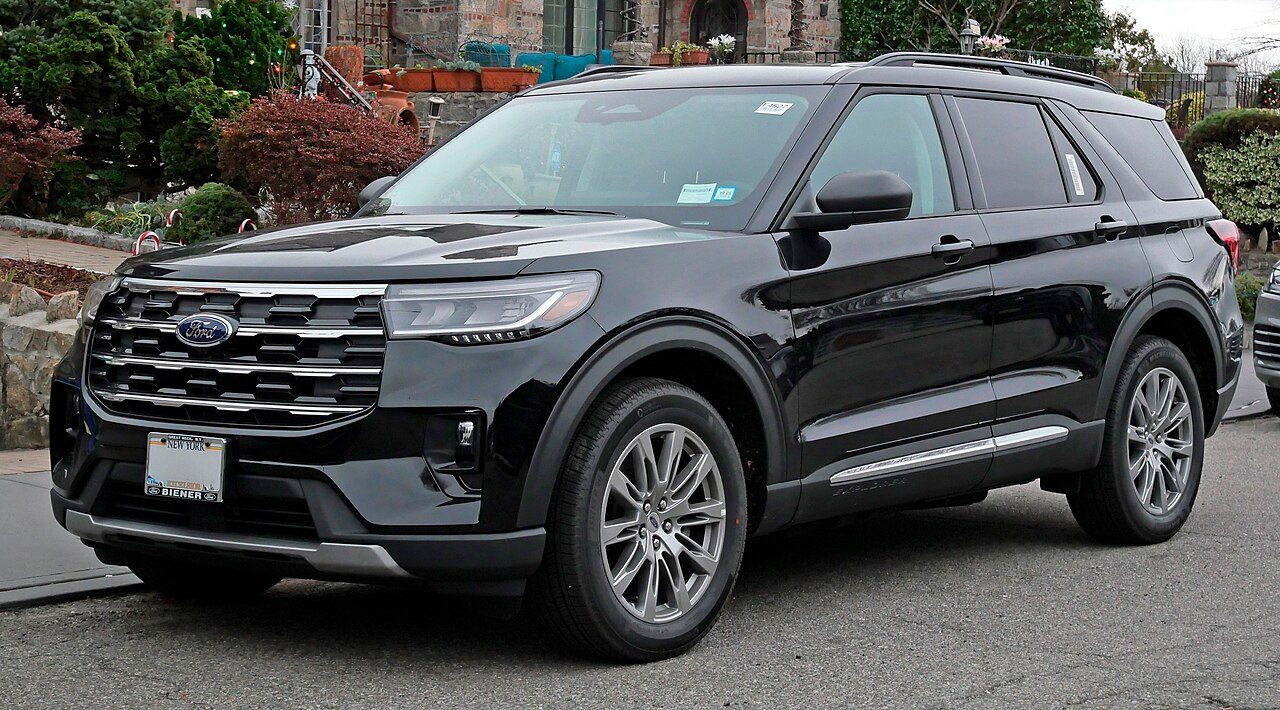
2017 Ford Explorer
The 2017 Ford Explorer came with 4 engines: 2.3 L 4-cylinder turbo, 3.5 L 6-cylinder, 3.5 L 6-cylinder, 3.5 L 6-cylinder turbo. It gets 18 to 22 MPG combined depending on the engine, per the EPA. NHTSA NCAP rates it 5 out of 5 stars. 14 recall campaigns and 1,715 owner complaints are on record.
Specs
| Cylinders | 4 |
|---|---|
| Transmission | Automatic · 6 speeds |
| Drivetrain | AWD |
| Dimensions (L × W × H) | 5,040 × 2,000 × 1,770 mm (198.4 × 78.7 × 69.7 in) |
| Wheelbase | 2,870 mm (113.0 in) |
| Curb weight | 2,106 kg (4,643 lb) |
| Body style | Standard Sport Utility Vehicle 2WD |
Dimensions and weight: median of the 2 versions in Canada's official specifications (NHTSA vPIC). Each version differs slightly.
For sale in United States
Safety
Crash-test results across markets. They can vary by version and equipment.
Fuel economy (MPG)
🇺🇸 Local dataBy version
| Engine | Transmission | Drivetrain | City | Highway | Combined |
|---|---|---|---|---|---|
| 2.3 L 4-cylinder turbo | Automatic · 6 speeds | AWD | 18 MPG | 25 MPG | 21 MPG |
| 2.3 L 4-cylinder turbo | Automatic · 6 speeds | Front-wheel (FWD) | 19 MPG | 27 MPG | 22 MPG |
| 3.5 L 6-cylinder | Automatic · 6 speeds | AWD | 16 MPG | 23 MPG | 19 MPG |
| 3.5 L 6-cylinder | Automatic · 6 speeds | Front-wheel (FWD) | 17 MPG | 24 MPG | 20 MPG |
| 3.5 L 6-cylinder | Automatic · 6 speeds | AWD | 16 MPG | 23 MPG | 19 MPG |
| 3.5 L 6-cylinder turbo | Automatic · 6 speeds | AWD | 16 MPG | 22 MPG | 18 MPG |
| 3.5 L 6-cylinder | Automatic · 6 speeds | Front-wheel (FWD) | 17 MPG | 24 MPG | 20 MPG |
EPA figures for each version sold in the U.S.
Recalls
Consequence · Remedy
A detached roof rail cover can create a road hazard, increasing the risk of a crash.
Dealers will inspect the roof rail covers and as necessary, repair or replace the push-pins, rail clips, or roof rail covers, free of charge. Interim letters, notifying owners of the safety risk, were mailed August 28, 2026. Additional letters will be sent once the remedy is available, anticipated in January 2027. Owners may contact Ford customer service at 1-866-436-7332. Ford's number for this recall is 26S54. This recall expands previous NHTSA recall number 21V316. Vehicle Identification Numbers (VINs) involved in this recall became searchable on NHTSA.gov on July 16, 2026.
Consequence · Remedy
A rear toe link fracture can result in a loss of steering control, increasing the risk of a crash.
Dealers will replace the toe links, free of charge. Owner notification letters were mailed on March 16, 2026. Owners may contact Ford Customer Service at 1-866-436-7332. Ford's number for this recall is 26S08. This recall is an expansion of previous NHTSA recall number 21V537. Vehicle Identification Numbers (VINs) involved in this recall will be searchable on NHTSA.gov beginning February 25, 2026.
Consequence · Remedy
An electrical short circuit can increase the risk of a fire.
Owners are advised not to plug in their block heater until the vehicle is remedied. Dealers will replace the block heater, free of charge. Owners will also have a alternative option to replace engine block heater element with a threaded blanking plug, and remove the block heater electrical cord. Interim letters, notifying owners of the safety risk, were mailed December 3, 2025. Additional letters will be sent once the final remedy is available, anticipated September 2026. Owners may contact Ford customer service at 1-866-436-7332. Ford's number for this recall is 25SA4. Vehicle Identification Numbers (VINs) involved in this recall became searchable on NHTSA.gov on October 15, 2025.
Consequence · Remedy
Door trim that detaches while driving can create a road hazard, increasing the risk of a crash.
Dealers will repair the B-pillar trim, free of charge. Interim letters, notifying owners of the safety risk, were mailed June 5, 2025. A second notice will be sent once the final remedy is available, anticipated November 2026. Owners may contact Ford customer service at 1-866-436-7332. Ford's number for this recall is 25S53.
Consequence · Remedy
A detached trim piece can fall off the vehicle, becoming a road hazard and increasing the risk of a crash.
Dealers will inspect and replace the A-pillar trim as necessary, free of charge. This will be a phased campaign, with the remedy becoming available in different phases based on model years. Owner notification letters were mailed between July 18, 2024 and December 16, 2025. Owners may contact Ford customer service at 1-866-436-7332. Ford's number for this recall is 24S02.
Consequence · Remedy
A rear toe-link fracture can result in a loss of steering control, increasing the risk of a crash.
Dealers will inspect and replace as necessary, the cross-axis ball joint (CABJ) knuckle, and replace the rear suspension toe links, free of charge. This recall is an expansion of previous NHTSA recall numbers 16V-245, 19V-435, and 20V-675. Certain vehicles previously repaired will need to return for the new remedy. An interim notification letter notifying owners of the safety risk were mailed on September 10, 2021. Owner notification letters were mailed on March 16, 2022. Owners may contact Ford's customer service at 1-866-436-7332. Ford's number for this recall is 21S32.
Consequence · Remedy
A detached roof rail cover can create a road hazard, increasing the risk of a crash.
Dealers will install push-pins and replace any damaged rail clips and roof rail covers, as necessary, free of charge. The interim owner notification letter was mailed on June 22, 2021. Owner notification letters (remedy available) were mailed on October 1, 2021. Owners may contact Ford customer service at 1-866-436-7332. Ford's number for this recall is 21S22.
Consequence · Remedy
A rear toe link fracture can result in a loss of steering control, increasing the risk of a crash.
Ford will notify owners, and dealers will inspect the cross-axis ball joint (CABJ) knuckle attached to the rear suspension toe link and replace it as necessary, free of charge. The recall began November 27, 2020. Owners may contact Ford customer service at 1-866-436-7332. Ford's number for this recall is 20S62.
Consequence · Remedy
Occupants my contact the sharp edges when reaching between the power front seat and center console, increasing their risk of injury.
Ford will notify owners, and dealers will install protective tape on the exposed inside edge and tab of the power seat frames, free of charge. The recall began November 8, 2019. Owners may contact Ford customer service at 1-866-436-7332. Ford's number for this recall is 19S29.
Consequence · Remedy
A fractured rear toe link will cause a sudden change in vehicle handling and increase the risk of a crash.
Ford will notify owners, and dealers will replace the rear suspension toe links, and inspect both rear toe link ball joints, replacing the rear wheel knuckle(s), if necessary, free of charge. The recall began June 26, 2019. Owners may contact Ford customer service at 1-866-436-7332. Ford's number for this recall is 19S17.
Consequence · Remedy
A loss of the wheel or wheel end can increase the risk of a crash.
Ford will notify the distributors of the hubs specifying that they are to only be used on drive axles. It is believed that none of the hubs were purchased from Ford dealers for the incorrect application. Owners may contact Ford customer service at 1-866-436-7332.
Consequence · Remedy
If the heat shield detaches, the steering gear may overheat, increasing the steering effort required by the driver, especially at lower speeds, and increasing the risk of a crash.
Ford will notify owners, and dealers to inspect and replace the heat shield fasteners as needed, free of charge. The recall began on September 13, 2017. Owners may contact Ford customer service at 1-866-436-7332. Ford's number for this recall is 17S23.
Consequence · Remedy
If the occupant is not adequately restrained in the event of a crash, they have an increased risk of injury.
Ford will notify owners, and dealers will inspect and, if necessary, replace the seat back frame, free of charge. The recall began on June 7, 2017. Owners may contact Ford at 1-866-436-7332. Ford's number for this recall is 17C08.
Consequence · Remedy
An oil leak, in the presence of an ignition source, increases the risk of a fire.
Ford will notify owners, and dealers will inspect, and if necessary, replace the turbocharger oil supply tubes, free of charge. The recall began on January 31, 2017. Owners may contact Ford customer service at 1-866-436-7332. Ford's number for this recall is 16S46.
It may not apply to vehicles sold in your country. Check with your VIN at the source.
Details
Issue: On certain vehicles, the repairs completed by a Ford dealer during customer satisfaction program 20N11 may not be effective. As a result, a second repair is required. On certain vehicles, the roof rail covers could become loose and detach while driving. Note: This recall is an expansion of Transport Canada recall no. 2021-267. Vehicles repaired under that recall don't require this repair. Safety Risk: A roof rail cover that detaches while driving could create a hazard for other road users and increase the risk of a crash. Corrective Actions: Ford will notify owners by mail and advise you to take your vehicle to a dealership to inspect and, if necessary, secure the roof rail covers.
Details
Issue: On certain vehicles, the outer ball joint for the rear suspension toe link(s) may seize. If this happens, the toe link(s) could break while driving. This could cause a sudden loss of vehicle stability. Safety Risk: A loss of vehicle stability could cause a loss of control and increase the risk of a crash. Corrective Actions: Ford will notify owners by mail and advise you to take your vehicle to a dealership to replace the rear suspension toe links.
Details
Issue: On certain vehicles, the engine block heater could leak coolant. If this happens, the block heater could short circuit when it's plugged in. Note: This recall replaces Transport Canada recall no. 2025-554. Vehicles that were repaired under that recall don't require this repair. Safety Risk: A short circuit can create the risk of a fire. Corrective Actions: To reduce the safety risk, Ford advises you not to use the engine block heater until the recall repairs have been completed. Ford will notify owners by mail and advise you to take your vehicle to a dealership to replace the block heater. Alternatively, owners can choose to have the dealership permanently disable the engine block heater.
Details
This recall was replaced by Transport Canada recall no. 2026-005. Issue: On certain vehicles, the engine block heater could leak coolant. If this happens, the block heater could short circuit when it's plugged in. Safety Risk: A short circuit can create the risk of a fire. Corrective Actions: To reduce the safety risk, Ford advises you not to use the engine block heater until the recall repairs have been completed. Ford will notify owners by mail and advise you to take your vehicle to a dealership to replace the block heater.
Details
Issue: On certain vehicles, the exterior B-pillar trims on the driver and front passenger doors may not be properly attached. As a result, the trim(s) could loosen and separate from the vehicle. Safety Risk: Trim that detaches from the vehicle could create a road hazard for others and increase the risk of a crash. Corrective Actions: Ford will notify owners by mail and advise you to take your vehicle to a dealership to inspect and, if necessary, secure the B-pillar trims.
Details
Issue: On certain vehicles, the exterior A-pillar trim on either side of the windshield may not be properly attached. As a result, the trim(s) could loosen and separate from the vehicle. Safety Risk: Trim that detaches from the vehicle could create a road hazard for others and increase the risk of a crash. Corrective Actions: Ford will notify owners by mail and advise you to take your vehicle to a dealership to inspect and, if necessary, replace the A-pillar trim.
Details
Issue: On certain vehicles, the outer ball joint for the rear suspension toe link may seize. If this happens, the toe link could break while driving. This could cause a sudden loss of vehicle stability. Note: This recall only affects vehicles equipped with a rear ball joint manufactured by ZF. Safety Risk: A loss of vehicle stability could cause a loss of control and increase the risk of a crash. Corrective Actions: Ford will notify owners by mail and instruct you to take your vehicle to a dealer to replace the rear suspension toe links and inspect the ball joints. If a ball joint requires replacement, the dealer will replace the rear suspension knuckle.
Details
Issue: On certain vehicles, the roof rail covers could detach. If this happens while driving, the roof rail cover could separate from the vehicle. Note: This recall only affects vehicles with painted roof rail covers. Safety Risk: A roof rail cover that detaches while driving could create a hazard for other drivers and nearby people, and could increase the risk of a crash. Corrective Actions: Ford will notify owners by mail and instruct you to take your vehicle to a dealer to secure the roof rail covers.
Details
Issue: On certain vehicles, the outer ball joint for the rear suspension toe link may seize. If this happens, the toe link could break while driving. This could cause a sudden loss of vehicle stability. Safety Risk: A loss of vehicle stability could cause a loss of control and increase the risk of a crash. Corrective Actions: Ford will notify owners by mail and instruct you to take your vehicle to a dealer to inspect the ball joints for the rear suspension toe links. If a ball joint requires replacement, the dealer will replace the rear suspension knuckle.
Details
Issue: On certain vehicles equipped with power front seats, the front seat frames may have sharp metal edges. Safety Risk: A person that reaches between the front seat and center console could be cut by the sharp edge. Corrective Actions: Ford will notify owners by mail and instruct them to take their vehicle to a Ford or Lincoln dealer to install protective tape on the exposed edges on the inboard side of the seat frames.
Details
Issue: On certain vehicles, the rear suspension toe link(s) could break. This could cause a sudden loss of vehicle stability. Note: This problem is more likely to occur on vehicles that are driven on rough roads. Safety Risk: A loss of vehicle stability could cause a loss of control and increase the risk of a crash. Corrective Actions: The company will notify owners by mail and instruct them to take their vehicle to a dealer to install improved rear suspension toe links.
Details
On certain vehicles, the steering gear heat shield fasteners may have an incorrect coating that could cause the heat shield to corrode and detach. This could expose the steering gear system to higher temperatures and could cause the steering gear to overheat, which could result in a reduction of steering assist until the gear cools. If the steering gear electrical connectors were to melt, it would result in a sudden loss of steering assist. A loss of power steering assist could unexpectedly increase steering effort, which would increase the risk of a crash causing injury and/or damage to property. Correction: Dealers will inspect the fasteners and replace as required. Note: In the event of a loss of power assist, the message "SERVICE POWER STEERING NOW" would be displayed in the instrument cluster.
Details
On certain vehicles operated in Alberta, Saskatchewan and Manitoba, soil properties unique to these areas could cause an accumulation of soil to occur at the attachment point of the rear suspension toe link. This could impede the toe link's travel, causing bending stresses and potential fracture. A fractured toe link would affect vehicle handling and could increase the risk of a crash causing injury and/or damage to property. Correction: Dealers will replace the toe links with revised parts.
Translated automatically from the RDW's Dutch text. The original is at the source.
It may not apply to vehicles sold in your country. Check with your VIN at the source.
Consequence · Remedy
The trim of the A-pillar on the outside may not be properly attached due to incorrect assembly or repair. If the trim of the A-pillar comes loose while driving, it can pose a danger to other road users, increasing the risk of a collision.
The vehicle owner is requested to make an appointment with a Ford authorized repairer or Ford authorized manufacturer. The trim will be properly attached.
Consequence · Remedy
The ball joint of the reaction rod may seize due to road salt. This can cause the outer part of the reaction rod of the rear suspension to crack, making the vehicle difficult to steer.
The vehicle owner is requested to make an appointment with a Ford certified repairer or Ford certified manufacturer.
Common problems
1715 reports🇺🇸 Local dataReported by owners to the source below. It is not a verdict on this car: it is what people wrote.
Received recall notice 6/2025 regarding the A pillar covers and scheduled for repair. Ford representative came out and placed black adhesive tape on the A pillars and windows but did not replace the covers. It is now 11/2026 and no word on when pillar covers will be replaced.
The contact owns a 2017 Ford Explorer. The contact stated that while entering the vehicle, the contact became aware that the driver’s side B-pillar door trim was detaching. The contact associated the failure with NHTSA Campaign Number: 25V347000 (Structure); however, the VIN was not included in the recall. The dealer…
About 3 years and 3 months after a Power Control Module reflash was done in March 2021 under the Customer Satisfaction Program (CSP) 20B27, vehicle was brought to Ford dealership on 06/07/2024 with mileage at 79,730 for multi point inspection due to vehicle runs rough and hard time accelerating. Diagnostic code was P0…
Vehicle losses power randomly during acceleration, may not stay in park without parking brake on. Shudders badly and shifts harshly decelerates without warning. Nearly has caused collision when merging onto roadways due to lack of control of acceleration, have had to slow onto shoulder multiple times.
The contact owns a 2017 Ford Explorer. The contact received notifications of NHTSA Campaign Numbers: 24V031000 (Structure) and 25V347000 (Structure) however, the parts to complete the recall repairs were not yet available. The local dealer was contacted. The contact stated that the manufacturer had exceeded a reasonab…
The contact owns a 2017 Ford Explorer. The contact stated that while the vehicle was parked, the passenger-side rear tire was low on air pressure. Upon inspecting the vehicle, the contact observed wires exposed on the inner tread of the tire. Additionally, the contact inspected the driver-side rear tire and observed e…
B-Pillar trim on drivers side detached/broke in half and flew off in traffic. Since then, electrical panel on the driver door messed with the locks. locks no longer work, back tailgate ajar warning is on (even though the tailgate is closed) unable to open to open the tailgate (stuck in lock)
Both turbochargers on my 2017 Ford Explorer Platinum with the 3.5L EcoBoost V6 have failed. The first turbocharger failed and was replaced in 2025. On August 10, 2026, at about 138,000 miles, the second turbocharger failed: the vehicle lost power and poured thick white smoke from the exhaust as engine oil burned off, …
This is a second complaint for the same vehicle. Complaint number 11770400, filed today, understated the failure history, and I am filing this one so the complete record is in the database. Vehicle: 2017 Ford Explorer Platinum, 3.5L EcoBoost V6, VIN [XXX]. The first turbocharger failure occurred in 2023, at under 11…
Sudden catastrophic engine failure due to coolant mixing. This resulted in a safety issue due to time and location of the event. From online consumer reports this event happens just after 100,000 miles to the 2017 Ford Explorer SUV's and is a KNOWN event that Ford has NOT disclosed. Regular maintenance can NOT pr…
Engine hesitated, kept hesitating/slowing down until 2017 Ford Explorer just stopped. Towed SUV to Koons Ford Service Center. Charged $200 for diagnostic assessment. Informed that oil/coolant mix due to water pump failure. Diagnose: replace Engine Long Block and Hardware and thermostat. Costing $11,195.04 fo…
1. Rubber is falling off the windshield and hood. This is a ford issue and they refuse to repair this. It appears to be heat related and the car was sold in an area with high summer temperatures. It is cracked and peeling at the bottom of the windshield causing rain and leaves to seep into the engine area. This coul…
2017 vs. other Explorer years
🇺🇸 Local dataOwner complaints and recall campaigns on record at NHTSA for each model year. Fewer complaints can also mean fewer cars sold or a newer car.
Questions
- What engine does the 2017 Ford Explorer have?
- The 2017 Ford Explorer came with 4 engines: 2.3 L 4-cylinder turbo, 3.5 L 6-cylinder, 3.5 L 6-cylinder, 3.5 L 6-cylinder turbo.
- What is the fuel economy of the 2017 Ford Explorer?
- It gets 18 to 22 MPG combined depending on the engine, per the EPA.
- Is the 2017 Ford Explorer safe?
- NHTSA NCAP rates it 5 out of 5 stars.
- Does the 2017 Ford Explorer have recalls?
- 14 recall campaigns are on record. The latest concerns Structure (2026-07-14).
- What are the common problems of the 2017 Ford Explorer?
- 1,715 owners have filed complaints, most often about structure.
Other years
Other models by Ford
Do you own a 2017 Explorer?
Post it for free and reach buyers who are already looking at this exact car.
- Free, with no commission
- About three minutes
- Your listing shows up on this page