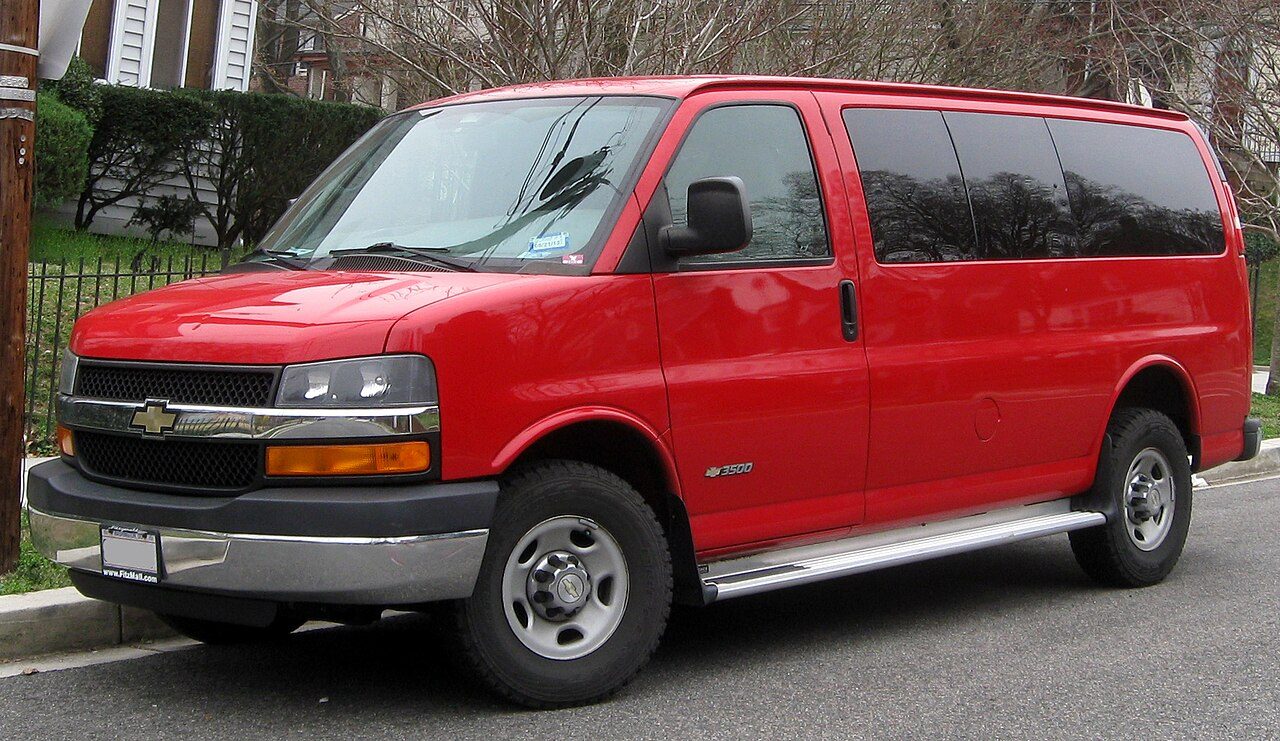
Chevrolet Express 2011
El 2011 Chevrolet Express vino con 4 motores: 4.3 L 6-cilindro, 4.8 L 8-cilindro, 5.3 L 8-cilindro, 6.0 L 8-cilindro. Usa 13.8 a 19.6 L/100 km combinado dependiendo del motor, según la EPA. 8 campañas de retiro están registradas.
Especificaciones
| Cilindros | 8 |
|---|---|
| Transmisión | Automática · 4 velocidades |
| Tracción | AWD |
| Estilo de carrocería | Furgonetas, Tipo Carga |
A la venta en Cuba
Consumo de combustible
🇺🇸 Dato de EE. UU.Medido en el ciclo de EE. UU.; el consumo real en tu país depende del combustible, el tráfico y la altura.
Por versión
| Motor | Transmisión | Tracción | Ciudad | Autopista | Mixto |
|---|---|---|---|---|---|
| 4.3 L 6-cilindro | Automática · 4 velocidades | Tracción trasera (RWD) | 15.7 L/100 km | 11.8 L/100 km | 13.8 L/100 km |
| 4.8 L 8-cilindro | Automática · 6 velocidades | Tracción trasera (RWD) | 21.4 L/100 km | 13.8 L/100 km | 18.1 L/100 km |
| 5.3 L 8-cilindro | Automática · 4 velocidades | AWD | 18.1 L/100 km | 13.8 L/100 km | 16.8 L/100 km |
| 5.3 L 8-cilindro | Automática · 4 velocidades | Tracción trasera (RWD) | 18.1 L/100 km | 13.1 L/100 km | 15.7 L/100 km |
| 5.3 L 8-cilindro | Automática · 4 velocidades | Tracción trasera (RWD) | 18.1 L/100 km | 13.8 L/100 km | 16.8 L/100 km |
| 6.0 L 8-cilindro | Automática · 6 velocidades | Tracción trasera (RWD) | 23.5 L/100 km | 14.7 L/100 km | 19.6 L/100 km |
| 6.0 L 8-cilindro | Automática · 6 velocidades | Tracción trasera (RWD) | 21.4 L/100 km | 14.7 L/100 km | 18.1 L/100 km |
| 6.0 L 8-cilindro | Automática · 6 velocidades | Tracción trasera (RWD) | 21.4 L/100 km | 14.7 L/100 km | 19.6 L/100 km |
Cifras de la EPA para cada versión vendida en EE. UU.
Llamados a revisión
En Cuba
Las campañas a continuación se emitieron en Estados Unidos o Canadá. La versión vendida en Cuba puede diferir: verifica el VIN de tu carro con el concesionario de la marca.
Traducción automática del texto oficial. El original está en la fuente.
Puede no aplicar a los vehículos vendidos en tu país. Verifica con tu VIN en la fuente.
Detalles
Issue: On certain vehicles, an unused wiring harness for a rear HVAC blower motor, located in the left B-pillar area, could become damaged if exposed to moisture or contaminants. If this happens, the wires could short circuit. Note: This recall only affects cutaway chassis incomplete vehicles. Safety Risk: A short circuit can create the risk of a fire. Corrective Actions: General Motors will notify owners by mail and instruct you to bring your vehicle to a dealership to seal the wiring for the rear HVAC blower motor at the left B-pillar.
Detalles
Issue: Certain vehicles may have incorrect body control module software. As a result, the immobilization system is not active during the learning procedure for a new "unlearned" blank replacement key could be used during a 30 minute reprogramming procedure to disable the immobilization system. During this time, the vehicle cannot be driven. Safety Risk: This small error does not affect vehicle safety. Corrective Actions: This is not a recall. General Motors has made changes to vehicle software to ensure that all unsold and new vehicles have the correct body control module software.
Detalles
On certain vehicles equipped with Kidde fire extinguishers with black plastic handles and valves, the fire extinguishers may become clogged or require excessive force to activate. Also, the nozzle may detach from the valve assembly with enough force that it could cause injury, and fail to discharge. In case of fire, failure of the extinguisher to function could result in injury and/or property damage. Correction: Owners will be provided with instructions on how to inspect the fire extinguisher to see if it is recalled. Replacement fire extinguishers will be supplied by Kidde directly. Note: For more information about recalled fire extinguishers, please visit <a href="https://inmarmarketaction.com/kidde/Kidde284CA/">www.kidde.com</a>
Detalles
Certain vehicles equipped with a hinged left side rear door may have a condition where inadequate clearance between the rear brake lines and the lower fuel filler hose clamp may result in abrasion to one or both rear brake lines. This condition could cause brake fluid loss which could result in decreased brake line pressure, increased brake pedal travel and increased stopping distance, increasing the risk of a crash causing injury and/or damage to property. This condition could cause various warning lights to illuminate in the instrument panel of the vehicle such the red “BRAKE” telltale symbol; illumination of the Stabilitrak telltale symbol; scrolling display of “Service Brake”, “Service Stabilitrak,” and “Service Traction Control” messages in the Driver Information Centre (DIC); and audible alerts/chimes. Correction: Dealers will inspect the brake lines. If the clearance is found to be below specification, the brake lines will be replaced with a new part design that provides adequate clearance.
Detalles
On certain compressed natural gas (CNG) fuelled vehicles, the CNG high pressure regulator may leak natural gas. Should a leak occur in the presence of an ignition source, a fire or explosion could result, increasing the risk of injury and/or damage to property. Correction: Dealers will replace the regulator. Note: If a leak is suspected, owners should not start nor drive their vehicles, and have the vehicle immediately towed, inspected and repaired.
Detalles
Certain vehicles may not comply with the requirements of Canada Motor Vehicle Safety Standard 201 - Occupant Protection. During a frontal impact below the airbag deployment threshold, if an unbelted front passenger's head were to impact the instrument panel where the passenger airbag is located, it could decelerate at a rate higher than what is allowable by the standard. This could increase the risk of injury. Correction: Dealers will install energy absorbing trim pieces on the passenger side of the instrument panel, and on 2012-2014 model year 1500 series vehicles, dealers will also replace the front passenger seat belt retractor.
Detalles
On certain vehicles, the right rear brake hose may contact the tire or wheel rim, which could cause chafe damage resulting in a brake fluid leak. This could increase stopping distances, possibly resulting in a crash causing property damage and/or personal injury. Correction: Dealers will secure the right rear brake hose to ensure sufficient clearance to the wheel/tire assembly. The brake hose will also be inspect for damage and, if necessary, replaced.
Detalles
On certain vehicles, the rear axle cross pin was improperly heat treated (during the manufacturing process) and could fracture and become displaced within the rear differential. As a result the driver may hear a banging noise emanating from the rear axle. Also, if the pin shifts out of position it could create an interference and cause the rear axle to lock. This could cause a loss of vehicle control, which could result in a crash causing property damage and/or personal injury. Correction: Dealers will inspect and, if necessary, replace the rear axle cross pin.
2011 vs. otros años de Express
🇺🇸 Dato de EE. UU.Quejas de propietarios y campañas de recall registradas en NHTSA para cada año modelo. Menos quejas también puede significar menos carros vendidos o un carro más nuevo.
Preguntas
- ¿Qué motor tiene el 2011 Chevrolet Express?
- El 2011 Chevrolet Express vino con 4 motores: 4.3 L 6-cilindro, 4.8 L 8-cilindro, 5.3 L 8-cilindro, 6.0 L 8-cilindro.
- ¿Cuál es la economía de combustible del 2011 Chevrolet Express?
- Usa 13.8 a 19.6 L/100 km combinado dependiendo del motor, según la EPA.
- ¿Tiene el 2011 Chevrolet Express campañas de retiro?
- 8 campañas de retiro están registradas. La más reciente concierne a Electrical (2023-04-06).
Otros años
Otros modelos de Chevrolet
¿Posees un 2011 Express?
Publícalo gratis y llega a compradores que ya están buscando este carro en particular.
- Gratis, sin comisión
- Aproximadamente tres minutos
- Tu anuncio aparece en esta página