
Toyota Sequoia 2003
The 2003 Toyota Sequoia has a 4.7 L engine. It gets 14 MPG combined (13 city, 16 highway), per the EPA. 7 recall campaigns and 40 owner complaints are on record.
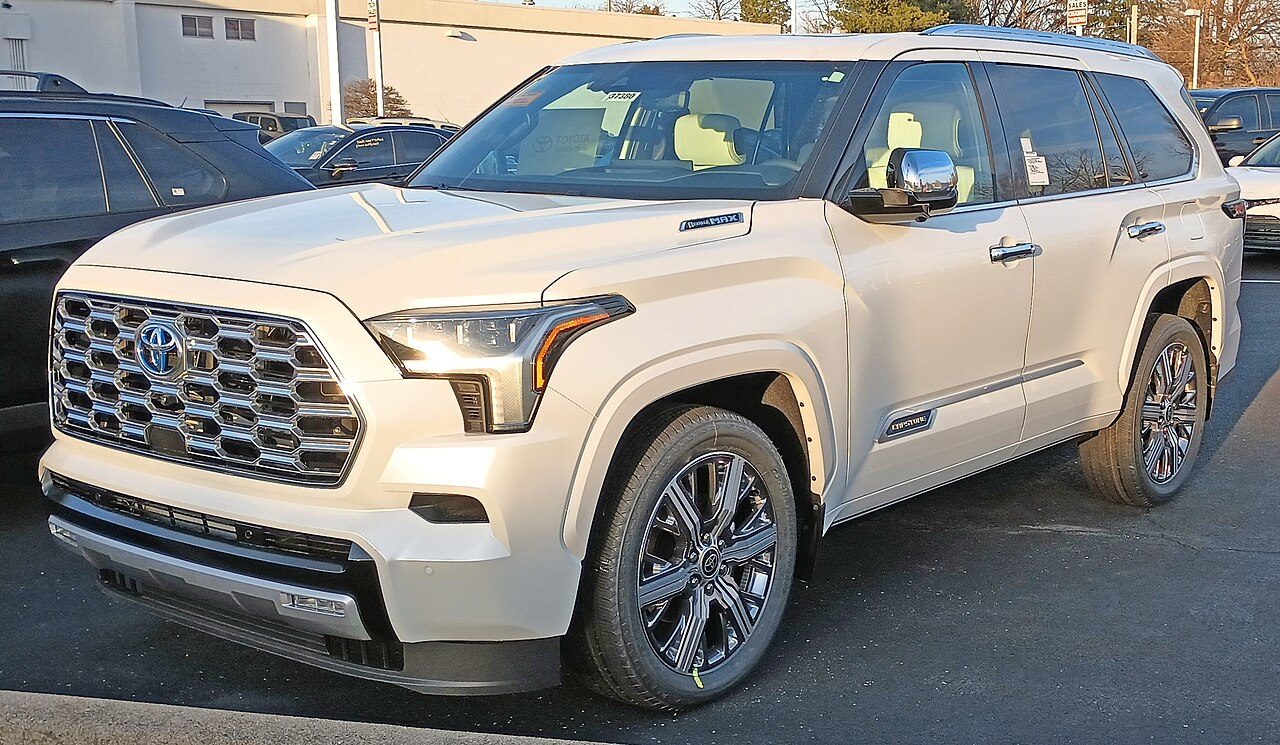
Specs
| Cylinders | 8 |
|---|---|
| Transmission | Automatic · 4 speeds |
| Drivetrain | AWD |
| Dimensions (L × W × H) | 5,180 × 1,910 × 1,870 mm (203.9 × 75.2 × 73.6 in) |
| Wheelbase | 3,000 mm (118.1 in) |
| Curb weight | 2,390 kg (5,269 lb) |
| Body style | Sport Utility Vehicle - 2WD |
Dimensions and weight: Canada's official specifications (NHTSA vPIC).
For sale in United States
Safety
Crash-test results across markets. They can vary by version and equipment.
Fuel economy (MPG)
🇺🇸 Local dataBy version
| Engine | Transmission | Drivetrain | City | Highway | Combined |
|---|---|---|---|---|---|
| 4.7 L 8-cylinder | Automatic · 4 speeds | AWD | 13 MPG | 16 MPG | 14 MPG |
| 4.7 L 8-cylinder | Automatic · 4 speeds | Rear-wheel (RWD) | 13 MPG | 17 MPG | 14 MPG |
EPA figures for each version sold in the U.S.
Recalls
Consequence · Remedy
An inflator explosion may result in sharp metal fragments striking the driver or other occupants resulting in serious injury or death.
Toyota will notify owners. Depending on the vehicle model, dealers will replace the front driver inflator, front passenger airbag inflator, the airbag assembly, or the front passenger airbag sub-assembly and inflator. The recall began November 20, 2019. Owners may contact Toyota customer service at 1-888-270-9371 or Lexus customer service at 1-800-255-3987. Toyota's numbers for this recall are J0A, J0B, and J0C. Lexus' numbers for this recall are JLI, JLJ, and JLK.
Consequence · Remedy
An inflator explosion may result in sharp metal fragments striking the driver or other occupants resulting in serious injury or death.
Toyota will notify the Toyota and Lexus owners. General Motors will notify the Pontiac Vibe owners. Depending on the vehicle model, dealers will replace the front passenger air bag inflator with an alternate inflator, or replace the air bag assembly that includes an alternate inflator, free of charge. The recall began January 23, 2019. Owners may contact Toyota customer service at 1-888-270-9371, Lexus customer service at 1-800-255-3987 or Pontiac customer service at 1-800-762-2737. Toyota's numbers for these recalls are J0A (Zone A Toyota), J0B (Zone B Toyota), J0C (Zone C Toyota), JLI (Zone A Lexus), JLJ (Zone B Lexus), and JLK (Zone C Lexus). Note: This recall includes vehicles that have had their air bag previously replaced under an earlier air bag campaign.
Consequence · Remedy
In the event of a crash necessitating deployment of the passenger's frontal air bag, the inflator could rupture with metal fragments striking the vehicle occupants potentially resulting in serious injury or death.
2003-2004 Corolla and Corolla Matrix vehicles that are recalled under both 15V-043 and 15V-286 are under a Do Not Drive advisory. Owners of these vehicles are advised not to drive their vehicles until the recall remedy has been completed. Toyota will notify their owners. Pontiac Vibe owners will be notified by GM. Dealers will replace the passenger side front air bag, free of charge. Owners may contact Toyota customer service at 1-800-331-4331. Toyota began the recall on July 13, 2015. Pontiac Vibe owners may contact GM at 1-800-762-2737. GM began the recall on June 29, 2015. NOTE: This recacll supersedes recall 14V-655 in its entirety. For vehicles located in the U.S. states not listed above, please see Toyota recall 15V-285 which covers all other U.S. states.
Consequence · Remedy
In the event of a crash necessitating deployment of the passenger's frontal air bag, the inflator could rupture with metal fragments striking the vehicle occupants potentially resulting in serious injury or death.
2003-2004 Corolla and Corolla Matrix vehicles that are recalled under both 15V-043 and 15V-285 are under a Do Not Drive advisory. Owners of these vehicles are advised not to drive their vehicles until the recall remedy has been completed. Toyota will notify their owners. Pontiac Vibe owners will be notified by GM. Dealers will replace the front passenger air bag. The recall began on July 13, 2015. Toyota owners may contact Toyota customer service at 1-800-331-4331. Pontiac owners may call 1-800-762-2737. NOTE: This recall supersedes recall 14V-312 in its entirety.
Consequence · Remedy
SHOULD THIS OCCUR, THE VEHICLE MAY NOT ACCELERATE AS QUICKLY AS THE DRIVER EXPECTS, INCREASING THE RISK OF A CRASH.
TOYOTA WILL NOTIFY OWNERS AND DEALERS WILL REFLASH THE ECU. IF THE REFLASH CANNOT BE COMPLETED ON A PARTICULAR VEHICLE, THE ECU WILL BE REPLACED WITH A NEW ONE. THIS SERVICE WILL BE PERFORMED FREE OF CHARGE. THE SAFETY RECALL BEGAN ON JUNE 11, 2010. OWNERS MAY CONTACT TOYOTA AT 1-800-331-4331.
Consequence · Remedy
WITHOUT THE AMBER REFLECTORS, THE VEHICLE WILL BE POORLY ILLUMINATED, POSSIBLY RESULTING IN A VEHICLE CRASH WITHOUT WARNING.
CK MOTORSPORT WILL NOTIFY OWNERS AND REPLACE THE NONCOMPLIANT LAMPS FREE OF CHARGE. THE RECALL BEGAN ON JULY 1, 2006. OWNERS MAY CONTACT CK MOTORSPORT AT 1-909-610-7211.
Consequence · Remedy
THE LOWER BALL JOINT MAY SEPARATE FROM THE KNUCKLE CAUSING LOSS OF STEERING CONTROL AND A CRASH COULD OCCUR.
DEALERS WILL REPLACE THE FRONT SUSPENSION LOWER BALL JOINTS FREE OF CHARGE. THE RECALL BEGAN ON JULY 5, 2005. OWNERS MAY CONTACT TOYOTA AT 1-800-331-4331.
It may not apply to vehicles sold in your country. Check with your VIN at the source.
Details
Issue: On certain vehicles, long-term exposure to high absolute humidity and temperature, combined with high temperature cycling, may eventually degrade the propellant contained in the passenger-front airbag. This could cause the airbag to deploy with more force than normal. If the airbag inflator ruptures, fragments could be propelled toward vehicle occupants or cause damage to the airbag assembly, preventing its proper function. Safety Risk: If the vehicle is involved in a crash requiring an airbag deployment, the airbag inflator could rupture and create a risk of injury. Corrective Action: Owners will be notified by mail and instructed to take their vehicle to a dealer to have the passenger-front airbag inflator or airbag module replaced. Note: The Canadian climate results in the propellant degrading slowly. This recall is being conducted as a precaution to address future risk. It is expected that all airbag inflators will be replaced before their function would be affected. Additional Note: Vehicles may have had the original front passenger airbag inflator replaced as a "like-for-like" replacement under recall 2016-103 (Toyota Recall #'s SRC 241 & SRC 242) as a temporary remedy while evaluating a permanent remedy. These vehicles will receive the permanent remedy passenger airbag assembly under this recall.
Details
On certain vehicles, long-term exposure to high absolute humidity and temperature, combined with high temperature cycling, could eventually degrade the propellant contained in the passenger frontal airbag. This could cause the airbag to deploy with more force than normal. As a result, if the vehicle were involved in a collision that warrants airbag deployment, fragments could be propelled toward vehicle occupants, and the airbag assembly could be damaged, preventing proper function. These issues could increase the risk of injury. Correction: Dealers will replace the passenger frontal airbag inflator or airbag assembly. <br><br> Note: Canadian climate results in the propellant degrading slowly. The recall is being conducted as a precaution to address future risk, and is expected to replace airbag inflators before their function would be affected. Vehicles may have had the original front passenger airbag inflator replaced as a “like-for-like” replacement under recall 2013-133 (Toyota Recall #'s SSC 193/241 & SSC 194/242) as a temporary remedy while evaluating a permanent remedy. These vehicles will receive the permanent remedy passenger airbag assembly under this recall.
Details
On certain vehicles, the passenger (frontal) airbag inflator could produce excessive internal pressure during airbag deployment. Increased pressure may cause the inflator to rupture, which could allow fragments to be propelled toward vehicle occupants, increasing the risk of injury. This could also damage the airbag module, which could prevent proper deployment. Failure of the passenger airbag to fully deploy during a crash (where deployment is warranted) could increase the risk of personal injury to the seat occupant. Note: This recall supersedes recalls 2013113, 2014224, 2015197 and 2015269. Correction: All vehicles having not received a replacement inflator as part of the previous recall will now have a replacement inflator installed by dealers. For Matrix model vehicles, dealers may replace the front passenger airbag assembly with one equipped with a newly specified inflator.
Details
On certain vehicles, the passenger (frontal) airbag inflator could produce excessive internal pressure during airbag deployment. Increased pressure may cause the inflator to rupture, which could allow fragments to be propelled toward vehicle occupants, increasing the risk of injury. This could also damage the airbag module, which could prevent proper deployment. Failure of the passenger airbag to fully deploy during a crash (where deployment is warranted) could increase the risk of personal injury to the seat occupant. Note: This recall is superseded by recall 2016103. Please see recall 2016103 for more information. <a href="http://wwwapps.tc.gc.ca/Saf-Sec-Sur/7/VRDB-BDRV/search-recherche/detail.aspx?lang=eng&&rn=2016103">Click here for more information</a>
Details
On certain vehicles, the center position of the Steering Angle Sensor (SAS) may not be stored correctly due to improper logic of skid control ECU programming. If this occurs, in most cases the VSC/TRAC warning light will illuminate. However, in limited situations the Vehicle Stability Control (VSC) system could activate at low speed (approximately 15 km/hr) for a few seconds after acceleration from a stopped position, and the vehicle may not accelerate as quickly as the driver expects. This could increase the risk of a crash causing property damage, personal injury or death. Correction: Dealers will re-program the skid control ECU.
Details
On certain vehicles, a manufacturing issue with the front lower ball joint could result in premature wear. If the vehicle is operated for an extended period of time in this condition, the ball joint may eventually experience excessive wear and looseness, resulting in increased steering effort, reduced vehicle self-centering and noise in the front suspension. In extreme cases, when the driver continues to operate the vehicle in this condition, the lower ball joint may separate from the knuckle causing a loss of vehicle steering control. Correction: Dealers will inspect and, if necessary, replace the front lower ball joints.
Common problems
40 reports🇺🇸 Local dataReported by owners to the source below. It is not a verdict on this car: it is what people wrote.
I was on the highway going 45 to And T-bone somebody who pulled out onto the highway the driver airbag did not deploy the seatbelt is the only thing that caught me and cause severe trauma to my chest neck and back for The car is totaled and it is being held at my insurer’s State Farm lot here in Southern Arizona I ass…
My 2003 Sequoia was in the garage for a check on the brakes. I also asked them to check the frame for any rust issues, because I had previously been concerned about it earlier. They reported to me that the car should be off the road because the rust in the frame was so severe. They said they would not put it up on th…
Many things are happening to my truck that’s why I am contacting you people to see if I got any callback thank you so much
Can not get BSC, TRC engine lights off traction control kicks in and locks steering and brakes . Unsafe can not smog after spending thousands replacing parts
Once again the rear latch system has failed and I am unable to open my rear hatch door. So I am unable to remove my spare tire. And can not acsess the failed charcoal canister Toyota is screwing up my life with all their failed parts preventing repair on other parts
Front end in rolled shacking. Tires wearing extremely fast and uneven image. Unable to drive
Can not acsess the failed charcoal canister due to rear door failing and am unable to open . So I can not drop the spare tire and acsess the canister
Traction control warning lights, VSC warning lights. These lights have been on for 2 years, resulting in check engine light on. I have replaced every sensor possible, fuses, gas cap, and reset the system multiple times but can not get these lights to stay off. Since lights have been on, when driving on a muddy, wet, i…
This Vehicle's frame had an extended warranty on it for excessive rust damage in the northern cities. There are holes in the frame, very close to welding points that may break at anytime while driving. And cause an accident.
So in few words when check engine light is happening then immediately traction control and skid control and maybe other safety features are automatically goes off, which almost made me crash with all my family during rain. I definitely don’t like it and I don’t think it’s a good idea if one of the non critical sensors…
The lock actuators in the doors are notorious for going on more than normal it's another very common issue with the seqouia. My driver one is bad right now. And clearly the window motors are faulty cuz I had 3 bad at once I fixed one but my sunroof and back tailgate window both do not work. It is also a very common pr…
UNKNOWN I'm unsure of what is causing it but it is a very common issue with the 03-04 sequoia. The brake light will come on like on mine and apparently it's a failure in one of the brake components. It's either the brake booster or the master cylinder in most cases is starting to g out. I've done research on this iss…
Questions
- What engine does the 2003 Toyota Sequoia have?
- The 2003 Toyota Sequoia has a 4.7 L engine.
- What is the fuel economy of the 2003 Toyota Sequoia?
- It gets 14 MPG combined (13 city, 16 highway), per the EPA.
- Does the 2003 Toyota Sequoia have recalls?
- 7 recall campaigns are on record. The latest concerns Air Bags (2019-10-17).
- What are the common problems of the 2003 Toyota Sequoia?
- 40 owners have filed complaints, most often about Structure.
Other years
Other models by Toyota
Do you own one?
Post it for free and reach buyers who are already looking at this exact car.