
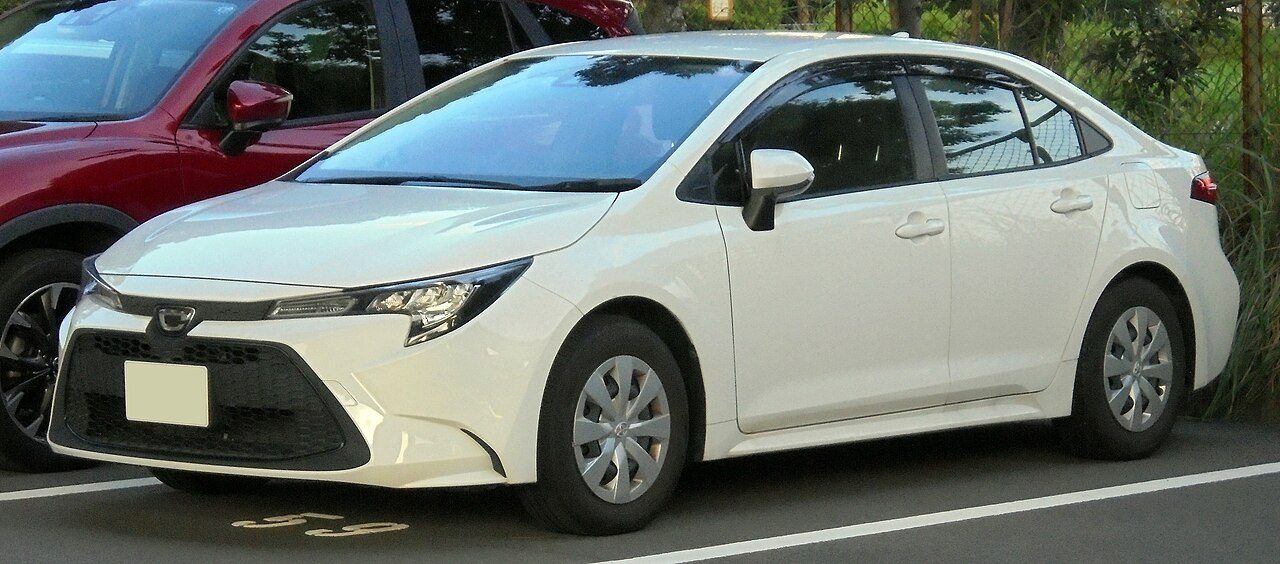
2020 Toyota Corolla
The 2020 Toyota Corolla came with 3 engines: 1.8 L 4-cylinder, 1.8 L 4-cylinder hybrid, 2.0 L 4-cylinder. It gets 31 to 52 MPG combined depending on the engine, per the EPA. NHTSA NCAP rates it 5 out of 5 stars. 3 recall campaigns and 315 owner complaints are on record.
Specs
| Cylinders | 4 |
|---|---|
| Transmission | CVT (continuously variable) |
| Drivetrain | Front-wheel (FWD) |
| Length | 4,570 mm (179.9 in) |
| Width | 1,790 mm |
| Wheelbase | 2,677 mm (105.4 in) |
| Curb weight | 1,288 kg (2,840 lb) |
| Seats | 5 |
| Body style | Compact Cars |
| CO₂ (EU, WLTP) | 113 g/km |
Power: lowest to highest version, from EEA (EU new registrations 2020). Electric range and energy use: EEA (EU new registrations 2020). WLTP figures: average of the cars registered new in the EU that year (EEA).
Specs: average of the cars of this model first registered in 2020 in the Netherlands (RDW vehicle register).
For sale in United States
Safety
Crash-test results across markets. They can vary by version and equipment.
Fuel economy (MPG)
🇺🇸 Local dataBy version
| Engine | Transmission | Drivetrain | City | Highway | Combined |
|---|---|---|---|---|---|
| 1.8 L 4-cylinder | CVT (continuously variable) | Front-wheel (FWD) | 30 MPG | 38 MPG | 33 MPG |
| 1.8 L 4-cylinder | CVT (continuously variable) | Front-wheel (FWD) | 29 MPG | 37 MPG | 32 MPG |
| 1.8 L 4-cylinder | Manual · 6 speeds | Front-wheel (FWD) | 29 MPG | 39 MPG | 33 MPG |
| 1.8 L 4-cylinder hybrid | CVT (continuously variable) | Front-wheel (FWD) | 53 MPG | 52 MPG | 52 MPG |
| 2.0 L 4-cylinder | CVT (continuously variable) | Front-wheel (FWD) | 31 MPG | 40 MPG | 34 MPG |
| 2.0 L 4-cylinder | CVT (continuously variable) | Front-wheel (FWD) | 31 MPG | 38 MPG | 34 MPG |
| 2.0 L 4-cylinder | CVT (continuously variable) | Front-wheel (FWD) | 32 MPG | 41 MPG | 35 MPG |
| 2.0 L 4-cylinder | CVT (continuously variable) | Front-wheel (FWD) | 30 MPG | 38 MPG | 33 MPG |
| 2.0 L 4-cylinder | Manual · 6 speeds | Front-wheel (FWD) | 29 MPG | 36 MPG | 32 MPG |
| 2.0 L 4-cylinder | Manual · 6 speeds | Front-wheel (FWD) | 28 MPG | 37 MPG | 31 MPG |
EPA figures for each version sold in the U.S.
Recalls
Consequence · Remedy
An air bag that does not deploy during a crash increases the risk of injury.
Dealers will inspect and replace the sensor as necessary, free of charge. Interim letters notifying owners of the safety risk were mailed in February 2024. Some final remedy owner letters were mailed October 31, 2024. Letters will continue to be mailed in phases through January 2026. Owners may contact Toyota customer service at 1-800-331-4331. Toyota's number for this recall is 23TB15/23TA15 Lexus 23LB03/23LA03.
Consequence · Remedy
If the fuel pump fails, the engine can stall while driving, increasing the risk of a crash.
Toyota will notify owners, and dealers will replace the fuel pump assembly with an improved one, free of charge. Owners of specific models were notified that remedy parts were available starting January 21, 2021. Owners of other models will be notified as remedy parts become available. Remedy parts should be available for all affected vehicles by late March 2021. Owners may contact Toyota customer service at 1-888-270-9371 or Lexus customer service at 1-800-255-3987. Note: This recall is an expansion of recall 20V-012. Toyota's number for this recall is 20TA02. Lexus' number for this recall is 20LA01.
Consequence · Remedy
In the event of a crash involving multiple impacts, the seat belt may not properly restrain the occupant, increasing the risk of injury.
Toyota will notify owners, and dealers will inspect the rear seat belt assembly production dates, and replace the assemblies, as necessary, free of charge. The recall began February 7, 2020. Owners may contact Toyota customer service at 1-888-270-9371. Toyota's numbers for this recall are 19TB22 and 19TA22.
It may not apply to vehicles sold in your country. Check with your VIN at the source.
Details
Issue: On certain vehicles, a sensor for the occupant classification system (OCS) may not have been manufactured properly. As a result, the sensor could short circuit and cause the airbag system to turn off the passenger-front airbag even when a passenger is seated. Note: This problem would cause a warning message to display on the instrument panel and the airbag indicator light would display "passenger airbag off". Safety Risk: An airbag that is turned off could increase the risk of injury to a passenger in a crash. Corrective Actions: Toyota will notify owners by mail and advise you to take your vehicle to a dealership to inspect and, if necessary, replace the OCS sensor.
Details
Issue: This recall is for certain block heater kits installed on certain vehicles or sold as accessories at Toyota or Lexus dealerships. On certain vehicles, the engine block heater cable may not have enough heat protection and could be damaged by high temperatures. If this happens, the cable could short circuit while plugged in, and cause the wiring to overheat or melt. Note: This recall only affects the following block heater/cord part numbers: C014003034 PK5A408J09 PU14000904 C014003151 PK5A408J13 PU14000905 C014000885 PK5A489J11 PU14000907 C014000888 PK5A489J22 PU14000909 C014000907 PK5A410H00 PU14000911 C014100904 PU14000900 PU14000913 C014100907 PU14000901 PU14003571 C014100911 PU14000902 PK5A489J14 PK5A408J05 PU14000903 Safety Risk: Engine block heater wiring that overheats or melts could create the risk of a fire. Corrective Actions: Toyota recommends that you should stop using the engine block heater immediately. Toyota will notify owners by mail and instruct you to take your vehicle to a dealer to disable the engine block heater. For some vehicles, the corrective actions for this recall are under development. For others, a new engine block heater cannot be installed, and the owner will receive a refund of the purchase price of the engine block heater.
Details
Issue: On certain vehicles, the low-pressure fuel pump could fail. If this happens, then engine may run rough or may not start and the check engine light may turn on. This could also result in a sudden loss of engine power while driving. Note: This recall is an expansion of recalls SRC R95/SRC R96 and SRC RA2/SRC RA3 (Transport Canada Recall Numbers 2020-005 and 2020-088). Safety Risk: A sudden loss of engine power could increase the risk of a crash. Corrective Actions: The company will notify owners by mail and instruct you to take your vehicle to a dealer to replace the fuel pump.
It may not apply to vehicles sold in your country. Check with your VIN at the source.
Consequence · Remedy
Due to insufficient design considerations, the high-pressure fuel pump may lack necessary strength after assembly, leading to wear or damage during use. This could cause stress concentration at the pump weld, resulting in cracks and potential fuel leaks.
Inspect the manufacturing numbers of the high-pressure fuel pumps in all vehicles and replace them with the remedial parts if applicable.
Consequence · Remedy
The high-pressure fuel pump may have insufficient pressure resistance performance of its components, leading to wear or damage during use. This could cause stress concentration at the welds, resulting in cracks and potential fuel leaks.
Inspect the manufacturing numbers of the high-pressure fuel pumps for all vehicles and replace them with the remedial parts if applicable.
Translated automatically from the RDW's Dutch text. The original is at the source.
It may not apply to vehicles sold in your country. Check with your VIN at the source.
Consequence · Remedy
The high-pressure fuel pump may not have been replaced during previous campaigns due to an inspection error. The fuel pump may start to leak. This increases the risk of fire in the presence of an ignition source.
The vehicle owner is requested to contact the brand dealer; they will check the fuel pump and replace it if necessary.
Consequence · Remedy
A weld in the high-pressure fuel pump may crack. This can lead to a fuel leak with a risk of fire as a consequence.
Toyota dealers will check the fuel pump and, if necessary, replace the fuel pump.
Consequence · Remedy
Due to a software error, an unintended reset may occur. As a result, the Data Communication Module (emergency call system) may be damaged. Emergency services cannot be contacted or activated without prior warning about the malfunction of the emergency call system.
The vehicle owner is requested to make an appointment with a brand dealer. The Data Communication Module (DCM) will then be reprogrammed and, if necessary, replaced.
Consequence · Remedy
The components in the high-pressure fuel pump have insufficient pressure resistance, which may cause the inside of the pump to wear or become damaged during operation. This may exert stress on the welded part of the pump, leading to cracks in the weld and potential fuel leakage.
The vehicle owner is requested to make an appointment with a brand dealer. The work consists of checking the fuel pump and replacing it if necessary.
Consequence · Remedy
The eCall system is not activated. In the event of a collision in which the airbags are deployed, emergency services will not be automatically activated.
The vehicle owner is requested to make an appointment with a brand dealer. The dealer will activate the eCall system.
Consequence · Remedy
A retaining clip of the wind deflector of the panoramic roof may not be installed. The wind deflector is then not secured properly. It could detach from the vehicle and fall onto the roadway.
The vehicle owner is requested to make an appointment with a brand dealer. They will check the attachment of the wind deflector. If necessary, the attachment will be adjusted.
On the road
Cars of this model first registered in 2020, from official registers. Each figure belongs to its country.
🇳🇱 Vehicle register, Netherlands
6,042 still registered
2% with an open recall
Average list price when new: 32,967 € (Dutch taxes included) · RDW, CC0
Common problems
315 reports🇺🇸 Local dataReported by owners to the source below. It is not a verdict on this car: it is what people wrote.
I am reporting an intermittent clutch hydraulic system malfunction that presents a serious safety concern. The symptoms strongly suggest a potential failure of the clutch slave cylinder, master cylinder, hydraulic seals, or another component of the clutch release and pedal-return system. The clutch pedal intermittent…
When in use the windshield wipers randomly stop working and will stop anywhere in their path including right in front of your field of vision. The dangerous part is when they do that it is extremely alarming considering you're already tense from the strong storm/rain and now the wipers aren't working and they've stopp…
The contact owns a 2020 Toyota Corolla. The contact stated that while driving at an undisclosed speed, a "Maintenance Required" message was displayed, and the front passenger air bag warning light illuminated. The speedometer was inoperable. The contact stated new tires had been installed previously. The vehicle was t…
I am reporting a severe, recurring safety hazard on my 2020 Toyota Corolla. The vehicle suddenly displays 'Drive-Start Control Malfunction' and completely cuts off engine power in motion, leaving the car stranded in active traffic. This happened after accelerating from a STOP sign on a main avenue. This is an inheren…
What component or system failed or malfunctioned: complete slave cylinder failure resulting in loss of braking and ability to shift. Luckily I was traveling at a low rate of speed when this happened, but if this happens to anyone on the freeway or while turning against traffic for example they would have no control o…
I am unable to lock or unlock the driver’s side door of my 2020 Toyota Corolla using the key fob because the door lock actuator is no longer functioning properly. I must manually use the physical key to lock and unlock the driver’s door. I consider this a significant safety concern because the power locking system is …
My Engine Maintenance light came on around 59,400 miles for my Coolest Control valve !! Needed it to be replaced! Light won’t go off just had it serviced for an oil change before this started!!
The concentric slave cylinder in my vehicle is a big issue with these cars. There has been so many reports of issues happening with these cars manual transmission Corolla's. This can cause fluid to spew, brakes to stop working, and no longer able to drive the vehicle safely. This part should be recalled and covered by…
The CV joint, there is a clicking sound when sharp turns are make to include U-turns. Spoke with a mechanic and was instructed to reach out to the dealership and check for recall on it. I did see any but I see a Technical Service Bulletin ( TSB-0106-20) for 2015- 2021 Corolla models regarding a potential clinking nois…
Part is the coolant bypass valve. Toyota has been taken to court but dealership claims now that I’m over 100k miles I can’t do it. There was also a second part about 10 years but I wasn’t clear on the details of the outcome. Toyota has acknowledged this issue in court but failed to do so at the customer level in my …
DESIGN FLAW & SAFETY RISK: Toyota critically mismatched the standard battery to the vehicle's electrical charging profile; an AGM battery should be specified from the factory. Engine programming drops alternator voltage during cruising, deeply discharging the battery, and forces high-voltage surges (15V+) into it duri…
FAILED COMPONENT & AVAILABILITY: The manual transmission Concentric Slave Cylinder (CSC) failed internally. Due to caustic hydraulic fluid contamination and severe system pressure loss, I had to replace the internal CSC unit, the clutch disc, the pressure plate, the flywheel, the master clutch cylinder, and the hydrau…
2020 vs. other Corolla years
🇺🇸 Local dataOwner complaints and recall campaigns on record at NHTSA for each model year. Fewer complaints can also mean fewer cars sold or a newer car.
Questions
- What engine does the 2020 Toyota Corolla have?
- The 2020 Toyota Corolla came with 3 engines: 1.8 L 4-cylinder, 1.8 L 4-cylinder hybrid, 2.0 L 4-cylinder.
- What is the fuel economy of the 2020 Toyota Corolla?
- It gets 31 to 52 MPG combined depending on the engine, per the EPA.
- Is the 2020 Toyota Corolla safe?
- NHTSA NCAP rates it 5 out of 5 stars.
- Does the 2020 Toyota Corolla have recalls?
- 3 recall campaigns are on record. The latest concerns Air bags (2023-12-20).
- What are the common problems of the 2020 Toyota Corolla?
- 315 owners have filed complaints, most often about engine.
Other years
Other models by Toyota
Do you own a 2020 Corolla?
Post it for free and reach buyers who are already looking at this exact car.
- Free, with no commission
- About three minutes
- Your listing shows up on this page