
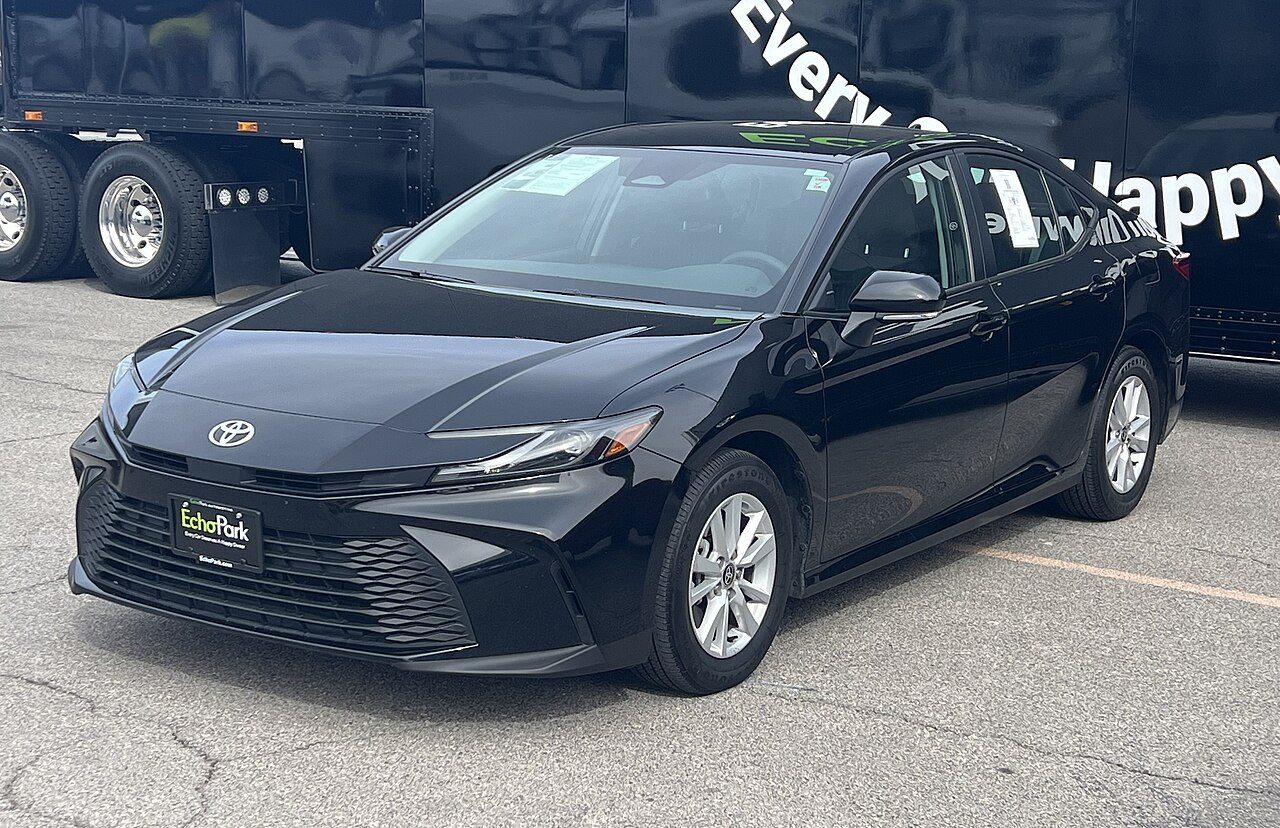
2018 Toyota Camry
The 2018 Toyota Camry came with 3 engines: 2.5 L 4-cylinder, 2.5 L 4-cylinder hybrid, 3.5 L 6-cylinder. It gets 26 to 52 MPG combined depending on the engine, per the EPA. NHTSA NCAP rates it 5 out of 5 stars. 8 recall campaigns and 756 owner complaints are on record.
Specs
| Cylinders | 4 |
|---|---|
| Transmission | Automatic · 8 speeds |
| Drivetrain | Front-wheel (FWD) |
| Dimensions (L × W × H) | 4,890 × 1,830 × 1,480 mm (192.5 × 72.0 × 58.3 in) |
| Wheelbase | 2,830 mm (111.4 in) |
| Curb weight | 1,575 kg (3,472 lb) |
| Body style | Midsize Cars |
Dimensions and weight: median of the 5 versions in Canada's official specifications (NHTSA vPIC). Each version differs slightly.
For sale in United States
Safety
Crash-test results across markets. They can vary by version and equipment.
Fuel economy (MPG)
🇺🇸 Local dataBy version
| Engine | Transmission | Drivetrain | City | Highway | Combined |
|---|---|---|---|---|---|
| 2.5 L 4-cylinder | Automatic · 8 speeds | Front-wheel (FWD) | 29 MPG | 41 MPG | 34 MPG |
| 2.5 L 4-cylinder | Automatic · 8 speeds | Front-wheel (FWD) | 28 MPG | 39 MPG | 32 MPG |
| 2.5 L 4-cylinder hybrid | CVT (continuously variable) | Front-wheel (FWD) | 51 MPG | 53 MPG | 52 MPG |
| 2.5 L 4-cylinder hybrid | CVT (continuously variable) | Front-wheel (FWD) | 44 MPG | 47 MPG | 46 MPG |
| 3.5 L 6-cylinder | Automatic · 8 speeds | Front-wheel (FWD) | 22 MPG | 33 MPG | 26 MPG |
| 3.5 L 6-cylinder | Automatic · 8 speeds | Front-wheel (FWD) | 22 MPG | 32 MPG | 26 MPG |
EPA figures for each version sold in the U.S.
Recalls
Consequence · Remedy
Fuel pump failure can cause an engine stall, increasing the risk of a crash.
Dealers will replace the fuel pump assembly, free of charge. Owner notification letters were mailed March 12, 2025. Owners may contact Toyota's customer service at 1-800-331-4331. Toyota's numbers for this recall are 25TA01 and 25LA01.
Consequence · Remedy
A sudden loss of braking assist can increase the risk of a crash.
Dealers will repair or replace the vacuum pump, as necessary, free of charge. Owner notification letters were mailed May 16, 2022. Owners may contact Toyota customer service at 1-800-331-4331.
Consequence · Remedy
If the fuel pump fails, the engine can stall while driving, increasing the risk of a crash.
Toyota will notify owners, and dealers will replace the fuel pump assembly with an improved one, free of charge. Owners of specific models were notified that remedy parts were available starting January 21, 2021. Owners of other models will be notified as remedy parts become available. Remedy parts should be available for all affected vehicles by late March 2021. Owners may contact Toyota customer service at 1-888-270-9371 or Lexus customer service at 1-800-255-3987. Note: This recall is an expansion of recall 20V-012. Toyota's number for this recall is 20TA02. Lexus' number for this recall is 20LA01.
Consequence · Remedy
If the fuel pump fails, the engine can stall while driving, increasing the risk of a crash.
Toyota will notify owners, and dealers will replace the fuel pump, free of charge. The recall began May 4, 2020. Owners may contact Toyota customer service at 1-888-270-9371 or Lexus customer service at 1-800-255-3987. Toyota's numbers for this recall are 20TB02 and 20TA02 for Toyota vehicles and 20LB01 and 20LA01 for Lexus vehicles.
Consequence · Remedy
An incorrect label may lead to unintentionally overloading the vehicle, increasing the risk of a crash.
SET will notify owners and provide a corrected label for placement over the inaccurate label, free of charge. The recall began August 23, 2019. Owners may contact Toyota customer service at 1-888-270-9371. SET's number for this recall is SET19A.
Consequence · Remedy
A sudden loss of braking assist can increase the risk of a crash.
Toyota will notify owners, and dealers will replace the brake booster vacuum pump, free of charge. The recall began on May 9, 2018. Owners may contact Toyota customer service at 1-888-270-9371, or Lexus customer service at 1-800-255-3987. Toyota's numbers for this recall are J0K/JLD.
Consequence · Remedy
An engine stall can increase the risk of a crash.
Toyota will notify owners, and dealers will inspect the production date codes of the pistons and, if an engine contains a piston from the affected production period, the engine assembly will be replaced, free of charge. The recall is expected to begin May 25, 2018. Owners may contact Toyota customer service at 1-888-270-9371. Toyota's number for this recall is J1M/J0M.
Consequence · Remedy
The improperly connected hoses may leak fuel, which, in the presence of an ignition source, can increase the risk of a fire.
Toyota will notify owners, and dealers will inspect the fuel pipes for the correct installation, correcting them as necessary, free of charge. The recall is expected to begin March 30, 2018. Owners may contact Toyota customer service at 1-888-270-9371. Toyota's number for this recall is J0G.
It may not apply to vehicles sold in your country. Check with your VIN at the source.
Details
Issue: This recall is for certain block heater kits installed on certain vehicles or sold as accessories at Toyota or Lexus dealerships. On certain vehicles, the engine block heater cable may not have enough heat protection and could be damaged by high temperatures. If this happens, the cable could short circuit while plugged in, and cause the wiring to overheat or melt. Note: This recall only affects the following block heater/cord part numbers: C014003034 PK5A408J09 PU14000904 C014003151 PK5A408J13 PU14000905 C014000885 PK5A489J11 PU14000907 C014000888 PK5A489J22 PU14000909 C014000907 PK5A410H00 PU14000911 C014100904 PU14000900 PU14000913 C014100907 PU14000901 PU14003571 C014100911 PU14000902 PK5A489J14 PK5A408J05 PU14000903 Safety Risk: Engine block heater wiring that overheats or melts could create the risk of a fire. Corrective Actions: Toyota recommends that you should stop using the engine block heater immediately. Toyota will notify owners by mail and instruct you to take your vehicle to a dealer to disable the engine block heater. For some vehicles, the corrective actions for this recall are under development. For others, a new engine block heater cannot be installed, and the owner will receive a refund of the purchase price of the engine block heater.
Details
Issue: On certain vehicles, the brake vacuum pump may fail. If this happens, there could be a loss of brake assist. This can cause an increase in brake pedal effort and increase the distance needed to stop the vehicle. Safety Risk: A sudden increase in brake pedal effort could lead to an increased stopping distance. This could increase the risk of a crash. Corrective Actions: Toyota will notify owners by mail and instruct you to take your vehicle to a dealer to inspect the vacuum pump. It will be repaired or replaced, as necessary.
Details
Issue: On certain vehicles, the low-pressure fuel pump could fail. If this happens, then engine may run rough or may not start and the check engine light may turn on. This could also result in a sudden loss of engine power while driving. Note: This recall is an expansion of recalls SRC R95/SRC R96 and SRC RA2/SRC RA3 (Transport Canada Recall Numbers 2020-005 and 2020-088). Safety Risk: A sudden loss of engine power could increase the risk of a crash. Corrective Actions: The company will notify owners by mail and instruct you to take your vehicle to a dealer to replace the fuel pump.
Details
Issue: On certain vehicles, the low-pressure fuel pump could fail. If this happens, then engine may run rough or may not start and the check engine light may turn on. This could also result in a sudden loss of engine power while driving. Note: This recall is an expansion of recall SRC R95/SRC R96 (Transport Canada Recall No. 2020-005) Safety Risk: A sudden loss of engine power could increase the risk of a crash. Corrective Actions: The company will notify owners by mail and instruct you to take your vehicle to a dealer to replace the fuel pump.
Details
On certain vehicles, an oil passage in the rotor of the vacuum pump may not have been machined properly and could result in oil not being distributed throughout the pump. This could lead to the illumination of a warning light and message, an audible tone, and a sudden loss of braking assist, which could increase stopping distances and increase the risk of a crash causing injury and/or damage to property. Correction: Dealers will replace the vacuum pump with a new one.
Details
On certain vehicles equipped with 4 cylinder engines, the engine pistons may have been produced with a diameter larger than the design specification. This could cause the engine to run rough, create an abnormal sound, emit smoke from the exhaust, and/or illuminate warning lights and messages. Additionally, it could result reduced motive power or the engine stopping, which could increase the risk of a crash causing injury and/or damage to property. Correction: Dealers will inspect piston production date code and, if an engine contains a piston from the affected production period, the engine assembly will be replaced with a new one.
Details
On certain vehicles equipped with a V6 engine, one or both fuel delivery pipes may not have been properly connected to the fuel hoses during assembly. If the fuel delivery pipes are partially engaged, it could result in a fuel odour and/or a fuel leak, which in the presence of an ignition source could increase the risk of a fire causing injury and/or damage to property. Correction: Dealers will inspect the fuel delivery pipes for proper installation and connect them, as necessary.
Common problems
756 reports🇺🇸 Local dataReported by owners to the source below. It is not a verdict on this car: it is what people wrote.
The vehicle transmission became inoperable while driving and the car stalled. After towing to a local Toyota dealership, the service department noted that it failed the stall test. Code P0745F identified. Vehicle required entire transmission assembly replacement at 88K miles.
The steering wheel has become extremely stiff and difficult to turn, making it very difficult to steer the vehicle in either direction (left or right). This occurs while the engine is running and the vehicle is in operation. The steering issue makes it extremely difficult to control the vehicle, especially when makin…
transmission failure and power loss while driving
Not sure if i'm reporting this correctly. my camry started making noise and it was a transmission issue. i went online and it seems to be a common complaint for 2018 and 2019 toyota camry's, when they reach approx 125k to 135 k. don't know if anything can be done but it would be nice to find out if this is more com…
Vehicle Safety Complaint – 2018 Toyota Camry On October 26, 2026, the driver was operating a 2018 Toyota Camry on a public roadway at approximately 45 mph when the vehicle unexpectedly activated its automatic emergency braking system. The dashboard displayed a “BRAKE!” warning, immediately followed by extremely forc…
This vehicle is experiencing the same problems since 2022 despite multiple attempts to have the vehicle repaired. The fuel pump was part of the recall and it was replaced in 2020. When these problems started in 2022, I was told they need the codes to figure out what’s going on but yet they still couldn’t give me an an…
Unknown
Transmission defective.
Total transmission failure at about 107,770 miles.
My 2018 Toyota Camry LE went into Limp mode while drive on the highway causing jerking while driving and tons of error codes on the dash, and issues with safety systems shutting off and accelration. After towing to a dealership, dealership gave me the following description of the defect: Coolant is coming through the …
The contact owns a 2018 Toyota Camry. The contact stated that while driving 60 MPH, the vehicle was jerking and hesitating. The failure was a recurring failure. The dealer was contacted and was able to reproduce the failure. The vehicle was diagnosed with transmission failure. The contact was informed that the transmi…
I am filing a formal complaint regarding a severe safety recall compliance violation and predatory conditional repair tactic committed by an authorized Toyota dealership. My vehicle exhibited severe engine sputtering and stalling symptoms. This vehicle had an active, federally mandated safety recall for a defective lo…
2018 vs. other Camry years
🇺🇸 Local dataOwner complaints and recall campaigns on record at NHTSA for each model year. Fewer complaints can also mean fewer cars sold or a newer car.
Questions
- What engine does the 2018 Toyota Camry have?
- The 2018 Toyota Camry came with 3 engines: 2.5 L 4-cylinder, 2.5 L 4-cylinder hybrid, 3.5 L 6-cylinder.
- What is the fuel economy of the 2018 Toyota Camry?
- It gets 26 to 52 MPG combined depending on the engine, per the EPA.
- Is the 2018 Toyota Camry safe?
- NHTSA NCAP rates it 5 out of 5 stars.
- Does the 2018 Toyota Camry have recalls?
- 8 recall campaigns are on record. The latest concerns Fuel system, gasoline (2025-01-22).
- What are the common problems of the 2018 Toyota Camry?
- 756 owners have filed complaints, most often about power train.
Other years
Other models by Toyota
Do you own a 2018 Camry?
Post it for free and reach buyers who are already looking at this exact car.
- Free, with no commission
- About three minutes
- Your listing shows up on this page