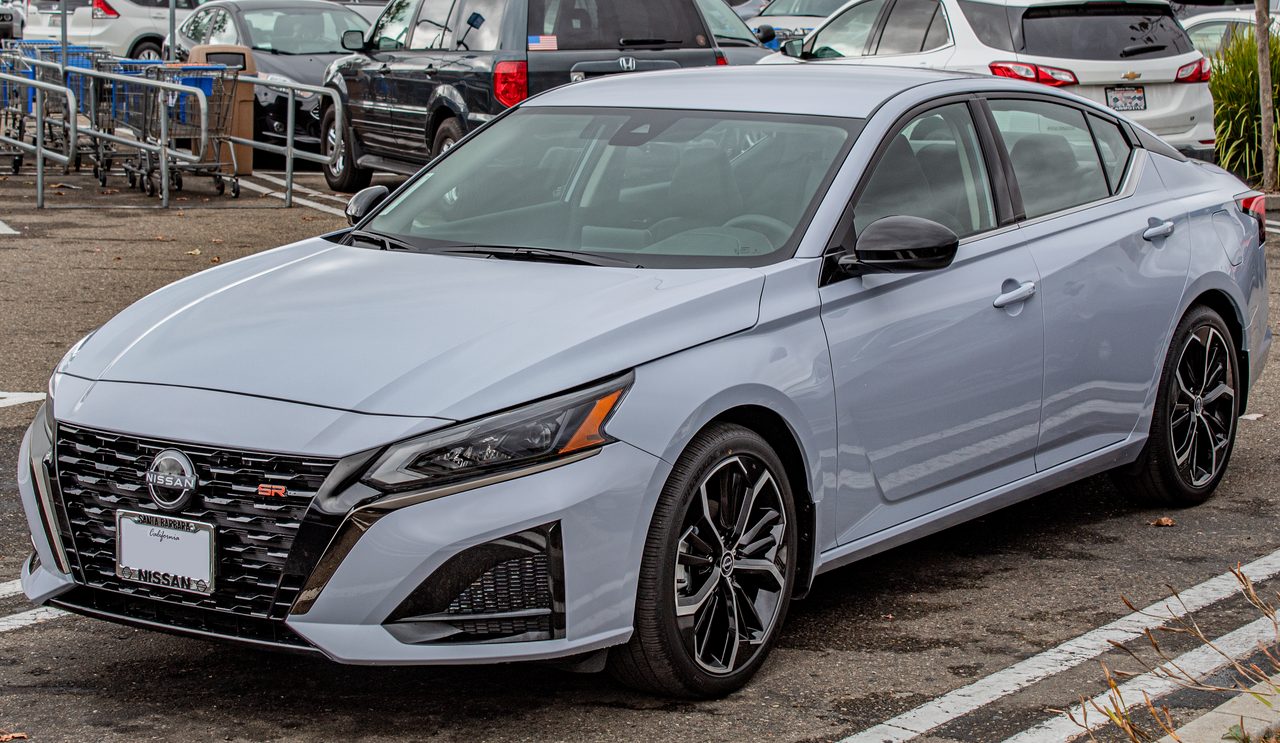
2014 Nissan Altima
The 2014 Nissan Altima came with 2 engines: 2.5 L 4-cylinder, 3.5 L 6-cylinder. It gets 25 to 31 MPG combined depending on the engine, per the EPA. NHTSA NCAP rates it 5 out of 5 stars. 8 recall campaigns and 1,113 owner complaints are on record.
Specs
| Cylinders | 4 |
|---|---|
| Transmission | CVT (continuously variable) |
| Drivetrain | Front-wheel (FWD) |
| Dimensions (L × W × H) | 4,870 × 1,830 × 1,475 mm (191.7 × 72.0 × 58.1 in) |
| Wheelbase | 2,780 mm (109.4 in) |
| Curb weight | 1,488 kg (3,280 lb) |
| Body style | Midsize Cars |
Dimensions and weight: median of the 2 versions in Canada's official specifications (NHTSA vPIC). Each version differs slightly.
For sale in United States
Other Nissan Altima for sale in United States
Safety
Crash-test results across markets. They can vary by version and equipment.
Fuel economy (MPG)
🇺🇸 Local dataBy version
| Engine | Transmission | Drivetrain | City | Highway | Combined |
|---|---|---|---|---|---|
| 2.5 L 4-cylinder | CVT (continuously variable) | Front-wheel (FWD) | 27 MPG | 37 MPG | 31 MPG |
| 3.5 L 6-cylinder | CVT (continuously variable) | Front-wheel (FWD) | 22 MPG | 31 MPG | 25 MPG |
EPA figures for each version sold in the U.S.
Recalls
Consequence · Remedy
Corrosion to the secondary latch may cause it to bind and remain in the unlatched position when the hood is closed. If the primary latch is inadvertently released again and the secondary latch is not engaged, the hood could unexpectedly open while driving, increasing the risk of a vehicle crash.
Nissan will notify owners, and dealers will install a stronger release spring in the hood release lever, a warning label near the secondary hood latch, and an Owners Manual addendum card with instructions on how to lubricate and maintain the secondary hood latch mechanism, free of charge. Owner notification letters were mailed June 30, 2021. Owners may contact Nissan customer service at 1-800-867-7669. Note: Recall 16V-029 remains open for any unremedied 2013-2015 Altimas and this recall applies to all vehicles covered by 16V-029 even if those repairs have already been performed.
Consequence · Remedy
If the front passenger seat occupant is misclassified, the air bag may deploy incorrectly in the event of a crash, increasing the risk of injury.
Nissan will notify owners, and dealers will replace the ECU and update the OCS software free of charge. The recall began February 13, 2017. Owners may contact Nissan customer service at 1-800-647-7261.
Consequence · Remedy
If the passenger frontal air bag does not deploy as intended in the event of a crash, the passenger is at an increased risk of injury.
Nissan will notify their owners. Chevrolet City Express owners will be notified by General Motors. Dealers will reprogram the Air Bag Control Unit (ACU) and OCS Electronic Control Unit (ECU) in Altima, Maxima, Murano, Rogue, and Sentra vehicles, and replace the OCS ECU in LEAF, NV200, NV200 Taxi, Pathfinder, Infiniti Q50, JX35, and QX60 and Chevrolet City Express vehicles, free of charge. Interim notices were sent to owners on May 31, 2016. Owners will receive a second notice when remedy parts become available. Owners may contact Nissan customer service at 1-800-867-7669, Infiniti customer service at 1-888-833-3216 or Chevrolet customer service at 1-800-222-1020.
Consequence · Remedy
If the primary latch is inadvertently released and the secondary latch is not engaged, the hood could unexpectedly open while driving, increasing the risk of a vehicle crash.
These vehicles were previously included in recalls 14V-565 and 15V-116, however the previous remedy plan may not have been performed consistently to remove the safety risk. To correct this issue, Nissan will re-notify all affected owners and dealers will replace the hood latch with a new one, free of charge. The recall began on February 17, 2016. Owners may contact Nissan customer service at 1-800-647-7261. Note: This recall supersedes recalls 14V-565 and 15V-116.
Consequence · Remedy
If the OCS does not detect an adult occupant in the passenger seat, the passenger air bag would be deactivated. Failure of the passenger airbag to deploy during a crash (where deployment is warranted) could increase the risk of injury to the passenger.
Nissan will notify owners, and dealers will update the OCS software, free of charge. The recall began on November 30, 2015. Owners may contact Nissan at 1-800-647-7261.
Consequence · Remedy
If fuel leaks from between the fuel sending unit and the tank, it may increase the risk of a fire in the event of a crash.
Nissan will notify owners, and dealers will install a retainer ring between the fuel tank and the fuel sending unit. The recall began on September 28, 2015. Owners may contact Nissan customer service at 1-800-647-7261.
Consequence · Remedy
If the primary latch is inadvertently released and the secondary latch is not engaged, the hood could unexpectedly open while driving, increasing the risk of a vehicle crash.
Nissan will notify owners, and dealers will be instructed to modify the bend angle of the hood actuation lever to eliminate potential interference with the hood inner panel. In addition, dealers will clean and lubricate the latch joint as needed. If significant corrosion is observed, the latch assembly will be replaced. This repairs will be performed free of charge. The recall began March 31, 2015. Owners may contact Nissan customer service at 1-800-647-7261. Note: This recall is an expansion of recall 14V-565.
Consequence · Remedy
If the OCS does not detect an adult occupant in the passenger seat, the passenger airbag would be deactivated. Failure of the passenger airbag to deploy during a crash (where deployment is warranted) could increase the risk of injury to the passenger.
Nissan will notify owners, and dealers will update the OCS software, free of charge. The recall began on April 14, 2014. Owners may contact Nissan at 1-800-647-7261.
It may not apply to vehicles sold in your country. Check with your VIN at the source.
Details
Issue: Over time, corrosion could cause the secondary hood latch to stick in the open position after it is used. If this happens, and the primary hood latch is released, the hood may open suddenly while driving. Safety Risk: A hood that opens suddenly while driving could block the driver's view and increase the risk of a crash. Corrective Actions: Nissan will notify owners by mail and provide an update to the owner's manual instruction for how to properly maintain the hood latch. Nissan will instruct you to take your vehicle to a dealer to replace the hood release lever spring. The dealer will also install a hood latch maintenance warning label.
Details
Certain vehicles may have been fitted with an incorrect Occupant Classification System (OCS) module. An incorrect OCS module would impair the effectiveness of the OCS, potentially failing to properly classify an adult passenger seated in the front passenger seat. This could increase the risk of injury to the occupant in a crash. Correction: Dealers will replace and update the OCS module.
Details
On certain vehicles, a defect in the occupant classification system could allow an adult sitting in the front passenger seat to be classified as a child or an “empty seat”. This would suppress the airbag, which could increase the risk of injury in a crash. Correction: For affected Altima, Maxima, Murano, Rogue and Sentra vehicles, dealers will reprogram the airbag control unit and the occupant classification system control unit. For affected Leaf, NV200, Pathfinder, Q50 and JX35/QX60 vehicles, dealers will replace the occupant classification system electronic control unit.
Details
On certain vehicles, the secondary hood latch may stick in the open position. As a result, the hood would only be held by the primary latch and could open suddenly if the primary latch were to be inadvertently released or improperly latched. This would compromise the driver’s ability to see the road and its users and cause damage to the windshield. These issues could result in a crash causing injury and/or property damage. Correction: Dealers will replace the hood latch. Note: This recall supersedes recalls 2014-401 and 2015-083.
Details
Certain vehicles serviced as part of recall 2014-093 or which had the Occupant Classification System (OCS) module replaced during servicing may have been fitted with an incorrect replacement OCS module. An incorrect OCS module would impair the effectiveness of the OCS, potentially failing to properly classify an adult passenger seated in the front passenger seat. This could increase the risk of injury to the occupant in a crash. Correction: Dealers will reprogram the OCS module.
Details
On certain vehicles, the sealing ring between the fuel sending unit and the fuel tank may move out of position in a crash. This could increase the potential risk of a fuel leak in the event of a crash increasing the risk of fire causing injury and/or damage to property. Correction: Dealers will install a retainer ring between the fuel sending unit and fuel tank. Note: This recall supersedes recall 2015-341.
Details
On certain vehicles, if the vehicle is driven with only the secondary latch engaged, the secondary hood latch may fail to hold the hood closed. As a result, the hood could open suddenly and compromise the driver’s ability to see the road and its users, as well as cause damage to the windshield. These issues could result in a crash causing injury and/or property damage. Correction: Dealers will affect repairs. Note: This is an expansion of recall 2014401.
Details
On certain vehicles, the front passenger seat occupant classification system software may incorrectly classify the passenger seat as empty, when it is occupied by an adult. If this occurs, the passenger airbag would be deactivated without the illumination of the airbag warning lamp. Failure of the passenger airbag to deploy during a crash (where deployment is warranted) could increase the risk of injury to the seat occupant. Correction: Dealers will reprogram the occupant classification system.
Translated automatically from the RDW's Dutch text. The original is at the source.
It may not apply to vehicles sold in your country. Check with your VIN at the source.
Consequence · Remedy
The occupancy detection system can incorrectly classify the status when an adult person is sitting in the passenger seat. If an adult person is sitting in the passenger seat, the detection system may classify the occupancy as unoccupied. This disables the airbag from functioning.
The manufacturer is recalling the affected vehicles. Measures will be taken to remedy the defect. The vehicle owner is requested to contact the brand dealer to make an appointment. The dealer will reprogram the occupancy detection system.
Common problems
1113 reports🇺🇸 Local dataReported by owners to the source below. It is not a verdict on this car: it is what people wrote.
My 2014 Nissan Altima has experienced loss of visibility from the headlights significantly to the point of feeling unsafe driving at night. I believe the cause of these issue is due to degradation of the reflective coating within the headlamps. New bulbs installed have not improved the quality of the headlights perfor…
Rear lower control arm broke while driving on interstate car darted to the left but control was maintained
Right rear lower control arm fully broke while traveling 35 mph and going around a curve. The car immediately pulled hard right into the adjacent lane. Fortunately, there were no vehicles in that lane at the moment. I have contacted the dealership. This issue is addressed in Service Bulletin NTB21-045. However, the…
As far as I am aware there are no causes to the failure but the sensor of the left panel on the driver side airbag is alerting. Nissan checked it and advised it would be @ $2000 to repair because it required the replacement of the entire driver side chair. However I am now being told that they don't have/make the repl…
The contact owns a 2014 Nissan Altima. The contact stated that while his son was driving 50 MPH, the ABS warning illuminated, and the vehicle failed to exceed 15 MPH. The vehicle was driven to the residence and parked. The vehicle was towed to the dealer to be diagnosed. The dealer associated the failure with TSB: NTB…
At159,000 main console air bag light came on and won't turn off.
-Upon research, it appears my Nissan has an issue with the headlight lamps that have caused the low beams to diminish over time. This is a recorded defect (class action lawsuit [XXX], et al. v. Nissan North America, Inc.) of Nissan Altimas years 2013-2018. -There is a Nissan Dealership in my city I can take the vehi…
Airbag light for driver turned on and took it to the dealership to get it fixed. They fixed it but it came back on and they reset it. A few months later it turned back on and they said they couldn't fix it because that part was not available anymore.
What component or system failed or malfunctioned, and is it available for inspection upon request? The rear control arm (rear suspension component) failed catastrophically by snapping while the vehicle was in motion. This is a critical structural component responsible for maintaining proper wheel alignment and vehicle…
Nissan has put a service campaign P9324 as a known issue for rear lower suspension corrosion. Last week as I was driving my vehicle collapsed on its back tire there was no safety warning lights that had come on. I was able to safely pull off the road however if I had been driving in a highway this would have more than…
Hi, my name is [XXX] . I rented a car through [XXX] , and I need to report serious mechanical issues. All of the spark plugs are not secured, as they are missing screws, and oil is present. The only reason i know is because of the check light engine being on one minute and off the next. I chose to get it looked at and…
The dash indicates the driver side air bag is not operational. After the car starts, the air bag indicator stays on, indicating the driver's air bag is defective. If I were in an accident, the Nissan dealership told me the air bag would not deploy. The car was inspected by the dealer. The car has never been in an acci…
2014 vs. other Altima years
🇺🇸 Local dataOwner complaints and recall campaigns on record at NHTSA for each model year. Fewer complaints can also mean fewer cars sold or a newer car.
Questions
- What engine does the 2014 Nissan Altima have?
- The 2014 Nissan Altima came with 2 engines: 2.5 L 4-cylinder, 3.5 L 6-cylinder.
- What is the fuel economy of the 2014 Nissan Altima?
- It gets 25 to 31 MPG combined depending on the engine, per the EPA.
- Is the 2014 Nissan Altima safe?
- NHTSA NCAP rates it 5 out of 5 stars.
- Does the 2014 Nissan Altima have recalls?
- 8 recall campaigns are on record. The latest concerns Latches/locks/linkages (2020-05-28).
- What are the common problems of the 2014 Nissan Altima?
- 1,113 owners have filed complaints, most often about exterior lighting.
Other years
Other models by Nissan
Do you own a 2014 Altima?
Post it for free and reach buyers who are already looking at this exact car.
- Free, with no commission
- About three minutes
- Your listing shows up on this page