
2021 Hyundai Kona
The 2021 Hyundai Kona came with 3 engines: electric, 1.6 L 4-cylinder turbo, 2.0 L 4-cylinder. It gets 27 to 30 MPG combined depending on the engine, per the EPA. NHTSA NCAP rates it 5 out of 5 stars. 1 recall campaigns and 120 owner complaints are on record.
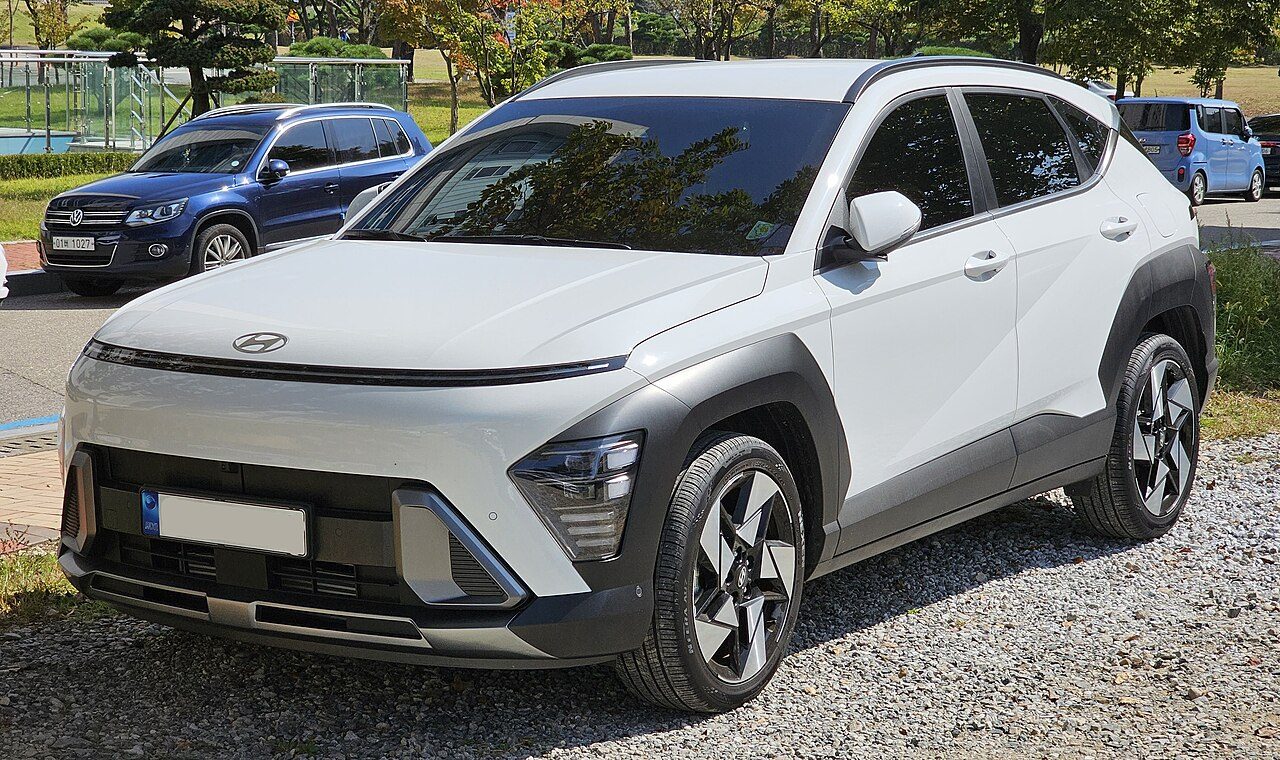
Specs
| Cylinders | 4 |
|---|---|
| Transmission | Automated manual / dual-clutch · 7 speeds |
| Drivetrain | AWD |
| Length | 4,200 mm (165.4 in) |
| Width | 1,800 mm |
| Wheelbase | 2,600 mm (102.4 in) |
| Curb weight | 1,440 kg (3,175 lb) |
| Seats | 5 |
| Body style | Small Sport Utility Vehicle 2WD |
| Fuel consumption (EU, WLTP) | 5.4 L/100 km |
| CO₂ (EU, WLTP) | 83 g/km |
Power: lowest to highest version, from Natural Resources Canada. Electric range and energy use: Natural Resources Canada. WLTP figures: average of the cars registered new in the EU that year (EEA).
Specs: average of the cars of this model first registered in 2021 in the Netherlands (RDW vehicle register).
For sale in United States
Other Hyundai cars for sale in United States
Safety
Crash-test results across markets. They can vary by version and equipment.
Fuel economy (MPG)
🇺🇸 Local dataBy version
| Engine | Transmission | Drivetrain | City | Highway | Combined |
|---|---|---|---|---|---|
| electric | Single-speed | Front-wheel (FWD) | — | — | — |
| 1.6 L 4-cylinder turbo | Automated manual / dual-clutch · 7 speeds | AWD | 26 MPG | 29 MPG | 27 MPG |
| 1.6 L 4-cylinder turbo | Automated manual / dual-clutch · 7 speeds | Front-wheel (FWD) | 28 MPG | 32 MPG | 30 MPG |
| 2.0 L 4-cylinder | Automatic · 6 speeds | AWD | 25 MPG | 30 MPG | 27 MPG |
| 2.0 L 4-cylinder | Automatic · 6 speeds | Front-wheel (FWD) | 27 MPG | 33 MPG | 30 MPG |
EPA figures for each version sold in the U.S.
Recalls
Consequence · Remedy
A damaged engine may stall, increasing the risk of a crash. In addition, oil may leak onto hot exhaust components, increasing the risk of a fire.
Dealers will inspect and, if necessary, replace the engine, free of charge. In addition, Hyundai will deploy Piston Ring Noise Sensing System (PNSS) software. Owner notification letters were mailed August 24, 2021. Owners may contact Hyundai customer service at 1-855-371-9460.
It may not apply to vehicles sold in your country. Check with your VIN at the source.
Details
Issue : Hyundai Auto Canada is conducting an extended warranty campaign for certain vehicles as water could enter the horn assembly and cause the horn's electrical contacts to corrode. As a result, the horn may not work properly or at all. Safety risk: A horn that doesn't work properly could prevent a driver from warning others of a danger and create an unsafe situation. Corrective Actions: To reduce the safety risk, Hyundai advises you to test the horn regularly. Hyundai will notify owners in writing and advise you to contact a dealership if your horn doesn't work properly. Hyundai will provide an extended warranty of 10 years/200 000 km to replace the horn for free if it fails.
Details
Issue: On certain vehicles, the compliance label may be missing information in French. The words listed on the label for "Tires", "Rims", "Front" and "Rear" appear in English only, when they should be listed as "Tires/Pneus", "Rims/Jantes", "Front/Avant" and "Rear/Arriere". Canadian regulations require this information to be listed on the label in both English and French. Safety Risk: These small errors do not affect vehicle safety. Corrective Actions: This is not a recall. The company has corrected the compliance label for all new vehicles.
Details
Issue: On certain vehicles, the engine's piston oil rings may be defective. This can cause engine wear that can lead to increased oil consumption. Eventually, this can create abnormal engine noise and the oil pressure warning light may turn on. If you continue to drive the vehicle with these symptoms, the engine could fail. Note: This only affects vehicles equipped with a 2.0 L Nu MPI engine. Safety Risk: A sudden loss of engine power could increase the risk of a crash. An engine failure could also create the risk of a fire. Corrective Actions: Hyundai will notify owners by mail and instruct you to take your vehicle to a dealer to inspect the engine. The engine will be replaced, if necessary. Hyundai is also developing a Piston-ring Noise Sensing System (PNSS) software update to be installed when available; it will alert the driver of potential damage before an engine failure occurs.
Translated automatically from the RDW's Dutch text. The original is at the source.
It may not apply to vehicles sold in your country. Check with your VIN at the source.
Consequence · Remedy
There may be a voltage difference between the individual cells of the high-voltage battery. This could cause a fire in the vehicle.
The vehicle owner is asked to make an appointment with the brand dealer. The software will be adjusted to detect deviations at an earlier stage. If a deviation is detected, the high-voltage battery will be replaced proactively.
Consequence · Remedy
The sealing of the cooling in the high-voltage/low-voltage control unit may not seal properly. As a result, internal coolant leakage may occur, leading to a loss of vehicle propulsion.
The vehicle owner is requested to make an appointment with the brand dealer. The sealing of the control unit will be tested, and the control unit may be replaced.
Consequence · Remedy
The seal of the cooling system in the high-voltage/low-voltage control unit may not seal properly. As a result, internal coolant leakage may occur, leading to a failure of the vehicle's drive system.
The vehicle owner is requested to make an appointment with the brand dealer. The seal of the control unit will be tested and potentially replaced.
Consequence · Remedy
Filter material from the diesel fuel filter may loosen and subsequently enter the high-pressure fuel pump. Loss of power and engine failure.
If the vehicle is registered in the Netherlands, the vehicle owner is asked to make an appointment with the brand dealer. The fuel filter and housing will then be replaced.
Consequence · Remedy
The eCall unit may not send VIN information to the eCall system when an airbag is deployed. In an accident where eCall is activated, the chassis number is not transmitted, resulting in valuable information not being known in advance.
The vehicles will be equipped with updated software before delivery to the end user.
Consequence · Remedy
A fault may occur in the software of the ESP system. As a result, the electric brake (IEB) will not function. To brake the vehicle, the brake pedal will need to be applied with more force than usual. This will also be indicated by a warning light.
The vehicle owner is asked to make an appointment with a brand dealer. The brand dealer will overwrite the software of the ESP system with a newer version.
On the road
Cars of this model first registered in 2021, from official registers. Each figure belongs to its country.
🇳🇱 Vehicle register, Netherlands
4,137 still registered
10% with an open recall
Average list price when new: 34,879 € (Dutch taxes included) · RDW, CC0
Common problems
120 reports🇺🇸 Local dataReported by owners to the source below. It is not a verdict on this car: it is what people wrote.
My 2021 Kona has undergone five separate oil consumption checks. The engine is depleting oil at an abnormal rate, creating a clear risk of sudden catastrophic engine failure and highway stalling. Dealership service personnel have repeatedly dismissed consumption data despite documented top-offs between 500 and 1,000 m…
All 4 fuel injectors failed. They were replaced but the check engine light came back on. Crank shaft sensor was then replaced and now the check engine light is back on. Driving the car waiting for something to fail is not safe
My exact engine was as in a recall but not my car which failed prematurely at 84,000. I have taken extensive maintenance in the car in the for the past 2 years. Hyundai made me pay to tow my car to a dealership denied me for a goodwill replacement with the same exact problems as the same exact recalled engine and stuc…
My 2021 Kona Limited 1.6L Turbo is consuming oil so rapidly that the Low Oil Pressure light has activated on the highway, creating a sudden risk of stalling and engine failure, that the dealership and Hyundai are declining service. According to research, when your oil pressure light flashes, your engine is moments aw…
"The vehicle suffered sudden internal engine failure while in operation due to catastrophic oil starvation, presenting a severe risk of engine stalling and loss of propulsion on the road. Active diagnostic codes are P0014, P0017, and P0303. An independent mechanic confirmed the engine was found 3 quarts low on oil wit…
At approximately 100,500 miles, the 2.0L Nu engine experienced a sudden, catastrophic internal failure while operating, causing a loss of power and stalling. Failed Component & Availability: The engine block assembly failed internally due to severe low compression (95 psi) across multiple cylinders and intake valve l…
2021 Hyundai Kona, VIN [XXX], 45,575 miles. Engine unexpectedly stalled while driving on 45 mph road and stopped at a light. Oil-pressure warning appeared when the engine stalled. Upon checking afterward, the oil level was below the measurable dipstick range with only droplets visible. Approximately 3.5 quarts were ad…
The contact owns a 2021 Hyundai Kona. The contact stated that while driving at an undisclosed speed, the horn button was depressed but was inoperable. The dealer was contacted and notified of the failure. The contact was informed that the horn needed to be replaced. The vehicle was not repaired. The manufacturer was n…
The contact owns a 2021 Hyundai Kona. The contact stated that while driving at approximately 5 MPH while making a turn, the vehicle stalled. Several warning lights illuminated but turned off after the vehicle was restarted. The contact stated that the failure occurred intermittently. The contact stated that several in…
Low speed hesitancy and shuddering. Car has lost power when driving at 55 mph. Car does not want to move at very slow speeds as in a parking garage. It hesitates and starts to roll backwards.
I am writing to express my frustration and concern regarding my 2021 Hyundai Kona, which currently has only 88,754 miles. My vehicle has been experiencing excessive oil consumption along with an ongoing check engine light. The diagnostic trouble codes are P0017 and P0011. In an effort to resolve the issue, I have had…
The contact owns a 2021 Hyundai Kona. The contact stated that there was a strong odor inside the vehicle. The contact stated that while cleaning and detailing the vehicle to remove the odor, the contact discovered that a leak had damaged the floorboard and the carpet. The vehicle was taken to the dealer to be diagnose…
2021 vs. other Kona years
🇺🇸 Local dataOwner complaints and recall campaigns on record at NHTSA for each model year. Fewer complaints can also mean fewer cars sold or a newer car.
Questions
- What engine does the 2021 Hyundai Kona have?
- The 2021 Hyundai Kona came with 3 engines: electric, 1.6 L 4-cylinder turbo, 2.0 L 4-cylinder.
- What is the fuel economy of the 2021 Hyundai Kona?
- It gets 27 to 30 MPG combined depending on the engine, per the EPA.
- Is the 2021 Hyundai Kona safe?
- NHTSA NCAP rates it 5 out of 5 stars.
- Does the 2021 Hyundai Kona have recalls?
- 1 recall campaigns are on record. The latest concerns Engine (2021-04-28).
- What are the common problems of the 2021 Hyundai Kona?
- 120 owners have filed complaints, most often about engine.
Other years
Other models by Hyundai
Do you own a 2021 Kona?
Post it for free and reach buyers who are already looking at this exact car.
- Free, with no commission
- About three minutes
- Your listing shows up on this page