
Hyundai Kona 2019
O 2019 Hyundai Kona veio com 3 motores: elétrico, 1.6 L 4-cilindro turbo, 2.0 L 4-cilindro. Faz 11.5 a 12.8 km/l combinado dependendo do motor, segundo a EPA. NHTSA NCAP classifica em 5 de 5 estrelas. 1 campanhas de recall e 198 reclamações de proprietários estão registradas.
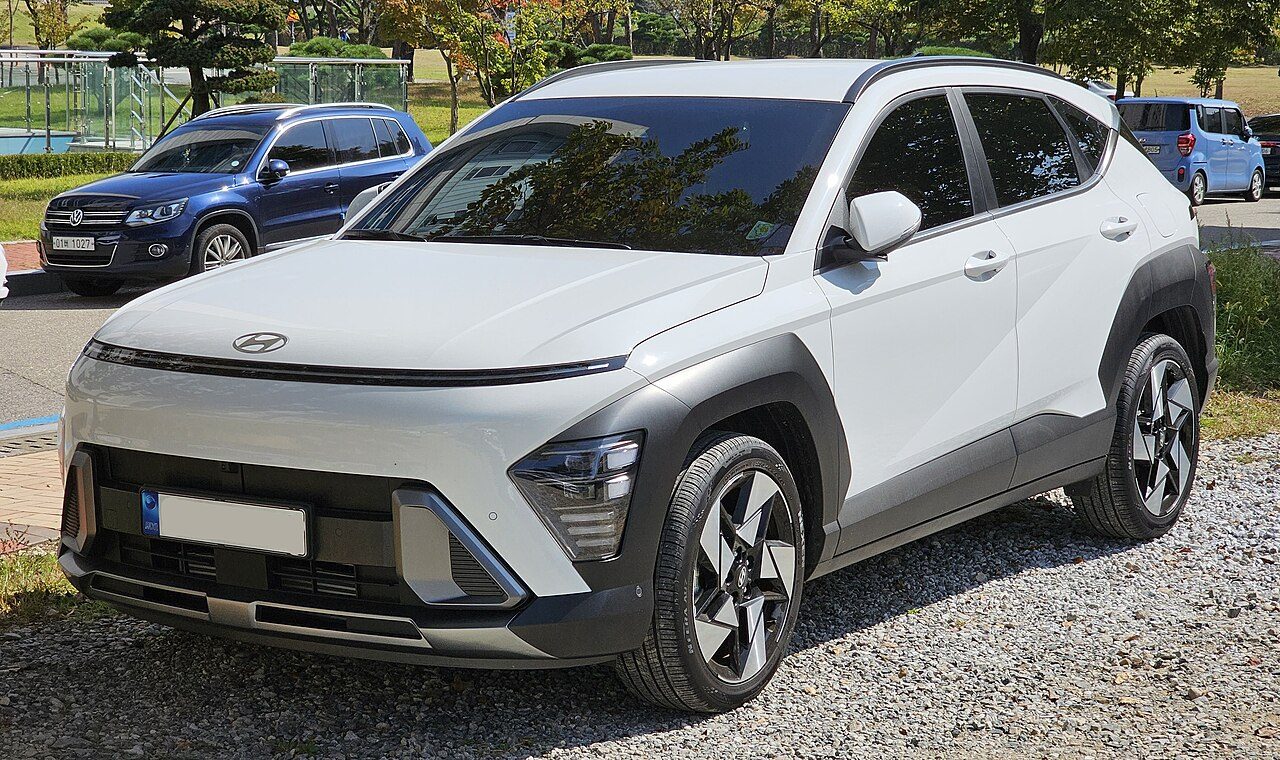
Especificações
| Cilindros | 4 |
|---|---|
| Câmbio | Manual automatizado / dupla embreagem · 7 marchas |
| Tração | AWD |
| Comprimento | 4,176 mm (164.4 in) |
| Largura | 1,800 mm |
| Peso bruto | 1,493 kg (3,291 lb) |
| Assentos | 5 |
| Carroceria | Veículo utilitário esportivo pequeno 2WD |
Potência: versão mais baixa para a mais alta, de Natural Resources Canada. Autonomia elétrica e consumo de energia: Natural Resources Canada.
Especificações: média dos carros deste modelo registrados pela primeira vez em 2019 na Holanda (registro de veículos RDW).
À venda em Estados Unidos
Outros carros Hyundai à venda em Estados Unidos
Segurança
Resultados de testes de colisão por mercado. Podem variar conforme versão e equipamento.
Economia de combustível (MPG)
🇺🇸 Dado localPor versão
| Motor | Câmbio | Tração | Cidade | Estrada | Misto |
|---|---|---|---|---|---|
| elétrico | Velocidade única | Dianteira (FWD) | — | — | — |
| 1.6 L 4-cilindro turbo | Manual automatizado / dupla embreagem · 7 marchas | AWD | 11.1 km/l (26 MPG) | 12.3 km/l (29 MPG) | 11.5 km/l (27 MPG) |
| 1.6 L 4-cilindro turbo | Manual automatizado / dupla embreagem · 7 marchas | Dianteira (FWD) | 11.9 km/l (28 MPG) | 13.5 km/l (32 MPG) | 12.8 km/l (30 MPG) |
| 2.0 L 4-cilindro | Automático · 6 marchas | AWD | 10.6 km/l (25 MPG) | 12.8 km/l (30 MPG) | 11.5 km/l (27 MPG) |
| 2.0 L 4-cilindro | Automático · 6 marchas | Dianteira (FWD) | 11.5 km/l (27 MPG) | 14.1 km/l (33 MPG) | 12.8 km/l (30 MPG) |
Dados da EPA para cada versão vendida nos EUA.
Chamadas de retorno
Consequência · Solução
A damaged engine may stall, increasing the risk of a crash. In addition, oil may leak onto hot exhaust components, increasing the risk of a fire.
Dealers will inspect and, if necessary, replace the engine, free of charge. In addition, Hyundai will deploy Piston Ring Noise Sensing System (PNSS) software. Owner notification letters were mailed August 24, 2021. Owners may contact Hyundai customer service at 1-855-371-9460.
Pode não se aplicar aos veículos vendidos no seu país. Verifique com seu VIN na fonte.
Detalhes
Issue : Hyundai Auto Canada is conducting an extended warranty campaign for certain vehicles as water could enter the horn assembly and cause the horn's electrical contacts to corrode. As a result, the horn may not work properly or at all. Safety risk: A horn that doesn't work properly could prevent a driver from warning others of a danger and create an unsafe situation. Corrective Actions: To reduce the safety risk, Hyundai advises you to test the horn regularly. Hyundai will notify owners in writing and advise you to contact a dealership if your horn doesn't work properly. Hyundai will provide an extended warranty of 10 years/200 000 km to replace the horn for free if it fails.
Detalhes
Issue: On certain vehicles, the compliance label may be missing information in French. The words listed on the label for "Tires", "Rims", "Front" and "Rear" appear in English only, when they should be listed as "Tires/Pneus", "Rims/Jantes", "Front/Avant" and "Rear/Arriere". Canadian regulations require this information to be listed on the label in both English and French. Safety Risk: These small errors do not affect vehicle safety. Corrective Actions: This is not a recall. The company has corrected the compliance label for all new vehicles.
Detalhes
Issue: On certain vehicles, the engine's piston oil rings may be defective. This can cause engine wear that can lead to increased oil consumption. Eventually, this can create abnormal engine noise and the oil pressure warning light may turn on. If you continue to drive the vehicle with these symptoms, the engine could fail. Note: This only affects vehicles equipped with a 2.0 L Nu MPI engine. Safety Risk: A sudden loss of engine power could increase the risk of a crash. An engine failure could also create the risk of a fire. Corrective Actions: Hyundai will notify owners by mail and instruct you to take your vehicle to a dealer to inspect the engine. The engine will be replaced, if necessary. Hyundai is also developing a Piston-ring Noise Sensing System (PNSS) software update to be installed when available; it will alert the driver of potential damage before an engine failure occurs.
Traduzido automaticamente do texto em holandês do RDW. O original está na fonte.
Pode não se aplicar aos veículos vendidos no seu país. Verifique com seu VIN na fonte.
Consequência · Solução
There may be a voltage difference between the individual cells of the high-voltage battery. This could cause a fire in the vehicle.
The vehicle owner is asked to make an appointment with the brand dealer. The software will be adjusted to detect deviations at an earlier stage. If a deviation is detected, the high-voltage battery will be replaced proactively.
Consequência · Solução
Filter material from the diesel fuel filter may loosen and subsequently enter the high-pressure fuel pump. Loss of power and engine failure.
If the vehicle is registered in the Netherlands, the vehicle owner is asked to make an appointment with the brand dealer. The fuel filter and housing will then be replaced.
Consequência · Solução
Regularly charging to 100% can damage the insulation of the high-voltage battery, which could lead to short circuits and even fires after a longer period. In the case of a short circuit in the high-voltage battery, there is a risk of fire in the engine compartment.
As soon as available, every owner will be contacted to replace the high-voltage battery with an improved version. The charging capacity that was previously set to 90% will be reset to 100%. Vehicles that received a new high-voltage battery between March and August 2021 will be checked again.
Consequência · Solução
Regularly charging to 100% can damage the insulation of the high-voltage battery, potentially leading to short circuits and even fires after a longer period. In the case of a short circuit in the high-voltage battery, there is a risk of fire in the engine compartment.
The vehicle owner will be assisted in 2 steps. In the first letter, every owner must go to the Hyundai dealer where the charging capacity will be limited to 90% electronically. If a DTC fault code is present, the high-voltage battery will be replaced proactively.
Consequência · Solução
A fault may occur in the software of the ESP system. As a result, the electric brake (IEB) will not function. To brake the vehicle, the brake pedal will need to be applied with more force than usual. This will also be indicated by a warning light.
The vehicle owner is asked to make an appointment with a brand dealer. The brand dealer will overwrite the software of the ESP system with a newer version.
Consequência · Solução
The control unit of the high-voltage battery may not work properly. Due to the failure to report required control signals from the high-voltage battery in a timely manner, one or more battery cells may become damaged and catch fire.
The vehicle owner is asked to make an appointment with a brand dealer. The work will involve proactively checking the battery modules and replacing them if necessary. The software for the high-voltage battery control unit will also be adjusted.
Consequência · Solução
The locking mechanism of the removable cargo carrier structure may unlock due to varying loads while driving, causing the ball structure along with any load to detach from the vehicle. The cargo carrier structure with any load can fall off the vehicle while driving and onto the road.
The vehicle owner is requested to make an appointment with a brand dealer. They will check the production number and, if necessary, replace the cargo carrier structure.
Consequência · Solução
The software in the airbag control module contains an error. This may result in sensor signals being misinterpreted. The airbag may deploy unintentionally or fail to deploy when necessary.
The vehicle owner is requested to make an appointment with a brand dealer. The dealer will update the airbag control module with new software.
Na estrada
Carros deste modelo registrados pela primeira vez em 2019, a partir de registros oficiais. Cada figura pertence ao seu país.
🇳🇱 Registro de veículos, Holanda
5,523 ainda registrado
22% com um recall aberto
Preço médio de lista quando novo: 38,634 € (impostos holandeses incluídos) · RDW, CC0
Problemas comuns
198 relatos🇺🇸 Dado localRelatado por donos à fonte abaixo. Não é um veredito sobre este carro: é o que as pessoas escreveram.
I have a 2019 Kona that has an issue with excessive oil consumption. I know that Hyundai issued a recall for this problem in 2019 Konas, but they claim my car isn’t included in that recall, and they refuse to help me. It feels like a scam on Hyundai’s part. my plate is: [XXX] INFORMATION REDACTED PURSUANT TO THE FREE…
My vehicle was brought into Kerry Hyundai of Alexandria in December 2025 and is still there. It was brought in for warranty work. The original complaint was oil consumption. It is supposedly getting a replacement engine but it has been 10 months of them giving me the run around. I feel this timeline is unreasonable.
My 2019 Hyundai Kona (VIN: [XXX]) experiences violent shaking and complete engine stalling in active traffic when braking, creating an immediate safety hazard on public roads. This directly mirrors the failure mechanics of Safety Recall 203 ([XXX]). Upon inspection, physical evidence of massive silver aluminum metal f…
While driving my 2019 Hyundai Kona with the 2.0L engine, the engine suddenly began making a loud knocking sound. Immediately after exiting the highway onto a main street, the vehicle stalled in active traffic, causing a sudden loss of motive power and creating a significant safety hazard. The first Hyundai dealership…
Large amounts of oil slipped past the damaged rings into the engine. Oil could not stay no matter how many oil changes and proper maintenance. Hard metal shards got loose into the engine causing the engine to blow. Many codes came up in the diagnoses done by a Hyundai dealership. This has been reported to be a common …
On September 11, 2026, while driving my 2019 Hyundai Kona Limited 1.6L Turbo on the highway, the vehicle suffered a sudden and dangerous loss of propulsion. The engine began vibrating violently, lost power significantly, and a strong chemical burning smell entered the cabin. I was forced to pull over immediately in tr…
The contact owns a 2019 Hyundai Kona. The contact stated that prior to purchasing the vehicle, the contact was informed that the vehicle had been previously repaired under recall. The contact stated that while driving approximately 25 – 35 MPH, and releasing the accelerator pedal, the vehicle independently accelerated…
My Blue Hyundai Kona Ultimate paint is peeling from the roof. This can create a hazard if the paint chips in large pieces and flys obstructing visibility. The paint chipping is also close to the front windshield which can block the path of the wiper blades. Hyundai has acknowledged that certain year vehicles have a…
I took my vehicle to a dealership for a recall and they refused to honor it. They made excuses and performed an unrelated service.
Vehicle starting using extreme amounts of oil, lose acceleration and stalling while driving and making klicking noises. All symptoms point to Hyundai recall 203 (NHTSA campaign number 21V301000). Dealer and manufacturer refuse to fix it, citing lack of extended warranty and high mileage, as well as insist of oil cons…
My 2019 Hyundai Kona SE (2.0L Nu MPI/Atkinson engine) was previously subject to NHTSA Recall 21V301000 (Hyundai Recall 203) for defective piston oil rings that can chip and cause accelerated oil consumption, engine knocking, and stalling. That recall's remedy was performed under a prior owner in December 2021. In Nove…
The engine was spewing oil into the air filter and also out of a hose near the turbo. It was also consuming high amounts of oil, yes its available for inspection. I was driving on a busy public highway and my car lost power and would not accelerate no the problem has not been confirmed as of yet vehicle has not rec…
2019 vs. outros anos Kona
🇺🇸 Dado localReclamações de proprietários e campanhas de recall registradas na NHTSA para cada ano do modelo. Menos reclamações também podem significar menos carros vendidos ou um carro mais novo.
Perguntas
- Qual motor tem o 2019 Hyundai Kona?
- O 2019 Hyundai Kona veio com 3 motores: elétrico, 1.6 L 4-cilindro turbo, 2.0 L 4-cilindro.
- Qual é a economia de combustível do 2019 Hyundai Kona?
- Faz 11.5 a 12.8 km/l combinado dependendo do motor, segundo a EPA.
- O 2019 Hyundai Kona é seguro?
- NHTSA NCAP classifica em 5 de 5 estrelas.
- O 2019 Hyundai Kona tem campanhas de recall?
- 1 campanhas de recall estão registradas. A mais recente envolve Motor (2021-04-28).
- Quais são os problemas comuns do 2019 Hyundai Kona?
- 198 proprietários apresentaram reclamações, com mais frequência sobre motor.
Outros anos
Outros modelos da Hyundai
Você possui um 2019 Kona?
Publique-o gratuitamente e alcance compradores que já estão interessados neste carro exato.
- Gratuito, sem comissão
- Cerca de três minutos
- Seu anúncio aparece nesta página