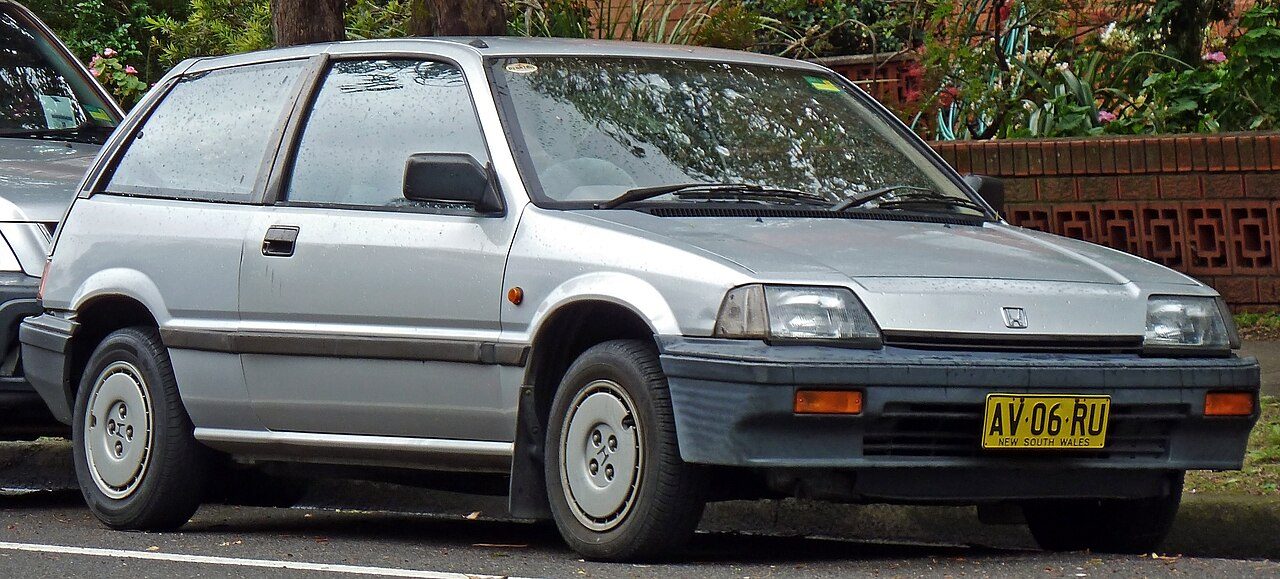
Honda Civic 2016
O 2016 Honda Civic veio com 2 motores: 1.5 L 4-cilindro turbo, 2.0 L 4-cilindro. Faz 12.8 a 14.9 km/l combinado dependendo do motor, segundo a EPA. NHTSA NCAP classifica em 5 de 5 estrelas. 5 campanhas de recall e 1,082 reclamações de proprietários estão registradas.
Especificações
| Cilindros | 4 |
|---|---|
| Câmbio | CVT (variável continuamente) |
| Tração | Dianteira (FWD) |
| Dimensões (C × L × A) | 4,560 × 1,880 × 1,405 mm (179.5 × 74.0 × 55.3 in) |
| Distância entre eixos | 2,700 mm (106.3 in) |
| Peso bruto | 1,284 kg (2,831 lb) |
| Carroceria | Carros de Médio Porte |
Dimensões e peso: mediana das 4 versões nas especificações oficiais do Canadá (NHTSA vPIC). Cada versão difere ligeiramente.
À venda em Estados Unidos
Segurança
Resultados de testes de colisão por mercado. Podem variar conforme versão e equipamento.
Economia de combustível (MPG)
🇺🇸 Dado localPor versão
| Motor | Câmbio | Tração | Cidade | Estrada | Misto |
|---|---|---|---|---|---|
| 1.5 L 4-cilindro turbo | CVT (variável continuamente) | Dianteira (FWD) | 13.2 km/l (31 MPG) | 17.9 km/l (42 MPG) | 14.9 km/l (35 MPG) |
| 1.5 L 4-cilindro turbo | CVT (variável continuamente) | Dianteira (FWD) | 13.2 km/l (31 MPG) | 17.5 km/l (41 MPG) | 14.9 km/l (35 MPG) |
| 2.0 L 4-cilindro | CVT (variável continuamente) | Dianteira (FWD) | 12.8 km/l (30 MPG) | 16.9 km/l (40 MPG) | 14.5 km/l (34 MPG) |
| 2.0 L 4-cilindro | CVT (variável continuamente) | Dianteira (FWD) | 12.8 km/l (30 MPG) | 16.7 km/l (39 MPG) | 14.5 km/l (34 MPG) |
| 2.0 L 4-cilindro | Manual · 6 marchas | Dianteira (FWD) | 11.5 km/l (27 MPG) | 16.1 km/l (38 MPG) | 13.2 km/l (31 MPG) |
| 2.0 L 4-cilindro | Manual · 6 marchas | Dianteira (FWD) | 11.1 km/l (26 MPG) | 15.6 km/l (37 MPG) | 12.8 km/l (30 MPG) |
Dados da EPA para cada versão vendida nos EUA.
Chamadas de retorno
Consequência · Solução
Air bags that deploy unintentionally during a crash increase the risk of injury.
Dealers will replace the seat weight sensors, free of charge. Owner notification letters were mailed July 7, 2026. Owners may contact Honda's customer service at 1-888-234-2138. Honda's numbers for this recall are BOL, WO9, OOA, WOM, XOH, NOC, POD, BOE, UOF, POB, EOG, AOI, QO8, TOJ, DO7, and SOK. This recall expands previous NHTSA recall number 24V064. Vehicle Identification Numbers (VINs) involved in this recall will be searchable on NHTSA.gov beginning May 29, 2026.
Consequência · Solução
Fuel pump failure can cause an engine stall while driving, increasing the risk of a crash.
Dealers will replace the fuel pump module, free of charge. Owner letters were mailed September 6, 2024. Owners may contact Honda customer service at 1-888-234-2138. Honda's numbers for this recall are KGC and KGD. This recall is an expansion of NHTSA recall numbers 21V-215 and 20V-314.
Consequência · Solução
If the EPB is not applied, the vehicle may roll away, increasing the risk of a crash.
Honda will notify owners, and dealers will update the vehicle's software to allow the EPB to engage immediately after the ignition is turned off, free of charge. The recall began on November 8, 2016. Owners may contact Honda customer service at 1-888-234-2138. Honda's number for this recall is KC6.
Consequência · Solução
If a side marker light does not function, vehicle visibility can be decreased to other drivers, increasing the risk of a crash.
Honda will notify owners, and dealers will inspect both the taillight assemblies, replacing them as necessary, free of charge. The recall began on August 31, 2016. Owners may contact Honda customer service at 1-888-234-2138. Honda's number for this recall is KB8.
Consequência · Solução
If a circlip is missing or incorrectly installed, the piston wrist pin may not be secure and may drift and damage the engine cylinder causing the engine to seize, and increasing the risk of a crash or a fire.
Honda will notify owners, and dealers will inspect and replace the piston assemblies and damaged engine components, as necessary, free of charge. Parts are expected to be available in the Summer of 2016. Owners were mailed an interim notification beginning March 31, 2016, and will be mailed a second notice when parts are available. Owners may contact Honda customer service at 1-888-234-2138. Honda's number for this recall is JX9.
Pode não se aplicar aos veículos vendidos no seu país. Verifique com seu VIN na fonte.
Detalhes
Issue: On certain vehicles, the weight sensor for the front passenger seat may not have been manufactured properly. As a result, the passenger-front airbag and knee airbag could deploy in a crash that doesn't require them to. Note: This recall is an expansion of Transport Canada recall no. 2024-059. If the weight sensor fails, the SRS warning light would turn on in the instrument panel. Safety Risk: An airbag system that doesn't work properly could increase the risk of injury in a crash. Corrective Actions: The company will notify owners by mail and advise you to take your vehicle to a dealership to replace the passenger-front seat weight sensor.
Detalhes
Certain two-door vehicles may not comply with the requirements of Canada Motor Vehicle Safety Standard (CMVSS) 108 - Lighting System and Retroreflective Devices. Some taillight assemblies may have a damaged rear LED side marker light, making it inoperable and are therefore not compliant with the requirements of the standard. This could reduce vehicle conspicuity, which could increase the risk of a crash causing injury and/or damage to property. Correction: Dealers will inspect, and, if necessary, replace the tail light assembly.
Detalhes
On certain vehicles equipped with 2.0L engines, a piston pin circlip may not have been installed or may have been improperly installed into the piston during assembly. If the circlip is not properly installed, over the course of engine operation, the piston pin will rub against the cylinder wall causing noise and damage, or in the worst case, the piston pin may detach from one side of the piston and cause an engine failure. Engine damage will eventually result in the engine stalling. Engine stalling would result in a loss of motive power; an engine failure would result in a sudden loss of motive power and may result in an under hood fire. These potential outcomes in conjunction with traffic and road conditions, and the driver's reactions, could increase the risk of a crash causing injury and/or property damage. Correction: Dealers will inspect, and repair as necessary.
Traduzido automaticamente do texto em holandês do RDW. O original está na fonte.
Pode não se aplicar aos veículos vendidos no seu país. Verifique com seu VIN na fonte.
Consequência · Solução
The vehicle stability enhancement modulator may be contaminated. This can hinder the correct operation of the anti-lock braking system and autonomous braking at low speeds. The CTBA system (City Brake Active System) may decelerate the vehicle less than intended, potentially not sufficiently reducing the consequences of a low-speed collision.
The manufacturer is recalling the affected vehicles. Measures will be taken to address the defect. The vehicle owner is requested to contact the authorized dealer or recognized repairer. They will replace the modulator.
Na estrada
Carros deste modelo registrados pela primeira vez em 2016, a partir de registros oficiais. Cada figura pertence ao seu país.
Problemas comuns
1082 relatos🇺🇸 Dado localRelatado por donos à fonte abaixo. Não é um veredito sobre este carro: é o que as pessoas escreveram.
Power steering rack needs replacement. No damage cause by myself. Later models of the same vehicle have recalls on the power steering rack. The steering wheel will “stick” when driving and i’ll have to use excessive force to turn the wheel even just slightly causing the vehicle to jerk around.
When driving at highway speeds/long distances, steering occasionally gets stiffer to the point where it will stick and require more force to free. This leads to overcorrections and constant adjustments for the duration of the drive, as well as difficulty staying in a lane. Issue can usually only be replicated when dri…
When the Honda Civic has been driven long enough for the steering to get warm, at highway speeds, the steering wheel will stick in position instead of centering itself. Manual adjustment has to be done to straighten the car.
Mostly during warm weather and driving over 45MPH the steering gets sticky. When attempting to use a little pressure to make a slight correction to keep the care centered in the lane the steering "jumps" and over steers requiring to re-correct to stay centered in the lane. I'm having to keep correcting the steering wh…
The contact owns a 2016 Honda Civic. The contact stated while driving 50 MPH, the steering wheel jerked, and the steering wheel was sticking. The contact stated that the failure was a known failure with the vehicle. The contact referenced an unknown recall; however, the VIN was not associated with a recall associated …
The check engine light came on the car had no power. The head gasket was blown.
My 2016 Honda Civic has developed a steering problem in which the steering feels sticky or notchy while driving. The steering wheel does not move smoothly when making small corrections and can feel like it catches or resists movement before releasing. This is especially noticeable while driving at higher speeds and ma…
Failure of my Electric Power Steering General Assembly/Steering Rack and Pinion in my 2016 Honda Civic EX sedan while driving at highway speeds. My steering wheel sticks or feels notchy at highway speeds requiring physical effort to overcome the binding. A highly reputable independent automotive shop (Gearheadz) in [X…
I've owned this 2016 Honda Civic since May of 2025. At first I never experienced any issue from the steering, that is when I started to notice that my steering felt like it would be sticking, like you couldn't balance yourself on highways or speeds exceeding 30+mph. I started doing my own research and discovered that …
My 2016 Honda Civic EX-T intermittently experiences a sticky/notchy steering condition, particularly while driving at highway speeds. When making small steering corrections around the straight-ahead/center position, the steering wheel sometimes resists movement and feels as though it is sticking or binding. Additional…
The vehicle has experienced repeated A/C refrigerant leaks. In March 2026, a Honda dealer replaced the condenser and compressor shaft seal under warranty. Several months later, the A/C again gradually lost cooling. The dealer diagnosed leaks from the evaporator, expansion valve, and two Schrader valves. The dealer quo…
Steering will feel notchy or sticky while driving, especially on the highway while trying to stay in a lane. This will cause excessive force to "unstick" the steering while will then require another steering correction. This has happening with the car since purchase (used) in 2020.
2016 vs. outros anos Civic
🇺🇸 Dado localReclamações de proprietários e campanhas de recall registradas na NHTSA para cada ano do modelo. Menos reclamações também podem significar menos carros vendidos ou um carro mais novo.
Perguntas
- Qual motor tem o 2016 Honda Civic?
- O 2016 Honda Civic veio com 2 motores: 1.5 L 4-cilindro turbo, 2.0 L 4-cilindro.
- Qual é a economia de combustível do 2016 Honda Civic?
- Faz 12.8 a 14.9 km/l combinado dependendo do motor, segundo a EPA.
- O 2016 Honda Civic é seguro?
- NHTSA NCAP classifica em 5 de 5 estrelas.
- O 2016 Honda Civic tem campanhas de recall?
- 5 campanhas de recall estão registradas. A mais recente envolve Air bags (2026-05-21).
- Quais são os problemas comuns do 2016 Honda Civic?
- 1,082 proprietários apresentaram reclamações, com mais frequência sobre steering.
Outros anos
Outros modelos da Honda
Você possui um 2016 Civic?
Publique-o gratuitamente e alcance compradores que já estão interessados neste carro exato.
- Gratuito, sem comissão
- Cerca de três minutos
- Seu anúncio aparece nesta página