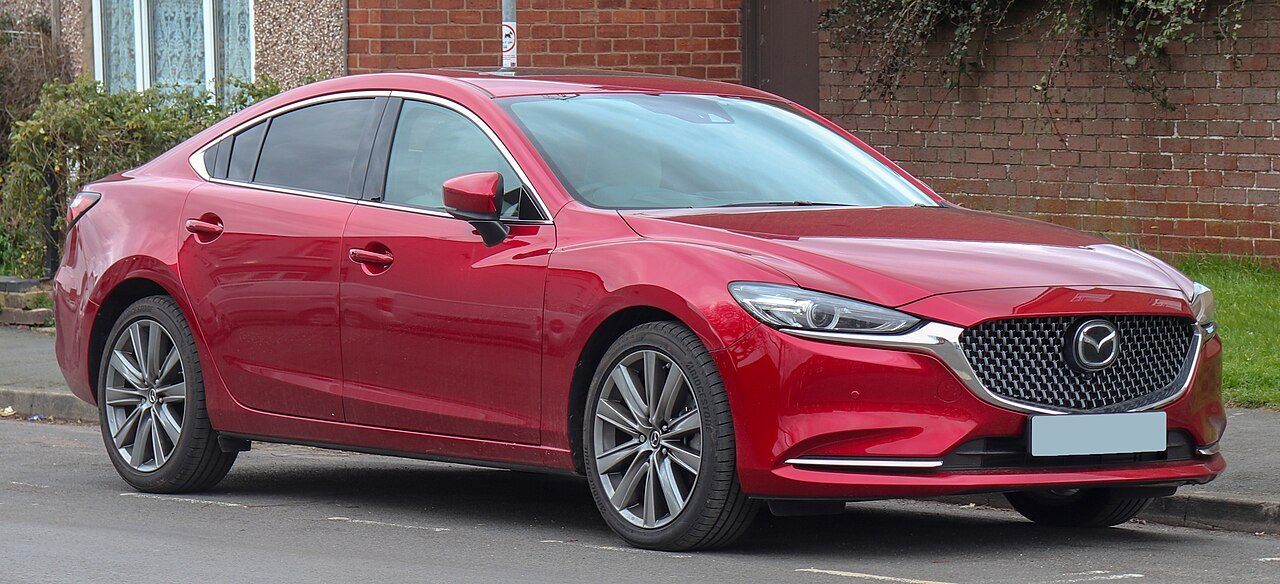
2013 Mazda 6
The 2013 Mazda 6 came with 2 engines: 2.5 L 4-cylinder, 3.7 L 6-cylinder. It gets 21 to 24 MPG combined depending on the engine, per the EPA. 10 recall campaigns are on record.
Specs
| Cylinders | 4 |
|---|---|
| Transmission | Automatic · 5 speeds |
| Drivetrain | Front-wheel (FWD) |
| Length | 1,546 mm (60.9 in) |
| Width | 1,608 mm |
| Curb weight | 1,313 kg (2,895 lb) |
| Seats | 5 |
| Body style | Midsize Cars |
Specs: average of the cars of this model first registered in 2013 in the Netherlands (RDW vehicle register).
For sale in United States
Fuel economy (MPG)
🇺🇸 Local dataBy version
| Engine | Transmission | Drivetrain | City | Highway | Combined |
|---|---|---|---|---|---|
| 2.5 L 4-cylinder | Automatic · 5 speeds | Front-wheel (FWD) | 21 MPG | 30 MPG | 24 MPG |
| 2.5 L 4-cylinder | Manual · 6 speeds | Front-wheel (FWD) | 21 MPG | 30 MPG | 24 MPG |
| 3.7 L 6-cylinder | Automatic · 6 speeds | Front-wheel (FWD) | 18 MPG | 27 MPG | 21 MPG |
EPA figures for each version sold in the U.S.
Recalls
Translated automatically from the RDW's Dutch text. The original is at the source.
It may not apply to vehicles sold in your country. Check with your VIN at the source.
Consequence · Remedy
The intake flap may become stuck in the closed position due to soot accumulation. This can prevent the intake flap from functioning properly. When the intake flap is blocked in the closed position, there is a possibility that the engine may stall spontaneously while driving.
The vehicle owner is requested to make an appointment with a brand dealer. The dealer will check the intake flap and clean or replace it if necessary. Additionally, the engine control unit will be updated with modified software.
Consequence · Remedy
The shaft of the vacuum pump of the braking system may wear out, the pressure in the injector's control circuit may become too high, and the mounting nuts of the injectors may not be sufficiently tightened. The capacity of the vacuum pump may decrease, resulting in reduced braking performance. Fuel injection may fail, causing the engine to stall and the vehicle to stop. Combustion gas leaks may occur, which can clog the oil filter and potentially cause the engine to seize.
The vehicle owner is requested to make an appointment with a brand dealer. The dealer will replace the vacuum pump, perform a software update of the engine control unit, and check the torque of the injectors, securing them with the correct torque.
Consequence · Remedy
The shaft of the vacuum pump of the braking system may wear out and the pressure in the injector's control circuit may become too high. The capacity of the vacuum pump may decrease, resulting in reduced braking performance. Fuel injection may fail, causing the engine to stall and the vehicle to stop.
The vehicle owner is requested to make an appointment with a brand dealer. The dealer will replace the vacuum pump and perform a software update of the engine control unit.
Consequence · Remedy
The sealing boot of the mechanical part of the parking brake on the rear brake caliper does not seal properly. As a result, corrosion can form on the mechanical part, and the mechanical part can become stuck. The parking brake may not work effectively. This can cause the vehicle to move if it is parked on an incline.
The vehicle owner is requested to make an appointment with a brand dealer. They will check the rear brake calipers and, if necessary, replace the caliper or install a modified sealing boot.
Consequence · Remedy
The tailgate dampers are insufficiently protected against corrosion. As a result, the wall thickness of the dampers may decrease. The tailgate dampers may break when opening the tailgate. This can cause the tailgate to slam shut and the broken pieces to hurt bystanders.
The manufacturer is recalling the affected vehicles. Measures are being taken to address the defect. The vehicle owner is requested to make an appointment with a brand dealer. They will replace the tailgate dampers.
Consequence · Remedy
The clamps of the engine air intake hose have been tightened with inadequate torque. As a result, the clamps may loosen and the air intake hose may come off. If the air intake hose comes loose, sudden power loss will occur.
The manufacturer is recalling the affected vehicles. Actions will be taken to address the defect. The vehicle owner is invited to make an appointment with a brand dealer soon. The dealer will check the clamp connections and replace and/or properly tighten them if necessary.
Consequence · Remedy
The pressure relief valve of the oil filter may operate at too low a pressure. Unfiltered engine oil then reduces the capacity of the vacuum pump of the braking system. Brake assist and thus braking capacity may decrease.
The manufacturer is recalling the affected vehicles. Measures will be taken to rectify the defect. The vehicle owner is requested to make an appointment with a brand dealer. The operation of the vacuum pump will be checked. The engine will be flushed, and the oil filter and engine oil will be replaced. If necessary, the vacuum pump will be replaced.
Consequence · Remedy
The software of the Powertrain Control Module (PCM) contains an error. As a result, if the alternator belt slips due to driving through deep puddles or in heavy rain, the PCM may interpret this as a defective capacitor. If this situation occurs, the PCM will stop charging the battery. This causes the battery to gradually drain, leading to the 'orange' engine warning light illuminating and a decrease in engine power. Additionally, steering assistance will diminish, the wiper function will fail, and ultimately the engine will stall.
The manufacturer recalls the affected vehicles. Measures are taken to rectify the defect. Vehicle owners are invited to make an appointment with a brand dealer or authorized repairer. They will install an updated software version in the PCM.
Consequence · Remedy
There is a possibility that the exhaust gas pressure sensor may be affected by the exhaust gases. This sensor then sends an incorrect signal to the engine management computer. As a result, the orange check engine light will illuminate on the instrument panel. The engine management will then switch to limp mode, negatively affecting exhaust gas emissions.
The manufacturer is recalling the affected vehicles. Measures will be taken to rectify the defect. Vehicle owners are invited to make an appointment with a brand dealer. The production number of the exhaust gas pressure sensor will then be checked. If the sensor has an incorrect production number, it will be replaced.
Consequence · Remedy
Cracks may occur in one of the electronic components of the DC-DC converter. There is a possibility of a short circuit in the DC-DC converter. This can cause smoke development and, in the worst case, pose a fire hazard.
The manufacturer recalls the affected vehicles and takes measures to rectify the defect. The vehicle owner is invited to make an appointment with a brand dealer to have the vehicle repaired. The dealer will replace the DC-DC converter.
On the road
Cars of this model first registered in 2013, from official registers. Each figure belongs to its country.
🇳🇱 Vehicle register, Netherlands
225 still registered
5% with an open recall
Average list price when new: 36,989 € (Dutch taxes included) · RDW, CC0
Questions
- What engine does the 2013 Mazda 6 have?
- The 2013 Mazda 6 came with 2 engines: 2.5 L 4-cylinder, 3.7 L 6-cylinder.
- What is the fuel economy of the 2013 Mazda 6?
- It gets 21 to 24 MPG combined depending on the engine, per the EPA.
- Does the 2013 Mazda 6 have recalls?
- 10 recall campaigns are on record. The latest concerns Engine and engine cooling, fuel system (2019-06-06).
Other years
Other models by Mazda
Do you own a 2013 6?
Post it for free and reach buyers who are already looking at this exact car.
- Free, with no commission
- About three minutes
- Your listing shows up on this page