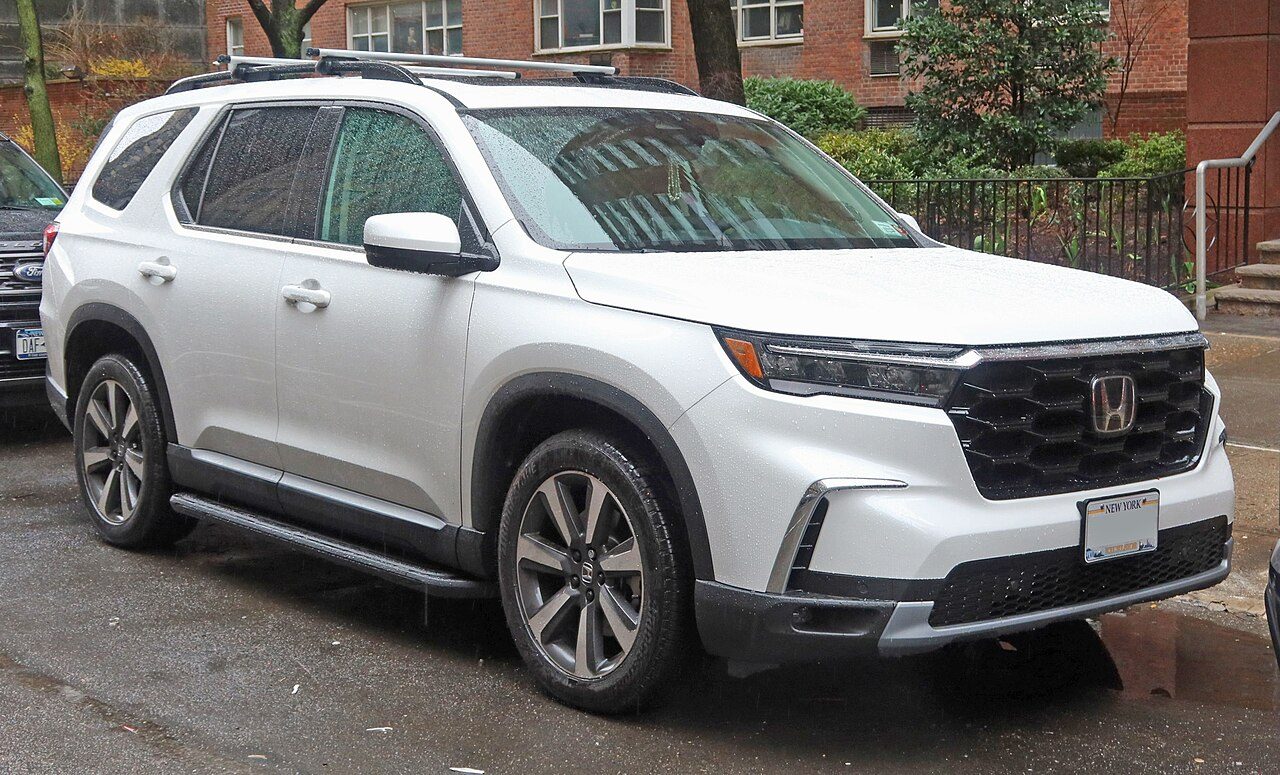
Honda Pilot 2003
El 2003 Honda Pilot tiene un motor de 3.5 L. Obtiene 7.2 km/l combinado (6.4 ciudad, 8.9 autopista), según la EPA. 14 campañas de retiro y 40 quejas de propietarios están registradas.
Especificaciones
| Cilindros | 6 |
|---|---|
| Transmisión | Automática · 5 velocidades |
| Tracción | AWD |
| Dimensiones (L × A × H) | 4,780 × 1,960 × 1,790 mm (188.2 × 77.2 × 70.5 in) |
| Distancia entre ejes | 2,690 mm (105.9 in) |
| Peso en vacío | 2,007 kg (4,425 lb) |
| Estilo de carrocería | Vehículo Utilitario Deportivo - 4WD |
Dimensiones y peso: especificaciones oficiales de Canadá (NHTSA vPIC).
A la venta en Estados Unidos
Seguridad
Resultados de pruebas de choque por mercado. Pueden variar según versión y equipamiento.
Economía de combustible (MPG)
🇺🇸 Dato localLlamados a revisión
Traducción automática del texto oficial. El original está en la fuente.
Consecuencia · Remedio
Una explosión del inflador puede resultar en fragmentos de metal afilados golpeando al conductor u otros ocupantes, resultando en lesiones graves o muerte.
Honda notificará a los propietarios, y los concesionarios reemplazarán el inflador de la bolsa de aire frontal del conductor, sin costo alguno. El retiro comenzó el 12 de agosto de 2019. Los propietarios pueden contactar al servicio al cliente de Honda al 1-888-234-2138. Los números de Honda para este retiro son Q5A y Y58.
Consecuencia · Remedio
Una explosión del inflador puede resultar en fragmentos de metal afilados golpeando al conductor u otros ocupantes, resultando en lesiones graves o muerte.
Honda notificará a los propietarios, y los concesionarios reemplazarán el inflador del airbag frontal del pasajero, sin costo alguno. El retiro comenzó el 12 de agosto de 2019. Los propietarios pueden contactar el servicio al cliente de Honda al 1-888-234-2138. Los números de Honda para este retiro son E5D y X5C.
Consecuencia · Remedio
Una explosión de un inflador dentro del módulo del airbag frontal del conductor puede resultar en fragmentos de metal afilados golpeando al conductor, al pasajero del asiento delantero u otros ocupantes, resultando en lesiones graves o muerte.
Honda notificará a los propietarios, y los concesionarios reemplazarán el inflador del airbag del conductor con un inflador alternativo, sin cargo. El recall comenzó el 10 de abril de 2019. Los propietarios de Honda pueden contactar al servicio al cliente al 1-888-234-2138. El número de Honda para este recall es O41. Los propietarios de Acura pueden contactar al servicio al cliente al 1-888-234-2138. El número de Acura para este recall es U40.
Consecuencia · Remedio
Un airbag instalado incorrectamente puede desplegarse de manera inapropiada en caso de un choque, aumentando el riesgo de lesión.
Honda notificará a los propietarios, y los concesionarios inspeccionarán y, si es necesario, reemplazarán el ensamblaje del módulo del airbag frontal del pasajero, sin cargo. El retiro comenzó el 22 de junio de 2018. Los propietarios pueden contactar al servicio al cliente de Honda al 1-888-234-2138. Los números de Honda para este retiro son K1P y M1O.
Consecuencia · Remedio
Un ruptura del inflador puede resultar en fragmentos de metal que impacten a los ocupantes del vehículo, resultando en lesiones graves o muerte.
Honda notificará a los propietarios, y los concesionarios reemplazarán el inflador del airbag frontal del pasajero, sin costo alguno. El retiro comenzó el 27 de junio de 2016. Los propietarios pueden contactar el servicio al cliente de Honda al 1-888-234-2138. Los números de Honda para este retiro son KA0, KA1, KA2 y KA3.
Consecuencia · Remedio
En caso de un accidente que requiera el despliegue del airbag frontal del pasajero, el inflador podría romperse con fragmentos metálicos que impacten al ocupante del asiento del pasajero u otros ocupantes, posiblemente causando lesiones graves o la muerte.
Honda notificará a los propietarios, y los concesionarios reemplazarán el inflador del airbag del pasajero, sin costo alguno. El retiro comenzó el 1 de julio de 2015. Los propietarios pueden contactar el servicio al cliente de Honda al 1-888-234-2138. Los números de Honda para este retiro son JU4, JU5, JU6 y JU7. Nota: Los vehículos que ya han recibido un inflador de airbag del pasajero como parte de la solución de retiro de una campaña anterior, como 14V353 o 14V700 (números de retiro de Honda S95, JH6, JH7, JH8, JH9, JJ0, JJ1, JJ2, JJ6, JM5 y JM6) no están incluidos en este retiro. Sin embargo, este retiro anula 13V132 y 14V349. Nota: El 18 de diciembre de 2015, Honda informó a la NHTSA de una expansión de este retiro para incluir ciertos vehículos Honda CR-V del año modelo 2004, además de vehículos CR-V del año modelo 2003 adicionales.
Consecuencia · Remedio
En caso de un accidente que requiera el despliegue del airbag frontal del conductor, el inflador podría romperse con fragmentos metálicos que impacten al conductor u otros ocupantes, resultando en lesiones graves o la muerte.
Honda notificará a los propietarios, y los concesionarios reemplazarán el inflador de la bolsa de aire frontal del conductor, sin costo alguno. El retiro comenzó el 1 de julio de 2015. Los propietarios pueden contactar al servicio al cliente de Honda al 1-888-234-2138. Los propietarios pueden contactar al servicio al cliente de Acura al 1-800-382-2238, seleccionando la opción 4. Nota: Los vehículos que hayan tenido su bolsa de aire frontal del conductor reemplazada previamente como parte de un remedio de retiro antes del 12 de septiembre de 2014 deben reemplazar su bolsa de aire bajo este retiro también. Los vehículos que, a partir del 12 de septiembre de 2014, recibieron un remedio por un retiro previo de inflador de bolsa de aire frontal del conductor ya recibieron un inflador de un diseño diferente, y por lo tanto no están incluidos en este retiro y no requieren servicio adicional. Nota: Este retiro reemplaza completamente los retiros 08V-593, 09V-259, 10V-041, 11V-260, 14V-351 y 15V-153. Los números de Honda para este retiro son JQ9, JR0, JR1, JR2, JR3, JR4, JR5, JR6, JR7 y JR8.
Consecuencia · Remedio
En caso de un accidente que requiera el despliegue del airbag frontal del pasajero, el inflador podría romperse con fragmentos metálicos que impacten a los ocupantes del vehículo, lo que podría resultar en lesiones graves o la muerte.
Honda notificará a los propietarios, y los concesionarios reemplazarán el inflador del airbag del lado del pasajero, sin costo alguno. El retiro comenzó el 26 de enero de 2015. Los propietarios pueden contactar el servicio al cliente de Honda al 1-800-999-1009.
Consecuencia · Remedio
En caso de un accidente que requiera el despliegue del airbag frontal del pasajero, el inflador podría romperse con fragmentos metálicos que impacten a los ocupantes del vehículo, lo que podría resultar en lesiones graves o la muerte.
Honda notificará a los propietarios, y los concesionarios reemplazarán los infladores en todos los vehículos afectados, sin cargo. Se espera que el recall comience en agosto de 2014. Los propietarios pueden contactar al servicio al cliente de Honda al 1-800-999-1009.
Consecuencia · Remedio
La extracción de la llave de encendido cuando el selector de marchas de un vehículo con transmisión automática no se ha colocado en la posición de estacionamiento puede permitir que el vehículo se desplace, aumentando el riesgo de un accidente.
Honda notificará a los propietarios e instruirá a llevar su vehículo a un concesionario Honda o Acura. El concesionario instalará una palanca de interbloqueo de cambio actualizada y, si es necesario, reemplazará cualquier parte necesaria del interruptor de encendido, sin costo alguno. El retiro comenzó el 22 de febrero de 2013. Los propietarios pueden contactar a Honda al 1-800-999-1009.
Consecuencia · Remedio
SI LOS EXTREMOS DEL TERMINAL SE FUNDEN DENTRO DEL CONECTOR DEL ARNESES ELÉCTRICO, LOS FAROS DE LUZ BAJA PUEDEN QUEDAR INOPERATIVOS, REDUCIENDO LA VISIBILIDAD DEL CONDUCTOR Y AUMENTANDO EL RIESGO DE UN ACCIDENTE.
HONDA NOTIFICARÁ A LOS PROPIETARIOS, Y LOS CONCESIONARIOS REPARARÁN EL ARNES DEL TERMINAL DE LAS LUCES BAJAS O REEMPLAZARÁN EL INTERRUPTOR DE ILUMINACIÓN SEGÚN SEA NECESARIO, SIN CARGO. EL RETIRO ORIGINAL COMENZÓ EN ABRIL DE 2012. LOS PROPIETARIOS DE VEHÍCULOS INVOLUCRADOS EN LA EXPANSIÓN DE SEPTIEMBRE DE 2012 SERÁN NOTIFICADOS EN SEPTIEMBRE DE 2012. LOS PROPIETARIOS PUEDEN CONTACTAR AL SERVICIO AL CLIENTE DE HONDA AL 1-800-999-1009.
Consecuencia · Remedio
AL MOVER EL SOPORTE DEL BRAZO DE LA BICI A SU POSICIÓN ABAJO, ESTE TORNILLO DE APRIETE TIENE EL POTENCIAL DE CAUSAR LACERACIONES SEVERAS O AMPUTACIONES EN LAS YEMAS O MANO DEL USUARIO.
LOS PROPIETARIOS DEBEN CONTACTAR A THULE AL 800-THULE91 (800-848-5391) PARA OBTENER UN KIT DE REPARACIÓN GRATUITO JUNTO CON INSTRUCCIONES DE REPARACIÓN O LOS PROPIETARIOS PUEDEN CONTACTAR A HONDA AL 1-800-999-1009 O ACURA AL 1-800-382-2238 PARA MÁS INFORMACIÓN.
Consecuencia · Remedio
LA FALLA DE LA ENGRENAGEM PODRÍA RESULTAR EN UN BLOQUEO DE LA TRANSMISIÓN, LO QUE PODRÍA RESULTAR EN UN ACCIDENTE.
EN VEHÍCULOS CON 15,000 MILLAS O MENOS, EL CONCESIONARIO ACTUALIZARÁ LA TRANSMISIÓN CON UNA REVISION SIMPLE DE LA LÍNEA DE RETORNO DEL ENFRIADOR DE ACEITE PARA AUMENTAR LA LUBRICACIÓN DE LA SEGUNDA MARCHA. EN VEHÍCULOS CON MÁS DE 15,000 MILLAS, EL CONCESIONARIO INSPECCIONARÁ LA TRANSMISIÓN PARA IDENTIFICAR ENGRANAJES QUE YA HAN EXPERIMENTADO DESCOLORACIÓN DEBIDO AL SOBRECALENTAMIENTO. SI EXISTE DESCOLORACIÓN, SE SUSTITUIRÁ LA TRANSMISIÓN. SI NO HAY PRESENTE DESCOLORACIÓN, EL CONCESIONARIO REALIZARÁ LA REVISION A LA LÍNEA DE RETORNO DEL ENFRIADOR DE ACEITE. EL RECUERDO INICIA EL 21 DE ABRIL DE 2004, PARA PROPIETARIOS DE PILOT, ODYSSEY Y MDX. LOS PROPIETARIOS DE LOS VEHÍCULOS ACCORD RECIBIRÁN CARTAS A PARTIR DEL 28 DE JUNIO DE 2004, Y EL 29 DE JUNIO DE 2004, PARA PROPIETARIOS DE VEHÍCULOS TL Y CL. LOS PROPIETARIOS DEBEN CONTACTAR A HONDA AL 1-800-999-1009 O ACURA AL 1-800-382-2238.
Consecuencia · Remedio
SI LA CORREAS DE DISTRIBUCIÓN SE ROMPE, EL MOTOR SE DETENDRÁ, AUMENTANDO EL RIESGO DE UN ACCIDENTE.
LOS CONCESIONARIOS INSPECCIONARÁN LA BOMBA DE AGUA Y SI ES UNA DE LAS BOMBAS DEFECTUOSAS, LA BOMBA DE AGUA Y LA CORREA DE DISTRIBUCIÓN SERÁN REEMPLAZADAS. LA NOTIFICACIÓN A LOS PROPIETARIOS COMENZÓ EL 30 DE AGOSTO DE 2002. LOS PROPIETARIOS QUE LLEVEN SUS VEHÍCULOS A UN CONCESIONARIO AUTORIZADO EN UNA FECHA DE SERVICIO ACORDADA Y NO RECIBAN LA SOLUCIÓN GRATUITA EN UN TIEMPO RAZONABLE DEBERÍAN CONTACTAR A HONDA AL 1-800-999-1009 O A ACURA AL 1-800-382-2238.
Traducción automática del texto oficial. El original está en la fuente.
Puede no aplicar a los vehículos vendidos en tu país. Verifica con tu VIN en la fuente.
Detalles
Issue: On certain vehicles, long-term exposure to high absolute humidity and temperature, combined with high temperature cycling, may eventually degrade the propellant contained in the airbag. This could cause the airbag to deploy with more force than normal. If the airbag inflator ruptures, fragments could be propelled toward vehicle occupants or cause damage to the airbag assembly, preventing its proper function. Note: This is a new recall campaign that includes vehicles that had an airbag inflator replaced under a previous recall or had a replacement airbag installed. The previous recall provided an interim (short-term) repair. Interim repair parts must be replaced with the final repair parts provided in this recall. Safety Risk: If the vehicle is involved in a crash requiring an airbag deployment, the airbag inflator could rupture and create a risk of injury. Corrective Action: Owners will be notified by mail and instructed to take their vehicle to a dealer to replace the driver and/or passenger-front airbag inflator. Note: The Canadian climate results in the propellant degrading slowly. This recall is being conducted as a precaution to address future risk. It is expected that all airbag inflators will be replaced before their function would be affected.
Detalles
Issue: On certain vehicles, there could be a problem with the driver-front airbag inflator. This could cause the airbag to deploy with more force than normal. If the airbag inflator ruptures, pieces could be propelled toward the occupants. This could also cause damage to the airbag assembly and prevent it from inflating properly. Note: This recall only affects certain vehicles that had a Takata airbag inflator installed during a previous airbag recall or collision repair. Safety Risk: In a crash where the airbag deploys, there could be an increased risk of injury. Corrective Action: The company will notify owners by mail. Owners will be instructed to take their vehicle to a dealer to have the driver-front airbag inflator replaced.
Detalles
On certain vehicles, the driver frontal airbag inflator could produce excessive internal pressure during airbag deployment. Increased pressure may cause the inflator to rupture, which could allow fragments to be propelled toward vehicle occupants, increasing the risk of injury. This could also damage the airbag module, which could prevent proper deployment. Failure of the airbag to fully deploy during a crash (where deployment is warranted) could increase the risk of personal injury to the seat occupant. Note: This recall supersedes special service campaign 2014567. Correction: Dealers will inspect/replace the driver's frontal airbag inflator. All vehicles having received a replacement inflator as part of any previous driver's inflator campaign will have a replacement inflator installed. Note: Honda Canada has created a special Airbag Inflator Hotline for immediate assistance. For more information, please contact: For Honda Owners: 1-877-445-7754 For Acura Owners: 1-877-445-9844
Detalles
Honda Canada is conducting a voluntary Safety Improvement Campaign concerning the driver's airbag inflator on certain vehicles equipped with Takata airbags. Honda will replace the driver's inflator on affected vehicles. This action is not being conducted under the requirements of the Motor Vehicle Safety Act. Note: This special service campaign was replaced by recall 2015225. Please see recall 2015225 for more information: <a href="http://wwwapps.tc.gc.ca/Saf-Sec-Sur/7/VRDB-BDRV/search-recherche/detail.aspx?lang=eng&&rn=2015225">Click here for more information</a>
Detalles
On certain vehicles, the passenger (frontal) airbag inflator could produce excessive internal pressure during airbag deployment. Increased pressure may cause the inflator to rupture, which could allow fragments to be propelled toward vehicle occupants, increasing the risk of injury. This could also damage the airbag module, which could prevent proper deployment. Failure of the passenger airbag to fully deploy during a crash (where deployment is warranted) could increase the risk of personal injury to the seat occupant. Correction: Dealers will inspect and, if necessary, replace the passenger airbag inflator. Note: This recall is an expansion of recall 2013111. Honda Canada has created a special Airbag Inflator Hotline for immediate assistance. For more information, please contact: For Honda Owners: 1-877-445-7754 For Acura Owners: 1-877-445-9844
Detalles
On certain vehicles, the ignition interlock blocking mechanism could become damaged if excessive force is applied to the ignition key. If this occurs, it may become possible for the driver to remove the ignition key when the gear selector is in a position other than the Park position. This could allow the vehicle to roll away, increasing the risk of a crash causing personal injury and/or damage to property. Correction: Dealers will install an updated ignition interlock lever and replace the ignition lock cylinder if necessary.
Detalles
Certain operating conditions can result in heat build-up between the countershaft and secondary shaft second gears in the automatic transmission, eventually leading to gear tooth chipping or, in very rare cases, gear breakage can occur. Gear failure could result in transmission lock-up. Correction: On vehicles with 24 000 kms or less, the dealer will update the transmission with a simple revision to the oil cooler return line to increase lubrication to second gear. On vehicles with more than 24 000 kms, the dealer will inspect the transmission to identify gears that have already experienced discoloration due to overheating. If discolouration exists, the transmission will be replaced. If discolouration is not present, the dealer will perform the revision to the oil cooler return line.
Problemas comunes
40 reportes🇺🇸 Dato localReportado por dueños a la fuente de abajo. No es un veredicto sobre este auto: es lo que la gente escribió.
Odometer Fraud. The contact purchased a 2003 Honda Pilot. While having an oil change performed, it was discovered that there was a mileage discrepancy. The vehicle was a dealer sale. At the time of purchase, the vehicle mileage was 138,000, and at the time of service, it was discovered that the mileage was 217,000.
I am the original owner of my 2003 Honda pilot and had to replace the front driver side door actuator years ago. Now all the remaining 3 doors need to have the door actuators replaced. If you're outside the car you cannot open the door. Using the key remote or putting the key into the front door keyhole will NOT unloc…
The contact owns a 2003 Honda Pilot. The contact stated that while driving at 60 MPH, the vehicle stalled. The contact stated that the vehicle violently jolted forward with several unknown warning lights illuminated. The contact drove the vehicle to the shoulder of the road. The failure had occurred while driving on a…
The contact owns a 2003 Honda Pilot. The contact stated that while starting the vehicle, the vehicle failed to shift into gear properly, with the check engine warning light illuminated. The dealer was contacted; however, the vehicle was not diagnosed or repaired. The manufacturer was not made aware of the failure. The…
Reporting an important safety issue I experienced due to random engine stalling on my 2003 Honda Pilot, typically after driving for a few minutes. The engine would crank for several seconds or sometimes start immediately after stalling, but no diagnostic trouble codes were ever stored. The vehicle had stable fuel trim…
the power steering losses fluid the steering is hard to turn and makes noise and the fluid gets on an area that gets hot i have not had an accident yet
Water leaked into front floors of vehicle soaking the carpet and the fuse panels in the floor. Yes it is available. Fuse boxes had standing water building up behind them slowly dumping water into them causing shorts in electrical system which could have caused the car to catch on fire. Yes the problem has been confi…
Transmission, overheating, loss of oil, loss of gears when driving,
severe erosion of my undecarriage, metal just falls off from under the car. My fuel tank leaks and gas pours out. It has been deemed unsafe to drive by my Honda dealer, but has a good engine and other parts. It has been severely impacted by rust and erosion. The previous owner was a resident of Chicago, where salt…
SRS airbag light stays on.
My 2003 Honda pilot rear subframe suspension is rusting and causing control issues. This is a common problem on the 2003-2008 Honda Pilots. In Honda TSB 21-019 Honda states " The subframe mounts may pull away from the body of the vehicle (see images below), but extensive testing has concluded that vehicle stability …
The contact owns a 2003 Honda Pilot. The contact stated that while the vehicle was parked unattended, the vehicle rolled out of the garage and crashed into the neighbor's home. There were no warning lights illuminated. The local dealer was not contacted. The vehicle was not diagnosed or repaired. The manufacturer was …
Preguntas
- ¿Qué motor tiene el 2003 Honda Pilot?
- El 2003 Honda Pilot tiene un motor de 3.5 L.
- ¿Cuál es la economía de combustible del 2003 Honda Pilot?
- Obtiene 7.2 km/l combinado (6.4 ciudad, 8.9 autopista), según la EPA.
- ¿Tiene el 2003 Honda Pilot campañas de retiro?
- 14 campañas de retiro están registradas. La más reciente concierne a Air Bags (2019-06-27).
- ¿Cuáles son los problemas comunes del 2003 Honda Pilot?
- 40 propietarios han presentado quejas, la mayoría sobre Air Bags.
Otros años
¿Qué año de Honda Pilot comprar? Recall y quejas por añoOtros modelos de Honda
¿Tienes uno?
Publícalo gratis y llega a compradores que ya están buscando este auto en particular.