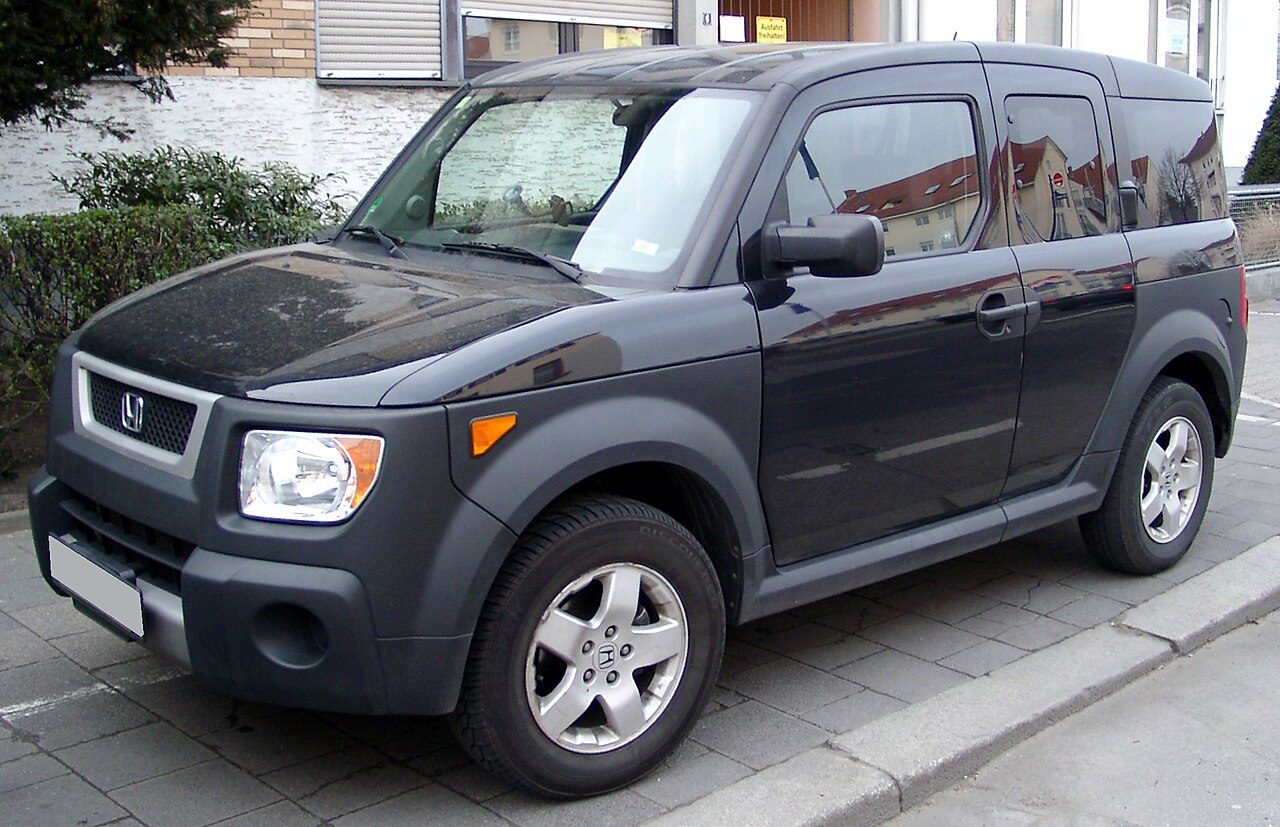
Honda Element 2003
El 2003 Honda Element tiene un motor de 2.4 L. Obtiene 8.5 km/l combinado (8.1 ciudad, 9.8 autopista), según la EPA. 12 campañas de retiro y 40 quejas de propietarios están registradas.
Especificaciones
| Cilindros | 4 |
|---|---|
| Transmisión | Automática · 4 velocidades |
| Tracción | AWD |
| Dimensiones (L × A × H) | 4,300 × 1,820 × 1,880 mm (169.3 × 71.7 × 74.0 in) |
| Distancia entre ejes | 2,580 mm (101.6 in) |
| Peso en vacío | 1,631 kg (3,596 lb) |
| Estilo de carrocería | Vehículo Utilitario Deportivo - 2WD |
Dimensiones y peso: especificaciones oficiales de Canadá (NHTSA vPIC).
A la venta en Estados Unidos
Seguridad
Resultados de pruebas de choque por mercado. Pueden variar según versión y equipamiento.
Economía de combustible (MPG)
🇺🇸 Dato localPor versión
| Motor | Transmisión | Tracción | Ciudad | Autopista | Mixto |
|---|---|---|---|---|---|
| 2.4 L 4-cilindro | Automática · 4 velocidades | AWD | 8.1 km/l (19 MPG) | 9.8 km/l (23 MPG) | 8.5 km/l (20 MPG) |
| 2.4 L 4-cilindro | Automática · 4 velocidades | Delantera (FWD) | 8.5 km/l (20 MPG) | 10.2 km/l (24 MPG) | 8.9 km/l (21 MPG) |
| 2.4 L 4-cilindro | Manual · 5 velocidades | AWD | 7.6 km/l (18 MPG) | 9.3 km/l (22 MPG) | 8.5 km/l (20 MPG) |
| 2.4 L 4-cilindro | Manual · 5 velocidades | Delantera (FWD) | 8.1 km/l (19 MPG) | 10.2 km/l (24 MPG) | 8.9 km/l (21 MPG) |
Cifras de la EPA para cada versión vendida en EE. UU.
Llamados a revisión
Traducción automática del texto oficial. El original está en la fuente.
Consecuencia · Remedio
Una explosión del inflador puede resultar en fragmentos de metal afilados golpeando al conductor u otros ocupantes, resultando en lesiones graves o muerte.
Honda notificará a los propietarios, y los concesionarios reemplazarán el inflador de la bolsa de aire frontal del conductor, sin costo alguno. El retiro comenzó el 12 de agosto de 2019. Los propietarios pueden contactar al servicio al cliente de Honda al 1-888-234-2138. Los números de Honda para este retiro son Q5A y Y58.
Consecuencia · Remedio
Una explosión del inflador puede resultar en fragmentos de metal afilados golpeando al conductor u otros ocupantes, resultando en lesiones graves o muerte.
Honda notificará a los propietarios, y los concesionarios reemplazarán el inflador del airbag frontal del pasajero, sin costo alguno. El retiro comenzó el 12 de agosto de 2019. Los propietarios pueden contactar el servicio al cliente de Honda al 1-888-234-2138. Los números de Honda para este retiro son E5D y X5C.
Consecuencia · Remedio
Una explosión de un inflador dentro del módulo del airbag frontal del conductor puede resultar en fragmentos de metal afilados golpeando al conductor, al pasajero del asiento delantero u otros ocupantes, resultando en lesiones graves o muerte.
Honda notificará a los propietarios, y los concesionarios reemplazarán el inflador del airbag del conductor con un inflador alternativo, sin cargo. El recall comenzó el 10 de abril de 2019. Los propietarios de Honda pueden contactar al servicio al cliente al 1-888-234-2138. El número de Honda para este recall es O41. Los propietarios de Acura pueden contactar al servicio al cliente al 1-888-234-2138. El número de Acura para este recall es U40.
Consecuencia · Remedio
Un airbag instalado incorrectamente puede desplegarse de manera inapropiada en caso de un choque, aumentando el riesgo de lesión.
Honda notificará a los propietarios, y los concesionarios inspeccionarán y, si es necesario, reemplazarán el ensamblaje del módulo del airbag frontal del pasajero, sin cargo. El retiro comenzó el 22 de junio de 2018. Los propietarios pueden contactar al servicio al cliente de Honda al 1-888-234-2138. Los números de Honda para este retiro son K1P y M1O.
Consecuencia · Remedio
Un ruptura del inflador puede resultar en fragmentos de metal que impacten a los ocupantes del vehículo, resultando en lesiones graves o muerte.
Honda notificará a los propietarios, y los concesionarios reemplazarán el inflador del airbag frontal del pasajero, sin costo alguno. El retiro comenzó el 27 de junio de 2016. Los propietarios pueden contactar el servicio al cliente de Honda al 1-888-234-2138. Los números de Honda para este retiro son KA0, KA1, KA2 y KA3.
Consecuencia · Remedio
En caso de un accidente que requiera el despliegue del airbag frontal del pasajero, el inflador podría romperse con fragmentos metálicos que impacten al ocupante del asiento del pasajero u otros ocupantes, posiblemente causando lesiones graves o la muerte.
Honda notificará a los propietarios, y los concesionarios reemplazarán el inflador del airbag del pasajero, sin costo alguno. El retiro comenzó el 1 de julio de 2015. Los propietarios pueden contactar el servicio al cliente de Honda al 1-888-234-2138. Los números de Honda para este retiro son JU4, JU5, JU6 y JU7. Nota: Los vehículos que ya han recibido un inflador de airbag del pasajero como parte de la solución de retiro de una campaña anterior, como 14V353 o 14V700 (números de retiro de Honda S95, JH6, JH7, JH8, JH9, JJ0, JJ1, JJ2, JJ6, JM5 y JM6) no están incluidos en este retiro. Sin embargo, este retiro anula 13V132 y 14V349. Nota: El 18 de diciembre de 2015, Honda informó a la NHTSA de una expansión de este retiro para incluir ciertos vehículos Honda CR-V del año modelo 2004, además de vehículos CR-V del año modelo 2003 adicionales.
Consecuencia · Remedio
En caso de un accidente que requiera el despliegue del airbag frontal del conductor, el inflador podría romperse con fragmentos metálicos que impacten al conductor u otros ocupantes, resultando en lesiones graves o la muerte.
Honda notificará a los propietarios, y los concesionarios reemplazarán el inflador de la bolsa de aire frontal del conductor, sin costo alguno. El retiro comenzó el 1 de julio de 2015. Los propietarios pueden contactar al servicio al cliente de Honda al 1-888-234-2138. Los propietarios pueden contactar al servicio al cliente de Acura al 1-800-382-2238, seleccionando la opción 4. Nota: Los vehículos que hayan tenido su bolsa de aire frontal del conductor reemplazada previamente como parte de un remedio de retiro antes del 12 de septiembre de 2014 deben reemplazar su bolsa de aire bajo este retiro también. Los vehículos que, a partir del 12 de septiembre de 2014, recibieron un remedio por un retiro previo de inflador de bolsa de aire frontal del conductor ya recibieron un inflador de un diseño diferente, y por lo tanto no están incluidos en este retiro y no requieren servicio adicional. Nota: Este retiro reemplaza completamente los retiros 08V-593, 09V-259, 10V-041, 11V-260, 14V-351 y 15V-153. Los números de Honda para este retiro son JQ9, JR0, JR1, JR2, JR3, JR4, JR5, JR6, JR7 y JR8.
Consecuencia · Remedio
En caso de un accidente que requiera el despliegue del airbag frontal del pasajero, el inflador podría romperse con fragmentos metálicos que impacten a los ocupantes del vehículo, lo que podría resultar en lesiones graves o la muerte.
Honda notificará a los propietarios, y los concesionarios reemplazarán el inflador del airbag del lado del pasajero, sin costo alguno. El retiro comenzó el 26 de enero de 2015. Los propietarios pueden contactar el servicio al cliente de Honda al 1-800-999-1009.
Consecuencia · Remedio
En caso de un accidente que requiera el despliegue del airbag frontal del pasajero, el inflador podría romperse con fragmentos metálicos que impacten a los ocupantes del vehículo, lo que podría resultar en lesiones graves o la muerte.
Honda notificará a los propietarios, y los concesionarios reemplazarán los infladores en todos los vehículos afectados, sin cargo. Se espera que el recall comience en agosto de 2014. Los propietarios pueden contactar al servicio al cliente de Honda al 1-800-999-1009.
Consecuencia · Remedio
LA RETIRADA DE LA LLAVE DE ENCENDIDO CUANDO EL SELECTOR DE MARCHA DE UN VEHÍCULO CON TRANSMISIÓN AUTOMÁTICA NO HA SIDO CAMBIADO A LA POSICIÓN DE ESTACIONAMIENTO PUEDE PERMITIR QUE EL VEHÍCULO SE DESPLACE, AUMENTANDO EL RIESGO DE UN CHOQUE.
LOS CONCESIONARIOS RETIRARÁN EL PIN DE INTERLOCK ORIGINAL Y LA PALANCA DENTRO DEL INTERRUPTOR DE ENCENDIDO, Y LOS REEMPLAZARÁN CON COMPONENTES NUEVOS DISEÑADOS. ESTE SERVICIO SE REALIZARÁ SIN CARGO. EL RECLAMO DE SEGURIDAD COMENZÓ EL 7 DE OCTUBRE DE 2010. LOS PROPIETARIOS PUEDEN CONTACTAR A HONDA AL 1-800-999-1009.
Consecuencia · Remedio
UNA VISIBILIDAD DE LUZ DISMINUIDA PUEDE RESULTAR EN UN ACCIDENTE VEHICULAR.
DOPE, INC. NOTIFICARÁ A LOS DUEÑOS Y OFRECERÁ UN REEMBOLSO COMPLETO POR LAS LÁMPARAS DE COMBINACIÓN NO CONFORMES. EL RETROCESO DE SEGURIDAD COMENZÓ EL 28 DE JULIO DE 2009. LOS DUEÑOS PUEDEN CONTACTAR A DOPE, INC. AL 1-626-272-1798.
Consecuencia · Remedio
UNA VISIBILIDAD DE LUZ DISMINUIDA PUEDE RESULTAR EN UN ACCIDENTE VEHICULAR.
SABERSPORT NOTIFICARÁ A LOS PROPIETARIOS Y OFRECERÁ UN REEMBOLSO TOTAL POR LAS LÁMPARAS DE COMBINACIÓN NO CONFORMES. EL RETIRO DE SEGURIDAD COMENZÓ EL 11 DE MAYO DE 2009. LOS PROPIETARIOS PUEDEN CONTACTAR A SABERSPORT AL 1-909-598-7589.
Traducción automática del texto oficial. El original está en la fuente.
Puede no aplicar a los vehículos vendidos en tu país. Verifica con tu VIN en la fuente.
Detalles
Issue: On certain vehicles, the rear frame could rust. In extreme cases, this could result in a rear trailing arm separating from the vehicle. This recall applies to vehicles originally sold or currently registered in areas of heavy road salt usage (Ontario, Quebec, New Brunswick, Nova Scotia, Prince Edward Island, and Newfoundland & Labrador). Safety Risk: A rear trailing arm that separates could cause a loss of control and increase the risk of a crash. Corrective Actions: Honda will notify owners by mail. Owners will be instructed to take their vehicle to a dealer for an inspection of the rear trailing arm front mount bolts. If the vehicle passes the inspection, the dealer will apply corrosion protection and install support braces. Honda will offer to repurchase vehicles that do not pass the inspection. In the event the repurchase is declined by an owner, a secondary inspection and body shop repair method may be possible.
Detalles
Issue: On certain vehicles, long-term exposure to high absolute humidity and temperature, combined with high temperature cycling, may eventually degrade the propellant contained in the airbag. This could cause the airbag to deploy with more force than normal. If the airbag inflator ruptures, fragments could be propelled toward vehicle occupants or cause damage to the airbag assembly, preventing its proper function. Note: This is a new recall campaign that includes vehicles that had an airbag inflator replaced under a previous recall or had a replacement airbag installed. The previous recall provided an interim (short-term) repair. Interim repair parts must be replaced with the final repair parts provided in this recall. Safety Risk: If the vehicle is involved in a crash requiring an airbag deployment, the airbag inflator could rupture and create a risk of injury. Corrective Action: Owners will be notified by mail and instructed to take their vehicle to a dealer to replace the driver and/or passenger-front airbag inflator. Note: The Canadian climate results in the propellant degrading slowly. This recall is being conducted as a precaution to address future risk. It is expected that all airbag inflators will be replaced before their function would be affected.
Detalles
Issue: On certain vehicles, there could be a problem with the driver-front airbag inflator. This could cause the airbag to deploy with more force than normal. If the airbag inflator ruptures, pieces could be propelled toward the occupants. This could also cause damage to the airbag assembly and prevent it from inflating properly. Note: This recall only affects certain vehicles that had a Takata airbag inflator installed during a previous airbag recall or collision repair. Safety Risk: In a crash where the airbag deploys, there could be an increased risk of injury. Corrective Action: The company will notify owners by mail. Owners will be instructed to take their vehicle to a dealer to have the driver-front airbag inflator replaced.
Detalles
On certain vehicles, long-term exposure to high absolute humidity and temperature, combined with high temperature cycling, could eventually degrade the propellant contained in the passenger frontal airbag. This could cause the airbag to deploy with more force than normal. As a result, if the vehicle were involved in a collision that warrants airbag deployment, fragments could be propelled toward vehicle occupants, and the airbag assembly could be damaged, preventing proper function. These issues could increase the risk of injury. Correction: Dealers will replace the airbag inflator. Note: Canadian climate results in the propellant degrading slowly. The recall is being conducted as a precaution to address future risk, and is expected to replace airbag inflators before their function would be affected.
Detalles
On certain vehicles, the driver frontal airbag inflator could produce excessive internal pressure during airbag deployment. Increased pressure may cause the inflator to rupture, which could allow fragments to be propelled toward vehicle occupants, increasing the risk of injury. This could also damage the airbag module, which could prevent proper deployment. Failure of the airbag to fully deploy during a crash (where deployment is warranted) could increase the risk of personal injury to the seat occupant. Note: This recall supersedes special service campaign 2014567. Correction: Dealers will inspect/replace the driver's frontal airbag inflator. All vehicles having received a replacement inflator as part of any previous driver's inflator campaign will have a replacement inflator installed. Note: Honda Canada has created a special Airbag Inflator Hotline for immediate assistance. For more information, please contact: For Honda Owners: 1-877-445-7754 For Acura Owners: 1-877-445-9844
Detalles
Honda Canada is conducting a voluntary Safety Improvement Campaign concerning the driver's airbag inflator on certain vehicles equipped with Takata airbags. Honda will replace the driver's inflator on affected vehicles. This action is not being conducted under the requirements of the Motor Vehicle Safety Act. Note: This special service campaign was replaced by recall 2015225. Please see recall 2015225 for more information: <a href="http://wwwapps.tc.gc.ca/Saf-Sec-Sur/7/VRDB-BDRV/search-recherche/detail.aspx?lang=eng&&rn=2015225">Click here for more information</a>
Detalles
On certain vehicles, the passenger (frontal) airbag inflator could produce excessive internal pressure during airbag deployment. Increased pressure may cause the inflator to rupture, which could allow fragments to be propelled toward vehicle occupants, increasing the risk of injury. This could also damage the airbag module, which could prevent proper deployment. Failure of the passenger airbag to fully deploy during a crash (where deployment is warranted) could increase the risk of personal injury to the seat occupant. Correction: Dealers will inspect and, if necessary, replace the passenger airbag inflator. Note: This recall is an expansion of recall 2013111. Honda Canada has created a special Airbag Inflator Hotline for immediate assistance. For more information, please contact: For Honda Owners: 1-877-445-7754 For Acura Owners: 1-877-445-9844
Detalles
On certain vehicles the interlock lever of the ignition switch may wear prematurely, which can allow the interlock function to be defeated if the driver does not follow the typical shut-down procedure of shifting the gear selector to the PARK position before rotating the ignition key to the OFF position. Removal of the ignition key when the gear selector of a vehicle with an automatic transmission has not been shifted to the PARK position can allow the vehicle to roll away, increasing the risk of a crash causing property damage and/or personal injury. Correction: Dealers will replace the original interlock pin and lever within the ignition switch with updated versions.
Problemas comunes
40 reportes🇺🇸 Dato localReportado por dueños a la fuente de abajo. No es un veredicto sobre este auto: es lo que la gente escribió.
The contact owns a 2003 Honda Element. The contact stated that while driving at an undisclosed speed, there was an abnormally loud sound coming from the rear of the vehicle. There was no warning light illuminated. Upon inspecting the vehicle, the contact discovered that the rear trailing arm was severely corroded. The…
Please see attachment:
The trailing arm connection that connects to the subframe has completely rusted make the car unsafe to drive. Parts will break and driver will lose control of the car. These same parts were recalled in Canada many years ago.
Rear driver side trailing arm separating from body non repairable. Needs professional inspection. Northern state purchased Michigan driven in salt conditioned roadways. Canadian recall for same issue. Recall Details Transport Canada Recall Number2021-024 Recall Date2021-01-26 Last Updated2023-07-07 Notification…
I was driving and my odometer light and dash lights went dim on me. I changed the bulbs it didn't make a difference. I had to replace the instrument cluster. Other complaint is drivers seat keeps loosening from the floor
Rust corrosion
in 2023 while driving my 2003 Honda Element the control arm ripped out of the frame I had it fixed to the tune of $1800. Fast forward to this week when servicing my Element I found a major rust spot on the other trailing arm bracket. After more research there is a recall in Canada to fix this but not in US. how can th…
Vehicle has extreme corrosion of the frame near the rear trailing arm which is nearing catastrophic failure. Trailing arm is in danger of separating from the frame. This is similar to NTSB Campaign # 23V-22800 for the CR-V which shares suspension parts with the Element on these model years. If the trailing arm sepa…
The contact owns a 2003 Honda Element. The contact received notification of NHTSA Campaign Number: 15V370000 (Air Bags). The vehicle was taken to the dealer and the recall repair was completed. The contact stated that the vehicle was at the dealer for a week for the recall repair. The contact stated that while the veh…
The contact owns a 2003 Honda Element. The contact stated that while the contact's wife was driving at an undisclosed speed, the trailing arm fractured. In addition, the rear of the vehicle dropped to the ground and the driver's rear side of the vehicle was dragging on the ground. The vehicle was towed to the residenc…
The drivers side mount for the rear trailing arm has rusted to the point it may be unsafe to drive according to my mechanic. I looked online and saw that Honda has issued a recall campaign in Canada but not the US. I do know from my local dealer that Honda did have them bring in several customer cars for inspection an…
While driving on a rough road the driver's seat airbag deployed injuring my arm (big bruise and tennis-ball size laceration). I plan to take the vehicle into the dealership to find out why this happened.
Preguntas
- ¿Qué motor tiene el 2003 Honda Element?
- El 2003 Honda Element tiene un motor de 2.4 L.
- ¿Cuál es la economía de combustible del 2003 Honda Element?
- Obtiene 8.5 km/l combinado (8.1 ciudad, 9.8 autopista), según la EPA.
- ¿Tiene el 2003 Honda Element campañas de retiro?
- 12 campañas de retiro están registradas. La más reciente concierne a Air Bags (2019-06-27).
- ¿Cuáles son los problemas comunes del 2003 Honda Element?
- 40 propietarios han presentado quejas, la mayoría sobre Suspension.
Otros años
¿Qué año de Honda Element comprar? Recall y quejas por añoOtros modelos de Honda
¿Tienes uno?
Publícalo gratis y llega a compradores que ya están buscando este auto en particular.